
Arianna Long, UT Austin
The Fall of Giants: How to Build and Kill Massive Galaxies in the Early Cosmos
One of the most puzzling discoveries of the decade is that substantial populations of massive galaxies ceased forming stars as early as two billion years after the Big Bang (i.e. by z = 3). These are likely some of the first galaxies in the Universe, yet we have failed to understand how they form and evolve. In order to piece the evolutionary puzzle together, we must capture massive galaxies at all phases of their evolution, from gas-rich star formers to fully quiescent systems, and we must follow both the source material and end-products of star formation — the cold molecular gas and stars, respectively — through these phases. Due to the rarity and diversity of the massive galaxy population at z > 3, such an endeavor requires a combination of wide-field observations from the UV to millimeter. In this talk, I will review what we do know about the evolution of these extreme populations, and what remains a mystery. I will highlight recent and ongoing efforts to identify galaxy populations that represent the different phases of evolution, and discuss how next generation telescopes will support this endeavor and transform our understanding of massive galaxy evolution in the first 2 Gyr post-Big Bang.

Dr. Arianna Long is a NASA Hubble Fellow at the University of Texas at Austin. Dr. Long uses multi-wavelength observations and galaxy formation modeling to understand the life cycle of the most massive galaxies in the early cosmos.
Ekta Patel, University of Utah
New Insights on the Local Group’s Dynamical History
High- precision astrometric data from space observatories, such as the Hubble Space Telescope (HST) and Gaia, are revolutionizing our ability to study the Local Group. 6D phase space measurements (3-dimensional position and velocity) now make it possible to rewind the clock and trace the orbital histories of nearly half of all Local Group satellites to their cosmic origins in the early Universe. These new datasets combined with high-resolution simulations pave the way for a revised model of the Local Group’s dynamical history and its current dark matter content. In this talk, I will review recent advancements in our understanding of the Milky Way and its massive halo substructures, and juxtapose those with the Andromeda system, focusing specifically on the Magellanic Clouds and M33, the most massive satellite galaxies orbiting around the MW and Andromeda, respectively. Finally, I will discuss how these two systems can act as a benchmark for next generation studies of analogous galaxies beyond the Local Group in the era of JWST, Roman, and Rubin.
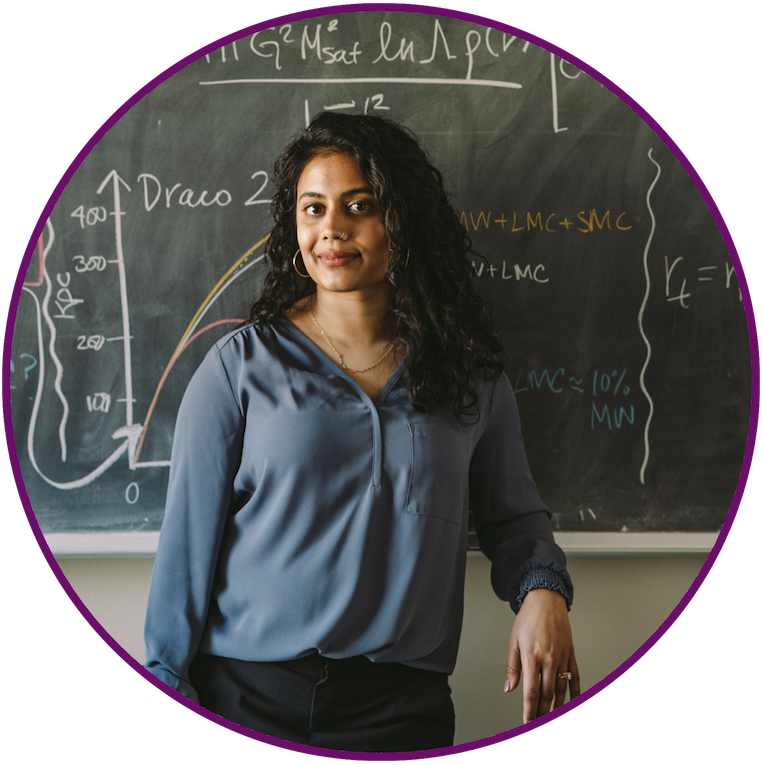
Dr. Ekta Patel is a NASA Hubble Fellow at the University of Utah working on galactic dynamics in the Local Group. Dr. Patel combines observations of stellar motions and data from simulations to uncover the dynamical history of our galactic neighborhood.
Erini Lambrides, Goddard Spaceflight Center
Hunting for Elusive Supermassive Black Hole Growth at Early Times
At cosmic dawn, a growing number of extremely powerful, accreting supermassive black holes (referred to as active galactic nuclei — AGN) have been newly identified with JWST. These recent results hint at a factor 1-2 over-abundance of early AGN, shaking some of our most widely regarded theories of supermassive black holes (SMBHs) and galaxy evolution to their core. Intense debate surrounding their nature has launched, and the field is at a critical juncture that hinges upon answering the following questions: what drives the rapid growth of early SMBHs and how do they impact the environment they live in? From quenching the first massive galaxies to re-ionizing the Universe, both theory and observations yield mixed conclusions regarding the importance of black hole growth in nascent galaxies. Furthermore, connecting observations from the early Universe to more intermediate, well studied epochs is non-trivial. I argue that to truly understand the context within which growing SMBHs are situated from cosmic dawn to the peak of their existence at cosmic noon, requires us to stop treating AGN and galaxies as separate samples. In this talk, I will review what current multi-wavelength observations can (or can’t) tell us about AGN onset and impact in the context of galaxy evolution. I will highlight recent JWST discoveries and their implications surrounding black hole growth in massive galaxies during the first half of our Universe’s life, while detailing that almost all of these high-z AGN samples are potentially built with the least representative types of AGN. Finally, I will conclude with what future observations are needed to help us with the outstanding questions that remain.

Dr. Erini Lambrides is a NASA Postdoctoral Fellow at Goddard Space Flight Center. Dr. Lambrides is an observational astronomer who leverages multiwavelength selection methods and community-sourced statistical learning to uncover growing supermassive black holes over cosmic time.
Eve Vavagiakis, Cornell University
A New Generation of Millimeter and Submillimeter Observations for Cosmology and Astrophysics
In our exciting current era of experimental cosmology, rapid developments in instrumentation and highly sensitive superconducting detectors have provided a wealth of arcminute-scale cosmic microwave background (CMB) data. These measurements are transforming our understanding of the evolution of our cosmos. I will present recent results from the Atacama Cosmology Telescope and discuss how our high-resolution CMB maps are at the frontier of Sunyaev-Zel’dovich effect science. I will also summarize the design and status of first light instruments and low temperature detectors for the CCAT Observatory and the Simons Observatory. These experiments will provide unparalleled measurements of the millimeter and submillimeter sky, offering rich opportunities for cross-correlation studies with upcoming surveys and paving the way towards CMB-S4, the next-generation ground-based CMB experiment. This will enable novel multifrequency science in the coming years, testing cosmological models and opening new windows on galaxy evolution and fundamental physics.

Dr. Eve Vavagiakis is an NSF Astronomy and Astrophysics Postdoctoral Fellow at Cornell University working on observational cosmology. Dr. Vavagiakis leads the development of Mod-Cam, a first light instrument for the CCAT Observatory‘s Fred Young Submillimeter Telescope (FYST), located in the Atacama Desert, Chile.
Jason Williams, Carnegie Observatories
Exploring Exoplanet Atmospheres: Theory, Instrumentation, and Observation
An exoplanet’s atmosphere hosts a wealth of information regarding a planet’s formation history and current composition, revealing the diversity of exoplanets and the placing our own Solar System in a broader context. The launch of JWST and the development of extremely large ground-based telescopes have commenced a golden age of unprecedented spectroscopic characterization of exoplanet atmospheres. This highlights an important and oft overlooked feature of astronomy – that new instrumentation plays a key role in pushing the boundaries of astronomical knowledge. In this talk, I will survey past, present, and future studies of exoplanet atmospheres and detail how these studies contribute to our understanding of exoplanet formation, composition, dynamics, and habitability. In particular, I will emphasize how past, present, and future instruments enable these groundbreaking studies and highlight my design for Henrietta, a new high-precision, low resolution exoatmosphere spectrograph soon to be commissioned on the 1-meter Swope Telescope.

Dr. Jason Williams is a Carnegie Postdoctoral fellow at the Carnegie Observatories. Dr. Williams specializes in developing high-precision spectrographs that enable the study of exoplanet atmospheres through precision spectral time series observations.
Mike Grudic, Carnegie Observatories
The Feedback-Regulated Universe
Star formation proceeds in our Galaxy in a way that is not so easily understood. Giant molecular clouds outweigh the most massive star clusters by orders of magnitude – star formation is inefficient. The mass spectrum of young stars – the IMF – exhibits a remarkable degree of regularity, across a wide range of conditions. Both facts suggest a certain degree of self-regulation. In fact, both observations can be understood within the same paradigm: the balance of stellar feedback and gravity. Giant molecular clouds are inherently 3-dimensional and highly substructured, so analytic approaches are limited and high-resolution, multi-physics numerical hydrodynamics simulations have proven to be the decisive laboratory for studying the self-regulation of star formation. I will review how numerical GMC simulations have progressed over the past decade from very simplistic setups to a much more realistic, physically-complete model with all feedback processes acting in concert. This new generation of star formation models is able to account for the key hallmarks of star formation in our Galaxy, and this emboldens us to use them as an interpretive tool for observations, and make predictions for stellar populations in more-extreme environments.

Dr. Mike Grudic is a NASA Hubble Fellow at Carnegie Observatories working on theoretical star formation. Dr. Grudic leads the development of STARFORGE, a computational framework for simulating the birth of star clusters.
Mukul Bhattacharya, Penn State
Heavy Element Nucleosynthesis & Energetic Neutrinos from Highly Magnetized Outflows
While nuclei lighter than iron are fused over the course of typical stellar evolution, almost half of the elements heavier than iron are created through the rapid neutron capture process (r-process). These nuclei are thought to be produced in magnetized outflows from neutron-rich explosive events including compact mergers and core-collapse supernovae. In this talk, I will discuss the potential of neutrino-driven winds from strongly magnetized and rapidly rotating protomagnetars as plausible sites for r-process nucleosynthesis. As heavy nuclei can eventually produce ultra-high energy cosmic rays, we examine the acceleration and survival conditions for these nuclei. We also explore the propagation of these jets within Wolf-Rayet stars and blue/red supergiants. In particular, we analyze the criteria for a successful jet breakout, maximum energy deposited into the cocoon and structural stability of these magnetized jets. We show that high-energy neutrinos can be produced for extended progenitors like blue/red supergiants and estimate the detectability of these neutrinos with IceCube-Gen2.
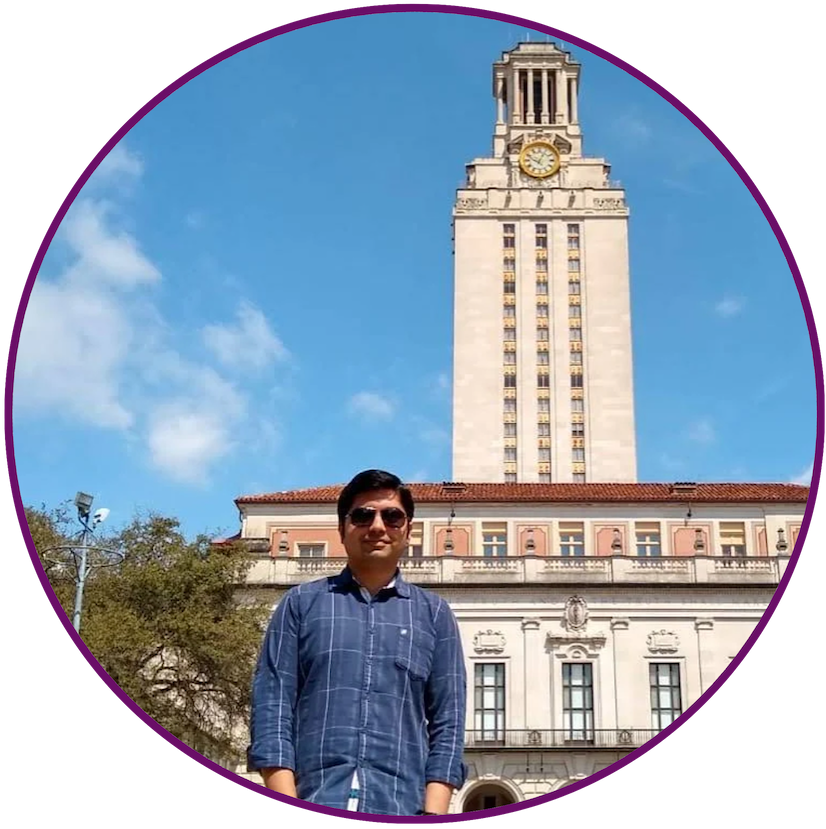
Dr. Mukul Bhattacharya is an Eberly Postdoctoral Research Fellow in the Department of Physics at Pennsylvania State University after earning his PhD at our own University of Texas at Austin. Dr. Bhattacharya is an expert in the nature of multi-messenger emission from highly magnetized stars and their associated high-energy neutrino events.
Rachel Fernandes, Penn State
Connecting the Dots: Comparative Exoplanet Demographics Enabled by Kepler
Large-scale exoplanet surveys like the Kepler mission have enabled us to study populations of exoplanets from a demographics perspective. Kepler discovered that transiting planets like super-Earths and sub-Neptunes are incredibly common, yet absent from our Solar System. Moreover, demographic features like the radius valley and the hot Neptune desert have challenged our theories of planet formation and evolution. However, Kepler mission data were restricted to planets in close-in orbits around Gyr-old Sun-like stars, leaving us with numerous unanswered questions about other populations, including so-called Earth analogues. In this presentation, I will offer an overview of key findings from the Kepler mission, and delve into the various efforts to compare/synthesize demographics across diverse missions and detection techniques, which probe populations Kepler wasn’t sensitive to. These include, but are not limited to, long-period planets and their orbits, planets orbiting young stars, and planets around stars of different spectral types. Via this synthesis, the exoplanet community aims to create a comprehensive understanding of planet formation, placing the solar system and life on Earth into a broader cosmic context.

Dr. Rachel Fernandes is a Habitable Worlds and President’s Postdoctoral Fellow at the Pennsylvania State University. Dr. Fernandes focuses on detecting and characterizing transiting planets around young stars and using the demographics of these planets to gain insights into the process of planet formation.
Rixin Li, University of California, Berkeley
Forming Planetesimals in Solar and Extrasolar Nebulae
The first step in planet formation is to build planetesimals from dust particles in protoplanetary disks. The origin and demographics of planetesimals are crucial to understanding the Solar System, exoplanetary systems, and circumstellar disks. In this talk, I will first review the recent works on planetesimal formation, with a main focus on theoretical modeling. I will then discuss their implications and compelling connections to recent disk observations, as well as Solar System explorations.

Dr. Rixin Li is a 51 Pegasi b Postdoctoral Fellow at the University of California, Berkeley. Dr. Li focuses on planet formation, specifically the numerical simulation of proplanetary disks and the demographics of planetesimals.
Sanjana Curtis, Kavli Institute
Heavy Element Nucleosynthesis and Kilonovae from Compact Object Mergers
From the gallium in our semiconductors to the gold in our jewelry, heavy elements occupy myriad roles in human life, including that of a mystery — their astrophysical production via the r-process has been a topic of debate since the 1950s. Kilonovae are the only direct observational evidence of r-process nucleosynthesis in situ and thus hold great promise for uncovering how and where heavy elements are produced. While the landmark detection of the kilonova counterpart to GW170817 confirmed that neutron star mergers are a site of the r-process, several open questions remain when it comes to the details of nucleosynthesis in merger ejecta and resulting kilonova light curves. In this talk, I will discuss both binary neutron star mergers and black hole-neutron star mergers, with a focus on the r-process and kilonovae. I will present our latest predictions based on cutting-edge, general-relativistic magnetohydrodynamic simulations. Crucially, we include important neutrino physics that sets the electron fraction of the ejecta, and in turn, the heavy element abundances. I will show how detailed numerical modeling can allow us to link kilonovae to their progenitors, interpret past and future observations of these transients, and gain unprecedented insight into the origin of heavy elements.

Dr. Sanjana Curtis is an Associate Fellow at The Kavli Institute for Cosmological Physics and will be starting a NSF Astronomy and Astrophysics Postdoctoral Fellowship this fall. Dr. Curtis develops multi-messenger models of supernovae and compact object mergers to explain the origin of heavy elements.