

Resources



Perinatal Mental Health Toolkit
For obstetric clinicians
The PeriPAN Perinatal Mental Health Toolkit gives perinatal primary care providers actionable information to help them build capacity for preventing, identifying, treating and monitoring perinatal mood and anxiety conditions. It includes:
- Clinical guidance on common perinatal mental health conditions, along with patient screening tools.
- Clinician resources for screening, symptom and risk assessment, treatment initiation, monitoring, follow-up, and management of mood disorders.
- Materials to support clinicians in mental health care practices and protocols.
- Patient resources, such as an action plan for mood changes, a safety plan, and a self-care plan.

PeriPAN Webinar: ‘Utilizing the PeriPAN Perinatal Mental Health Toolkit’
PeriPAN Medical Director Sarah Wakefield, M.D., and ACOG District XI Chair Gayle Olson, M.D., discuss best practices for using the toolkit.
PeriPAN gathered the latest guidance from the American College of Obstetricians and Gynecologists (ACOG), Lifeline for Moms, Postpartum Support International and other leaders in the field to develop one convenient toolkit specifically designed for perinatal clinicians.
Click to read a transcript of the webinar in English.
Hi, I’m Gayle Olson. I’m the chair for the Texas District 11 Section of the American College of Obstetricians and Gynecologists. And hi, I’m Sarah Wakefield, the Medical Director for the Perinatal Psychiatry Access Network in Texas.
We’re here today to talk to you about ways PeriPAN can support the mental healthcare of your pregnant and postpartum patients, including our PeriPAN OB toolkit.
So today in our toolkit discussion, we’ll be um reviewing some screening tools, which ones to use and how to score them, um clinical resources for you and patient-facing resources, and how PeriPAN can support you in real-time in your day-to-day practice.
Uh if you would like to follow along with the toolkit, please uh hit this look at this QR code and follow along as we go through the toolkit today.
So a little bit about PeriPAN, uh PeriPAN is your partner. We create tools that OBs and other perinatal clinicians need to expand their capacity. One tool is the PeriPAN mental health toolkit. You can find the toolkit on our website at that QR code you just hit, or at Texas txperipan.org. Uh today we are going to walk you through the toolkit, go through those screenings, how to score, when to call us, uh, and we will talk about psychoeducation and other clinical guidance and tools we’ve provided you in the toolkit.
Here’s the overview uh where the the title page of our toolkit. Um we’ve worked with Dr. Olson and other clinicians to create a usable and practical resource for you to help you expand capacity and know when to call Perry pan for mental health guidance for your perinatal patients.
We’ve pulled resources together so that you have one place to go. The toolkit builds on and improves a previous version used in Massachusetts and now with ACG guidelines. We have pulled multiple resources in one place for your reference and use. Usable piece of information clinically within your practice.
But what we really want to show you in this toolkit today is um our screening packets that you would be able to print off and hand to a patient with the recommended guidelines for different screeners to use.
We have two packets, um Packet 1 and Packet 2, they’re identical except for the difference of using the Edinburgh Postnatal Depression screening and the patient health questionnaire or the PHQ-9. Uh we have these two versions because many of our systems have been using the EPDS for a prepartum and perinatal screener and a postpartum screener.
Sometimes because this screen was validated in Scotland, uh it doesn’t translate as well for women using American English. Uh and can get a little confusing. And so we also recommend using the packet two with the PHQ-9 version.
But if your system is uh has the EPDS as a part of their protocol, we did provide the packet one for you as well.
What’s really exciting is when you go to this website, you can see many different tabs here, and you’re able to um print off and look at the entire toolkit at one time, but if there are different pieces as you familiarize yourself with this toolkit that you would like to use, you can go directly to that patient packet one or patient packet two or some of the clinical guidance or the um patient-facing resources.
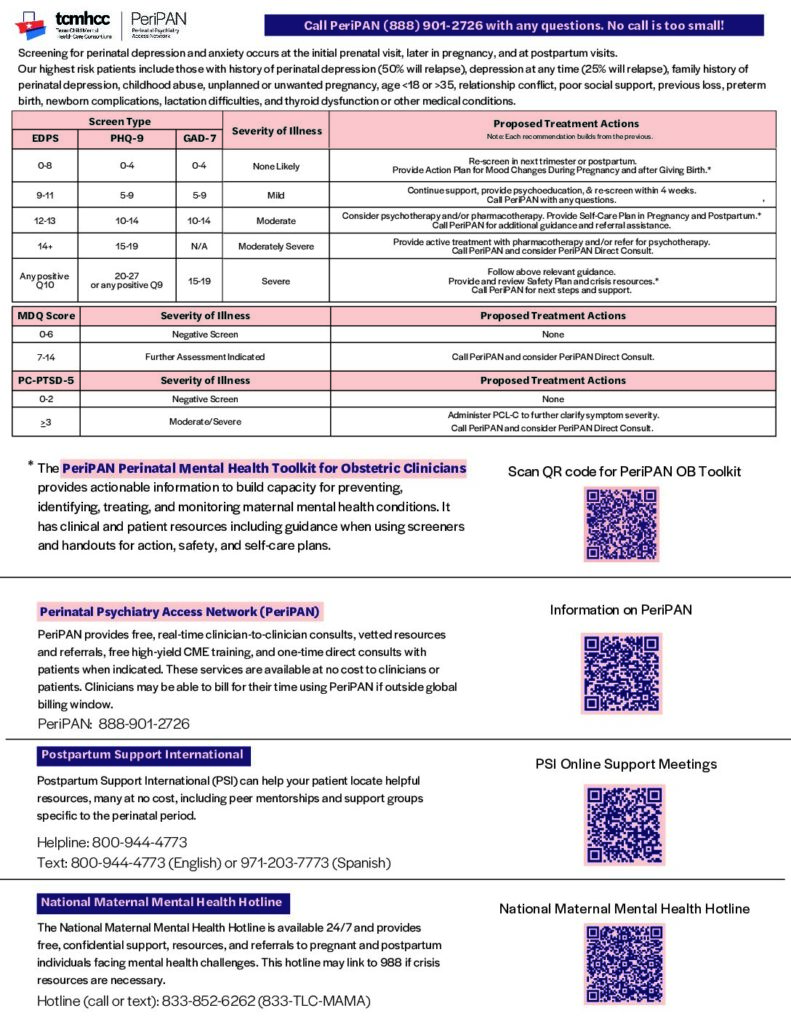
And here’s an overview of our screening tools. We have um we’ve not only included the packet of Packet one and Packet two, the patient-facing screeners, but also a resource that I think will be very helpful to you, and what these score cutoffs mean and what to do next.
So we’ll look a little bit more closely at those in the next slide.
This slide shows you for the EPDS and the PHQ-9 and the GAD 7, if women are falling in these different categories, what would we would recommend as next steps.
So if they’re scoring mild, we would recommend some watchful waiting, psychoeducation, um rescreening in a certain amount of time, uh when we’re looking at moderate or possible depression, we’re wanting to um really say, here are some things that you can be doing, some self-care plans, um and make sure we rescreen and give some psychoeducation about what might come next if things get worse or if they get better.
and then so on and so on.
So if we’re moderate, um, what do we do next?
How do we help support a woman who is trying to weigh uh what our options are in treatment when we have moderate or severe depression or anxiety symptoms, and we want you uh at all times, anytime you have a question, to call Perry pan. We’re here for you, and when you call and say the the woman I was seeing right now, scored in this uh you know, scored a 12 or scored a 22 on the PHQ, it really helps us guide you on those next steps.
We also have other scores for uh the MDQ, which is a mania screening, um, and the and PTSD scale.
So these may not be scales that you use every single visit, uh but we do recommend the MDQ being given at one point during pregnancy, especially before an SSRI is started.
Um, and then the PTSD scale as a screener as well to really understand if a woman has suffered trauma and is having those symptoms now.
Another tool in this toolkit is um our psychoeducational resources, and these are really patient-facing.
Um, there’s a self-care plan that we think is a good idea for every single mom or mama to be uh about you know, how to take care of yourself in this transition in life.
There’s also an action plan for mood changes during pregnancy or after giving birth.
So a way to provide education to mom, if this happens, if you’re feeling this, then this is what we would recommend next.
And so if moms at home feeling worried about how she’s feeling, she might uh she has a little bit more guidance in when to call, when to follow up, what are some things she can do uh that are proactive to help her mood and anxiety during this difficult time.