During our first day of orientation in Milan walking tour of the city’s fashion district, IES Abroad Director, Roberto Andreoni, mentioned the strange juxtaposition of the city’s residential and urban architecture: old and awe-inspiring buildings stand squeezed next to mundane and “ugly” new constructions. His statement reminded me of the Futurist Manifesto and their goal to diverge from antiquity and tradition, embrace the change that came along with industrialization.
Roberto Andreoni also mentioned that most of these newer buildings were constructed to replace the old structures that were destroyed during the bombing of Milan in World War II. Instead of imitating older styles of architecture the municipal government used its limited resources and loan money to reconstruct the city from rubble. They used what was left over to construct a newer city instead of leaving all traces of it behind, quite the opposite of what the Futurists would have liked.
This trope of old blending with new, and not in a clean and uniform way, is a rather pervasive theme in the parts of Italy I have visited thus far. Bellagio, Verona, and Milan are full to bursting with old architecture, landmarks, and monuments that stand in close proximity or even crammed together, sharing walls, so that no single structure can be taken in without comparing and contrasting it with buildings in the vicinity. Buildings like the Duomo or the arena in Verona, I would have expected to view then in their untainted glory, standing tall and magnificent, calling upon the memory and artistry of architects and artists who lived eons ago.
Instead the Duomo exists alongside an upscale mall, above an efficient subway system and in a piazza teeming with tourists. Even the view from the top doesn’t remain uninterrupted. The spires topped with detailed sculptures stand out against a background of blue or cloudy sky (depending on the rather flaky weather) and the industrial grey of urban construction. This doesn’t really devalue or corrupt the glory of the Duomo as much as its existence is recontextualized.

Similarly with the Arena in Verona, it was quite a task to find a view of any one side of the exterior without including at least a sliver of modern technology. The Arena was dwarfed, in my opinion, by the fleet of Vespas, performance stage metalwork, barrier gates, construction cranes, and oddly a float of a medieval knight. Admittedly there was no time to sit and ponder about the fact that it actually exists today even though it was constructed during the Roman Empire OH MY GOD because of the time crunch on our day trip.

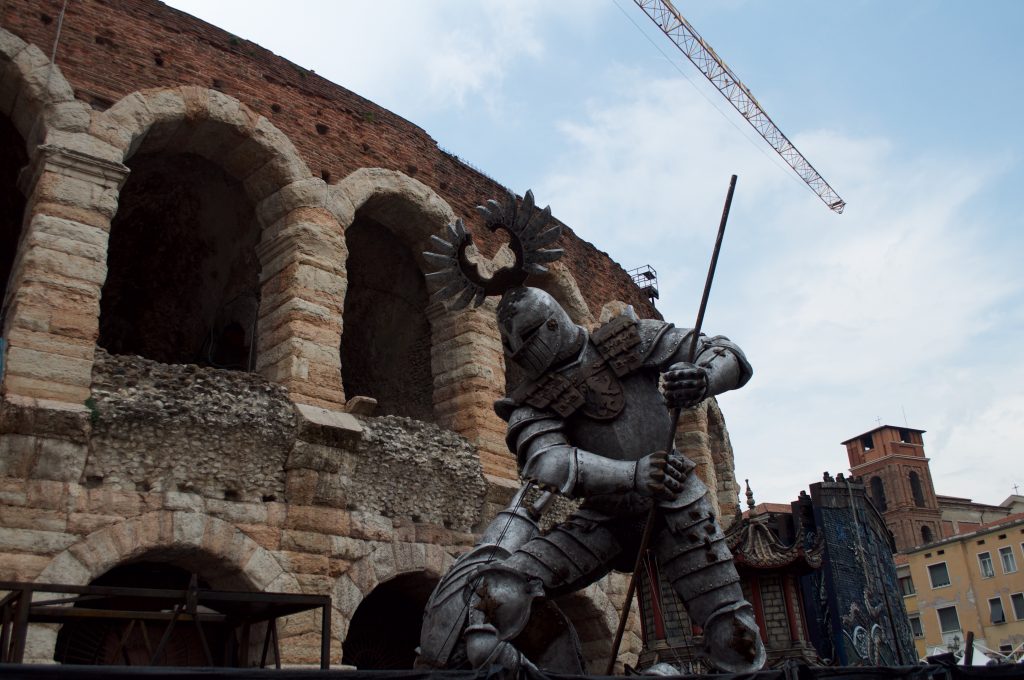
There is such a huge difference in the way important monument structures are treated in Italy versus the States. Italy has made history part of life, carrying it forward with progress. America sets it aside in a museum, to be observed, used as inspiration, never to be mixed with modern life.
~Saniya