Umberto Boccioni was and is the key and arguably most important artist of the Futurist period. This was quite evident due to the fact that there was one entire gallery at the Palazzo Reale dedicated to his work and several pieces by him at the Novecento.
The ideals of the Futurists seemed rather entitled and exclusive but the artwork is amazing nonetheless. One of their central pillars was the use of speed and motion. There are also many references in his work to cubism and the work of Picasso.
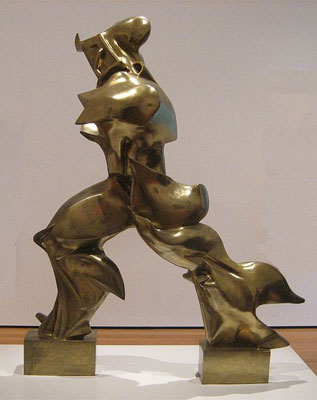
Umberto Boccioni
1913
Boccioni’s most famous piece Forme uniche della continuità nello spazio (1913) is a sculpture that combines multiple forms created by a man in stride. It’s a three dimensional rendition of what cubists created in the form of painting. This piece magnificently captures the futurist ideals of portraying speed and motion, as is very apparent. The texture and form are a more subtle hint at the chaos and “war” that the Futurists are so taken up with.
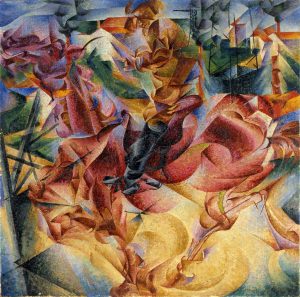
Elasticità (1912) once again by Boccioni also employs the Futurist elements of motion and chaos. The picture evokes a sense of urgency through the use of contrasting colours, the overlapping lines of the figures blending together to create one amorphous form. Circular shapes that create undulating contours add to the motion of the piece. There is also a similarity between cubist abstraction and the portrayal of motion in Boccioni’s piece.
Both these pieces utilize human figures to embody the Futurist principles, but incidentally use traditional forms of travel. The man in the sculpture is using the age old mode of transportation, walking, while the painting is of a man on horseback. Both modes are common for the time, but not the new and upcoming technologies that the Futurists aspired to embrace and embody.
~Saniya