This week we walked countless steps throughout the city, however, the majority of the walking took place throughout various museums and exhibitions within Milan. One of these exhibitions was held at the Palazzo Reale and featured works primarily from Umberto Boccioni, an influential Italian artist who helped shaped the style of the Futurism Movement in the early 1900s.
While the exhibit displayed various pieces of Boccioni’s work, the ones in which movement were more noticeable seemed to catch my attention the most. His work all conveyed emotional connections and stories, however, the movement that was captured within his later pieces (more futuristic) seemed heavier in emotional response and comprehension. Although I admired all of the pieces, I was captivated and intrigued by one particular painting and sculpture on display at this exhibit.
‘The City Rises’ (1910) is a painting by Boccioni that captures the movement and growth of a modern city during the time period. And although dark and full of movement, there seems to be an appreciation of the direction the city is taking and an encouragement of continuing to support the modern city. There seems to be a horse that is uncontrollable within the environment and the people are working together to reclaim order, which can be seen as struggle to achieve a greater end goal, as well as a shift in levels of importance between nature/ animals and futuristics visions of the urban environment.
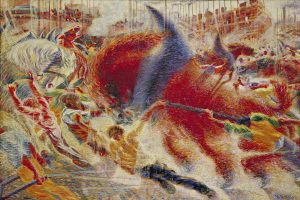
Umberto Boccioni
1910
The second piece of work that intrigued me the most was the iconic sculpture, Unique Forms in Continuity of Space (1913). This bronze sculpture of a man, who seems to be of machine-like qualities, exemplifies the movement that many of Boccioni’s paintings had captured. Although made of metal and full of well-defined sculptural lines, this sculpture seems to be capturing movement in a second of time with a fluidity incomparable to that of the two-dimensional paintings. Although this piece was created a few years later than the painting, ‘The City Rises’, I believe there is a similar notion of wanting to continue moving forward and exploring the possibilities for the modern world.

Umberto Boccioni
1913