This past weekend I braved a solo adventured to Lille, France to meet up with old friends, who had previously studied abroad in Texas. My ‘mini-adventure’ consisted of three countries in three days (Italy, Belgium, and France) and it was incredible! Once I had finally arrived in Lille, I walked the city center to learn more about this surprisingly not so small place in France. While I have become more acquainted to the less than grid-like layout of Milan, Lille introduced an entirely new level of maze-like qualities within the landscape of its city center.
The center of Lille was a maze of radial grids without any of the typical straight axes out from the center. However, the pedestrian-friendly streets / walkways and old cobblestone streets were quaint and refreshing in comparison to the narrow and traffic heavy areas I have been experiencing in Milan. In the center of the maze was another intriguing discovery, the Norte Dame de la Treille.
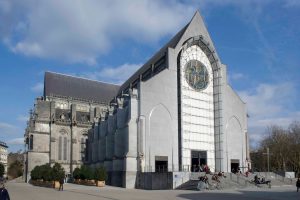
Differing drastically from the scale and architectural style of the Duomo in Milan, the Norte Dame de la Treille is a cathedral with an odd juxtaposition of styles. The drastic mash-up of architectural styles is what made this structure stand out to me as something different from most other structures I have seen, or studied, previously. Similar to the Duomo, the Norte Dame de la Treille was in the beginning stages of construction around the 13th century and utilized gothic style architecture. However, in comparison to the Duomo, which also took several centuries to complete, the Notre Dame de la Treille was not complete in the same style as when it began. Construction began in the 13th century and continued on into the 20th century on Lille’s cathedral. And while many remarkable structures of this time took centuries to complete, there was often a consistency in the overall design of the original plans. However, the Notre Dame de la Treille is striking simply because it did not follow this typical consistency.
While the back portion of the Notre Dame de la Treille is an example of classic gothic architecture, the front facade appears as a modern aesthetic from the 20th century. This visual juxtaposition of architectural styles, which also expresses the timeline of construction for this particular structure, was definitely one of my favorite findings of my weekend getaway.