The Triennale exhibition has compounded a deeper and better understanding of political and critical art and design for me. I find myself drawn to works that have political and/or philosophical statements. The deeper, more ambitious projects seem to draw me in, especially the ones that take a moment to comprehend. The two major projects that captured my attention were Andrea Branzi’s project and now, Anselm Keifer. Both Branzi and Keifer are new discoveries for me. I had never heard of either artists, but I have quickly become a fan. They both make political, personal and philosophical work. Formally, the works speak in a quiet, aesthetically pleasing mode. It takes a moment to discover the hidden treasures.
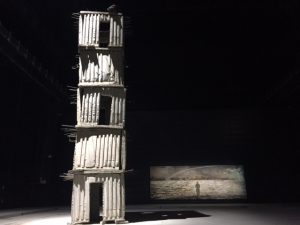
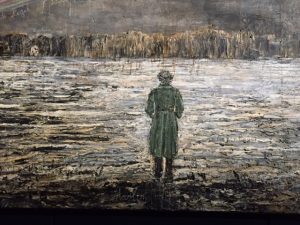
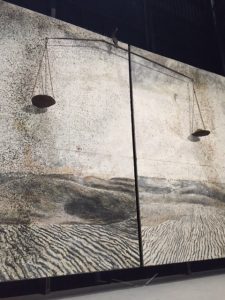
Having just returned from Germany, I immediately connected to Kiefer’s work, which I had never experienced or seen before, I automatically connected to his work through the reinterpretation of Germany. Although, the theme for this particular exhibition was “The Seven Heavenly Palaces”—which spanned across a broad spectrum from Melancholia to Magnetico, the pieces hold remnants of post-war (post-apocalyptic) Germany. The towers stood high, powerful (in an authoritative manner, waiting to be seen, yet a bit unsure of themselves and off-balanced, almost ready to collapse. It allowed for the viewer to take from them as they wished. The empty rooms and broken elements added to the darkness and unbalanced isolation. The paintings added to the desolation—dark, contained, but well-balanced. The Alchemie was my favorite piece—drawn by the balancing scales. They clearly represented the positive and negative of life, space and time. The scales were balanced by Salt on one side for sterility and Sunflower seeds on the other for fertility. At the end of the walk opposite the entrance on the back of the room across a long, wide path, you were presented with a solitary man staring at a sunset or maybe, his life—this new apocalyptic world that has dismantled the old has problems, but the individual has a vision. But is it his vision? Is he there by choice? Has he been awaken to the realities of war or to the realities of peace. The man is surrounded by the names of great philosophers that have seemingly opened a path (represented by the rainbow above the man) for him. Does this mean that the path can only be brought through learnt knowledge? Has he been set free by shared knowledge? Or has he set himself free through self-recognition and self-awareness or is he merely in a meditative space? … as he is floating on water.
Happily admiring the darkness and light of the exhibit. There is a light at the end of a tunnel which seemingly came through knowledge, meditation and self-awareness.