Alessi

The Alessi factory and “museum” was quite frankly the most amazing space ever. I’ve said on multiple occasions that as long as I had a supply of food, I could live my life out in an art supply store. The same applies to the Alessi design archive. I bet there wouldn’t be a single dull day there because I’d be finding some small little work of design that had a deeply intriguing backstory to it. Our tour guide for the archive was the cutest little Italian lady who perhaps was the best estimate for a middle aged Luna Lovegood.

One of the central themes in their process of design is functionality and durability while also building an emotional relationship with the user. That primarily seemed to manifest itself through the “cute” aspect whether it be gimmicky and silly or just compact and adorable. As our lovely tour guide started to elaborate on that theme though, the relationship aspect became clearer. She mentioned a project that Alessi had for a group of designers where they were asked to create a tray or object that drew inspiration from memories of comfort and home. The artists involved drew inspiration from childhood memories or things commonly used in places where they grew up to forge a sort of emotional bond with the piece they created.

This concept of functionality and familiarity seems like a rather clever way of denoting their products are worthy of a place in someone’s home. The environment of comfort and warmth that Alessi strives to imbue in their sensible and necessary domestic products really came through.
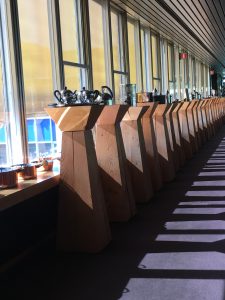
Alessi Museum

Boccioni

Umberto Boccioni was and is the key and arguably most important artist of the Futurist period. This was quite evident due to the fact that there was one entire gallery at the Palazzo Reale dedicated to his work and several pieces by him at the Novecento.

The ideals of the Futurists seemed rather entitled and exclusive but the artwork is amazing nonetheless. One of their central pillars was the use of speed and motion. There are also many references in his work to cubism and the work of Picasso.

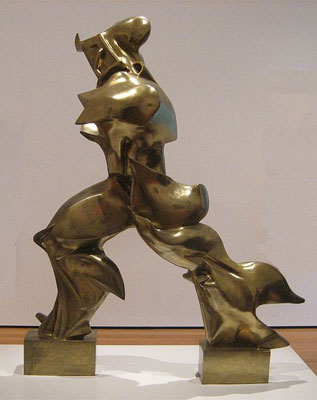
'Unique Forms in Continuity' Umberto Boccioni 1913
‘Unique Forms in Continuity’
Umberto Boccioni
1913

Boccioni’s most famous piece Forme uniche della continuità nello spazio (1913) is a sculpture that combines multiple forms created by a man in stride. It’s a three dimensional rendition of what cubists created in the form of painting. This piece magnificently captures the futurist ideals of portraying speed and motion, as is very apparent. The texture and form are a more subtle hint at the chaos and “war” that the Futurists are so taken up with.

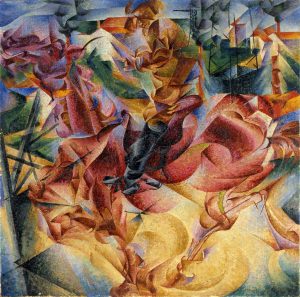
Elasticità (1912)

Elasticità (1912) once again by Boccioni also employs the Futurist elements of motion and chaos. The picture evokes a sense of urgency through the use of contrasting colours, the overlapping lines of the figures blending together to create one amorphous form. Circular shapes that create undulating contours add to the motion of the piece. There is also a similarity between cubist abstraction and the portrayal of motion in Boccioni’s piece.

Both these pieces utilize human figures to embody the Futurist principles, but incidentally use traditional forms of travel. The man in the sculpture is using the age old mode of transportation, walking, while the painting is of a man on horseback. Both modes are common for the time, but not the new and upcoming technologies that the Futurists aspired to embrace and embody.

~Saniya

Living With Relics-Milan

During our first day of orientation in Milan walking tour of the city’s fashion district, IES Abroad Director, Roberto Andreoni, mentioned the strange juxtaposition of the city’s residential and urban architecture: old and awe-inspiring buildings stand squeezed next to mundane and “ugly” new constructions. His statement reminded me of the Futurist Manifesto and their goal to diverge from antiquity and tradition, embrace the change that came along with industrialization.

Roberto Andreoni also mentioned that most of these newer buildings were constructed to replace the old structures that were destroyed during the bombing of Milan in World War II. Instead of imitating older styles of architecture the municipal government used its limited resources and loan money to reconstruct the city from rubble.  They used what was left over to construct a newer city instead of leaving all traces of it behind, quite the opposite of what the Futurists would have liked.

This trope of old blending with new, and not in a clean and uniform way, is a rather pervasive theme in the parts of Italy I have visited thus far. Bellagio, Verona, and Milan are full to bursting with old architecture, landmarks, and monuments that stand in close proximity or even crammed together, sharing walls, so that no single structure can be taken in without comparing and contrasting it with buildings in the vicinity. Buildings like the Duomo or the arena in Verona, I would have expected to view then in their untainted glory, standing tall and magnificent, calling upon the memory and artistry of architects and artists who lived eons ago.

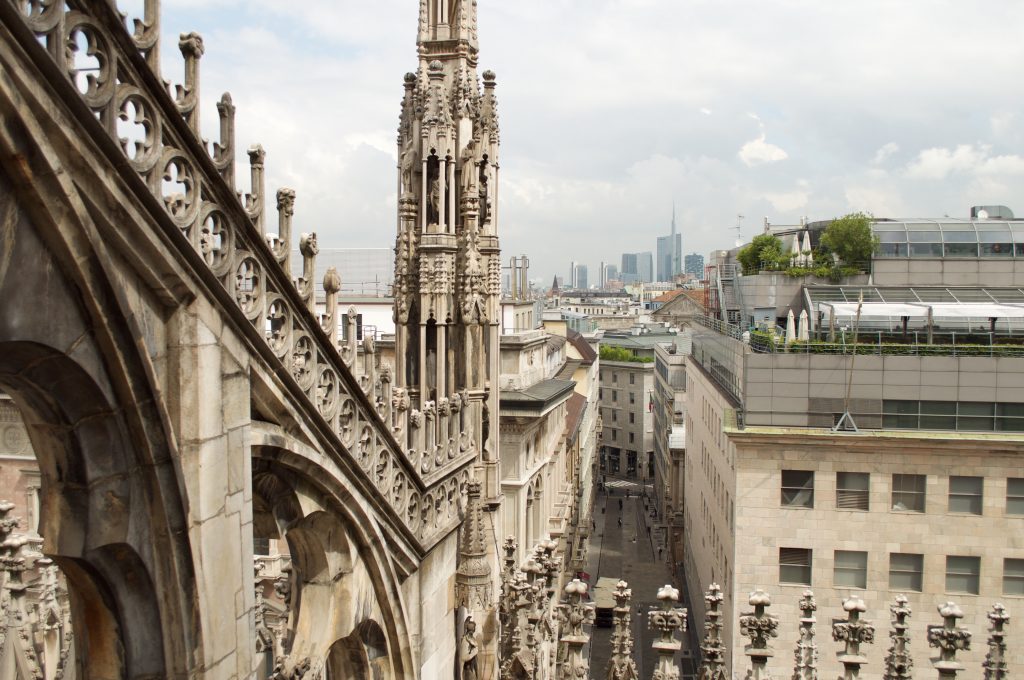
Instead the Duomo exists alongside an upscale mall, above an efficient subway system and in a piazza teeming with tourists.  Even the view from the top doesn’t remain uninterrupted. The spires topped with detailed sculptures stand out against a background of blue or cloudy sky (depending on the rather flaky weather) and the industrial grey of urban construction. This doesn’t really devalue or corrupt the glory of the Duomo as much as its existence is recontextualized.

The Duomo

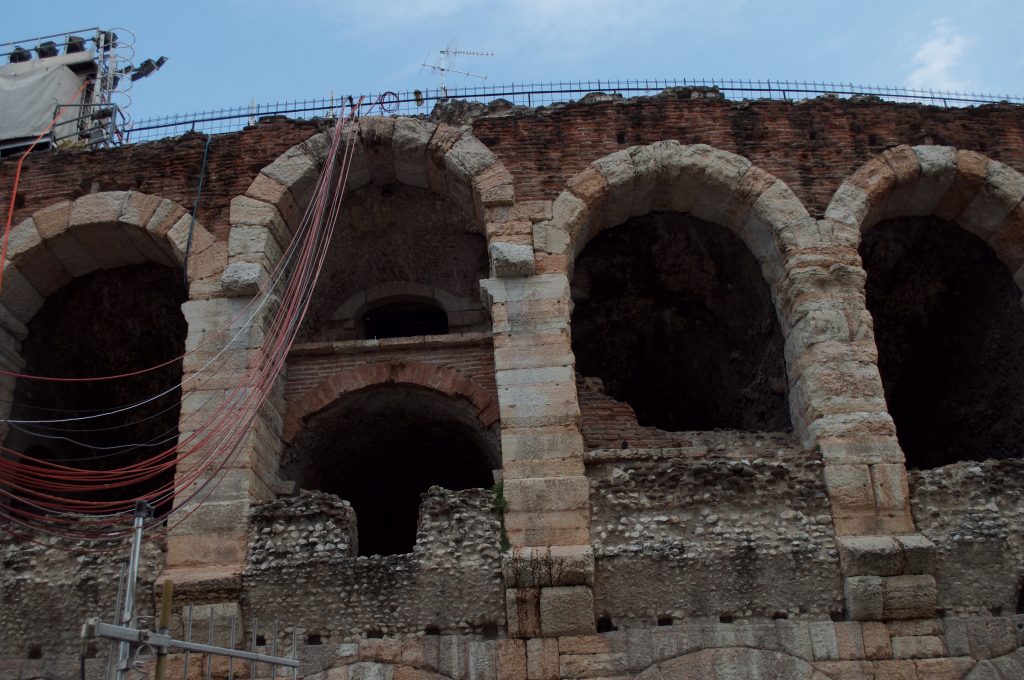
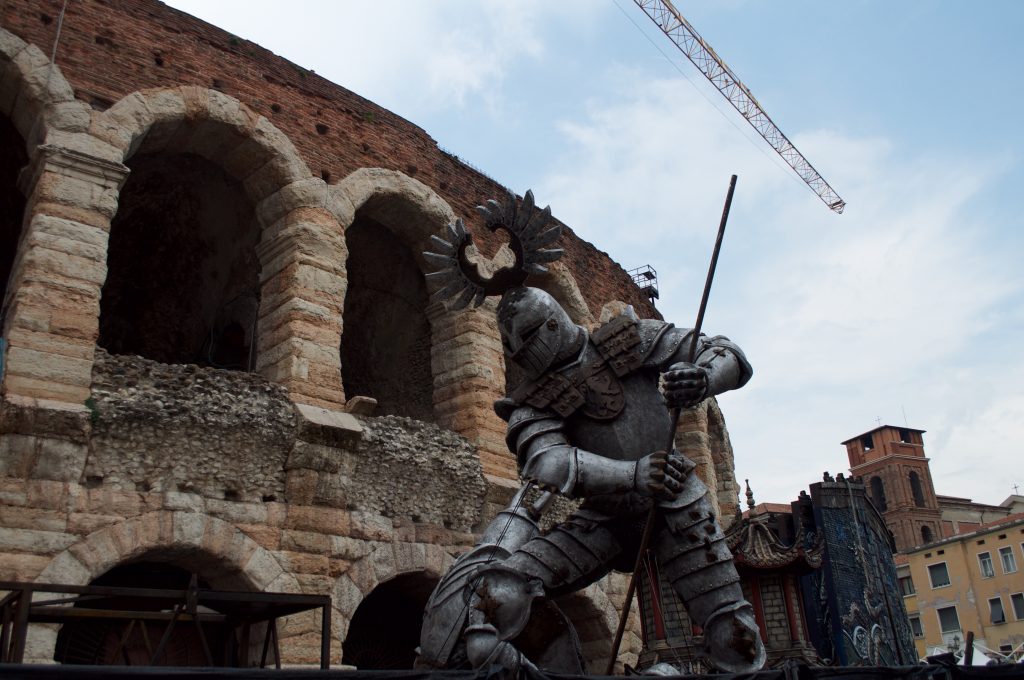
Similarly with the Arena in Verona, it was quite a task to find a view of any one side of the exterior without including at least a sliver of modern technology. The Arena was dwarfed, in my opinion, by the fleet of Vespas, performance stage metalwork, barrier gates, construction cranes, and oddly a float of a medieval knight. Admittedly there was no time to sit and ponder about the fact that it actually exists today even though it was constructed during the Roman Empire OH MY GOD because of the time crunch on our day trip.

 The Arena in Verona

Medieval Knight in Verona

There is such a huge difference in the way important monument structures are treated in Italy versus the States. Italy has made history part of life, carrying it forward with progress. America sets it aside in a museum, to be observed, used as inspiration, never to be mixed with modern life.

~Saniya