After my airport experience, I recalled John Thackara’s article regarding design. The quote that arose for me was “After building objects as projections of our bodies, we can now begin to consider them as projections of our minds.” This is a beautiful inspiring note. Not only does it inspire me to continue with my research, but also encourages me to ask questions … How do we begin to design objects after design? How do we design them to remind us of who we truly are? How do we begin to design artifacts that inspire our minds to grow? How do we reconnect with one another? How do we negotiate and navigate these questions with the global markets? I don’t have any answers to these questions, but it sure is exciting that there are conversations happening. There are small actions taking place in the design world. Let’s hope that the transformations occurring take us (the designers) back to aspirations of the futurists, to the radical movements that inspired and helped shift the ideals of everyday life. As John Thackara commented that small actions can transform bigger experiences and systems. Let’s hope that we begin to reconnect to the ground, to nature, to our true selves.
Category: Weekly posts_2016
London Airport Retail
A weekend in Scotland via London… stuck in an airport in a 4-hour layover was stranger than strange. As I walked out of the immigration checkpoint and into the “gates” area, I found myself surrounded not only by advertisements, I was bombarded by these massive airport retail stores. My first thought was, wow… who’s designing these and who’s making money? The second thought, after I took a minute to digest all this information—and it is the most important … How is this affecting our lives and the way we communicate with each other? Am I the only one noticing something wrong with this picture? Everyone was shopping without realizing that they had become numb to their surroundings. Most people were either shopping or looking down on to their phones. Never had I experienced such an unsual event. The beauty at airports for me was seeing people communicate with one another—either saying goodbye to someone with a long affectionate embrace, happy smiles because their on vacation or simply, a caring glance to the person sitting next to you. The luxury of traveling (at least for me) was to converse with others across the globe, meet new people and experience new places. I don’t recall traveling as a shopping experience. Have we lost the art of traveling or has it simply shifted as our needs have changed? Has our environment simply adjusted to the populations needs? Are consumers asking for this or are they being fed this? Has traveling simply shifted to shopping? How is this impacting the way we travel and live? Lots of questions … maybe, a topic for another discussion.
Gucci concept development center at Novara
We went on a walk through of the factory where catwalk collections (prototypes) are made for Gucci, Alexander McQueen and Stella McCartney and others. We saw where the designers sketches are developed toile and the departments where patterns are digitized, cut, fabricated and finished – fascinating!
Pirelli Building_Gio Ponti
We visited the Pirelli Building today to see the exhibition charting the building’s history. The view from the 26th floor is spectacular, a 360 perspective of Milano and an especially amazing view of Stazione Centrale.
Sketchbook Update!
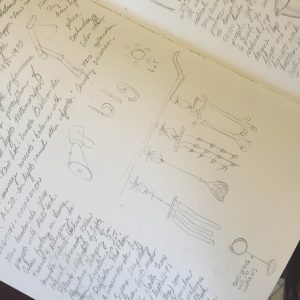
Now that we are about half way through our trip, my sketchbook is nearly halfway used. When I started sketching, I was terrified. I’m not an art/design major, nor do I have any background in art, so I was nervous that not only would I not enjoy it but that I’d be terrible at it.
However, I have grown to love my sketchbook; I make notes in there, sketch my daily life, and attempt to keep up with the assignment. Now when I don’t sketch or journal, I don’t feel right. Using my journal as my creative outlet has become very therapeutic, and I couldn’t imagine not having it.
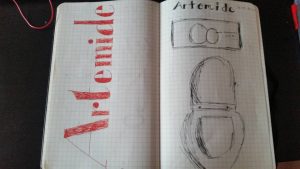
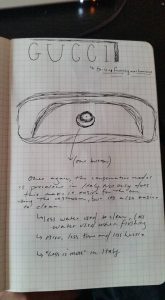
My focus for my journal is the flushing mechanisms in Europe (Italy, primarily, but also Scotland), and I wanted to compare them to the ones we have back home in the States in the attempt to figure out why they are so distinctly different.
Thus far, Europeans tend to favor the single button flusher or the two-buttoned one, because they want to conserve water and reduce waste as much as possible. The two-buttoned restrooms are especially conservation centered: the large button used for waste and the smaller one for water conservation.
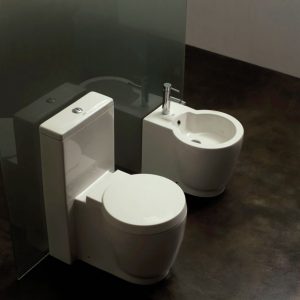
In America, however, the handle flush is widely used except in a few upscale locations such as big corporations or more environmentally conscious areas (i.e. Austin, TX).
The concept of focusing on this was to easily compare the two ways of living; my American lifestyle never took into account the level of water consumption, because I never had to, yet here in Italy we are forced to pay for water or pay for the restroom or use toilets that are a bit foreign. It really makes you pay attention to the rest of your life.
For instance, trash is separated here in Italy between glass, plastic, paper, compost, and general trash, while in the States people may occasionally recycle or reuse, but there’s no enforcement nor incentive. I think once I’m back home, I’ll be able to implement all of the useful, environmentally helpful things I’ve picked up here – maybe even convince others to try it as well. It would be interesting to say the least if we could implement more conservative methods both in our consumption and waste back home.
Week: Artemide
This year I had a very special birthday. It entailed a day touring the ground of Artemide, a lighting company. Founded in 1959 by Mundi, they pride themselves on their ingenuity and attention to detail. They focus on the relationship between man and light. How does man interact with light, and how does light affect man’s surroundings and emotions? Their products/projects attend to these ideas.
They produced “The Human Light” (1980-1990) which was an idea that focussed on how light can change the perception of a place. After this they created touch sensitive lighting that changed colors (1900-2000) which gave the user more control and creativity in their lighting process using Metamorforsi Technology. My favorite project was a group of lights that all interacted with each other. They were all bulbs of glass with a single light emitted through one point. As a user touches one in a sliding motion, it dims this light, but all the others as well. In this way one can connect with all of the lights through any point, not simply through a switch on the wall. This is useful, yet also an interesting study in the way that appliances can relate and interact with eachother.
We then discussed the change of their production methods as the LED light was produced. This was a time with innovation met tradition, as LED technology was combined with traditional Italian design such as their glass factory in Venice. With this we were shown a list of patents of that Artemide had acquired. Their passion was transferred not only through design but into the sciences. The Alphabet of Light, Ameluna, LoT, LoT Reflectors were some patents, to name just a few.
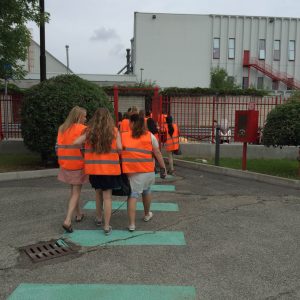
We viewed this passion through their creations and facility. We were allowed to walk through their factory. Here, dawned in our orange reflective vests, we saw metal pellets being spat from the mouths of machines. We saw CNC routers cutting sheets of metal as a man shook out the results. Piles of metal lined the shelves that reached the factory ceiling. Pieces of lamps hung from a rack and moved throughout the building.
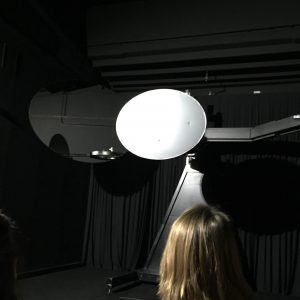
We then removed the vests and traveled to the laboratory. Here we learned just how much attention Artemide paid to details. They had a machine that tested the intensity and light distribution of their products with a rotating mirror and sensors. Another room tested the longevity of the lights. The products were put in devices that heated them and acted as x-many years of outdoor life. Most interesting, there was a machine (looked as a simple sphere on a pole) that received the radiation as a human body would. In this way they can attend to all of the Italian regulations.
Artemide was a wonderful example of collaboration. Designers + scientists + engineers all coming together to produce products that spread light + innovation.
Artemide
Artemide
3 collections of Artemide:
- Design: Glass and Tech
- Architectural: Indoor and Outdoor
- Danese: Professional and Environmental
From the 1960s to now, Artemide has experienced drastic changes. For instance, in the beginning, the company focused on Plastic and many new materials, and they did (and still do) extensive research on the relationship between man and light. In the early stages, they were experimenting with how different designs changed how people used their products as well as how to efficiently make changes that were both aesthetic and functional. However, Artemide now focuses more on remakes and the aesthetic of their design.
One of the biggest advances of the company was through the revolutionary use of LED lights. LED lights don’t give off much light, but they gave the company the ability to add color and dimension to their previous inventions. Not only could they completely change their old products and bring forth a new model, but designers were able to create completely new products – many beyond the comprehension of those in their time. They brought in real-life applicable techniques such as the addition of joints to lamps and changing the shapes in order to cast light in a whole new way.
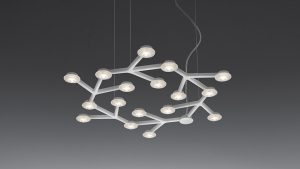
As of 2015, the company has begun using more glass, technology, and modern approaches to design in order to reduce their environmental impacts through their old techniques (i.e. large consumption of Plastic). Now, they try to mix tradition with innovation in order to keep their brand as familiar as possible while still making grand strides towards advancement.
Many great projects include: Li-fi and Ameluna:
“Li-fi” is the interaction between humans and light sources. By creating a dialogue between the two, data and information can be communicated between light sources; this new science is still in the process, but it opens new forms of communication as well as a more in-depth understanding of the relationship between man and their environment.
And Ameluna is a “bright future project” that continues that push for environmental awareness. Light and heat relationship brings about the technical and emotional connections humans have with their environments.
There is also the use of lights to create fonts and creative outlets through the extensive use of lights. Michele de Lucchi, for example, created the Tycho Professional of 2016, which incorporates light by creating a font and building a light-based alphabet. It goes by the acronym: LoT, Light over Time. It’s Reflective Technology that uses LED lights (both colored and not). It can be scheduled through a time sequence, and it creates light symmetry through the programming of light and appliances.
Overall, Artemide is about modernity and functionality. It was a great pleasure to explore their shop as well as their factory. It gives one a new perspective on the relationship between us (humans) and light.
Milan Week 2 overview
Another exciting week in Milan. From Portaluppi to Terragni to Castiglioni to Boccioni to a small glimpse into Aldo Rossi’s design process. Here are my takeaways from all these designers.
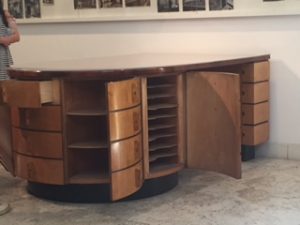
Portaluppi – an explorer, experimenter and visionary. He marbled at patterns, form and function. He loved to throw something old into a contemporary object and vice versa. He designed furniture that was ahead of its time. The black couch in his studio, for example, that particular form is still in use today. He shared his vision for the future and many designers were inspired by that spirit.
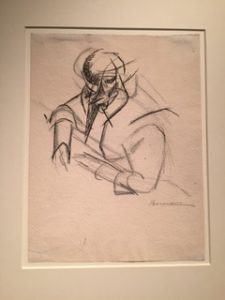
Boccioni – artist, painter and activist. Amazing attention to detail. I was drawn to his pencil studies and portrait work. Especially, the emphasis placed on the human nose—each stroke on the nose added a different quality to each portrait. He truly captured the essence of each person. A shift in his work occurred when he started to deconstruct the image. By placing equal focus on both the object and subject with movement and color, he reversed the importance of the image. He was inspired and drew from his environment. He went from representative to abstract. Or to better describe this shift, he became a futurist, which was similar to cubism, but more powerful, in my opinion, as they were also making political statements. His shift in philosophy also separated him from the Divisionists.
Terragni – an architect that designed for the fascist regime. He loved to design utilitarian buildings with uniformity and symmetry. He represented uniformity, but designed for very specific needs. He was mindful of every object and its use. The attention to project’s needs was incredible. He designed an elementary school that completely captured my interest. Although, a bit off putting for me, it was amazing to see that he designed every single element of the building was designed to fit a child’s body. The chairs, the tables, the bathrooms, the sinks and even the stairs. The stairs in the back of the building were situated exactly to the Roman tower on top of the mountain (maybe, placed for a historical lesson for the children.) Every aspect of a building had to have a purpose.
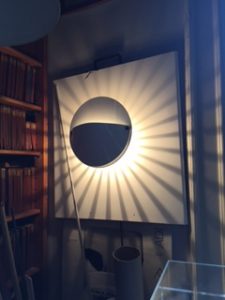
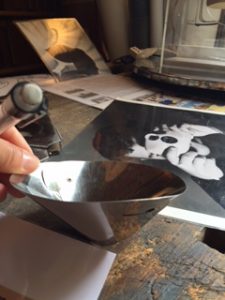
Castiglioni – an amazing collector, observer and a very creative man with a sense of humor. He was a problem solver that truly believed in the term form follows function. He was known to say … “if you are not aware, you are not a designer.” His inspiration for his designed objects were actually anonymous objects. For example, he was inspired by a fisherman’s cup to design a lamp. He was also inspired to design a 3 point balance system by a milking chair/stool. His studio was filled trinkets and anonymous object.
Alessi
The project that captured my attention at Alessi was the “memory containers” workshop, which prompted designers to draw from their cultural heritage or personal experience to design an object (or I’d like to think, to design a memory). It was great to hear our host discuss the rituals of gifting. “Every culture all over the world has an offering ritual.” They had the designers explore the memory of their gifting culture. There was no prescribed goal or object to design—only explorations. Alberto wanted the designers to have freedom to explore and play without any restrictions. This allowed the designers to explore their traditions, cultures and even childhood memories to generate activities. What arose from this activity was a variety of products. The outcome was so successful that 15 objects were produced from this project. Although, I am not an industrial designer, my thesis project closely relates to this gifting ritual and workshop generated by Alberto. The outcome was different than my Cultura within thesis project, but the intention was the same to use one’s culture to strengthen and build connections. My project involved learning about one’s culture to find strength within. The hope for my project is to create agency and perseverance to continue with one’s goals rather than be paralyzed by fear and doubts. Just as Alberto is interested in developing products that encourage development in the public, I am interested in the development of the community through objects—taking it one step further—I’m making a connection between object and subject to build a stronger, supportive and better community.
Another aspect of Alessi’s visit that captured my attention was the designers’ process of creation and design. I was fascinated by seeing Aldo Rossi’s process compared to Michael Graves, Ricardo Dalisi, Ettere Sottsass, etc … I loved seeing the varying making processes of all designers. It was interesting learning about the transition process for all designers, from drawing to paper to wood prototype to stainless steel prototypes. The contrast from progression to simplification of the final product intrigued me. I was enthralled by Aldo Rossi’s “hands off” style of designing, where he allowed the technical team to solve the small, technical details of the object. He was never preoccupied with the minutia of an object, just the larger vision. He was mainly interested in the final outcome. Unlike, Ricardo Dalisi—he needed to visualize every step of the process so, he created prototype after prototype. He was a visual maker—he created varying prototypes from paper to wood to generate a final product. All artists, designers, and architects had a particular process of designing, whether it be collecting, making, writing or drawing, they all followed different processes. Their practice was based on personal style, they all discovered their way of working. There was no prescribed process. They all wanted to make better products for a better living.
Mapping Project
As a group we had our first walk from our first location Universita Luigi Bocconi, to the Torre Velasca Piazza.
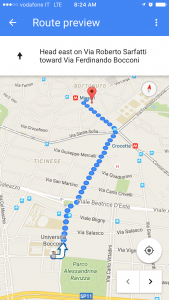
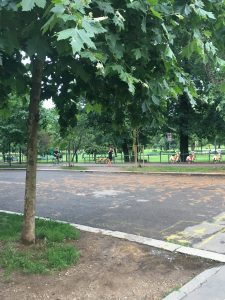
The route was about an 18 min walk. At first arriving to the Universita, it is encompassed by a beautiful public park, with students and people buzzing all around. The closest feeling of this space would be Washington Square Park in New York. As we continued to walk down the path the buildings went from some student living apartments, to hip bistros and bars, and then to a residential area that was less modern with huge magnolia trees, and Jasmine growing everywhere.
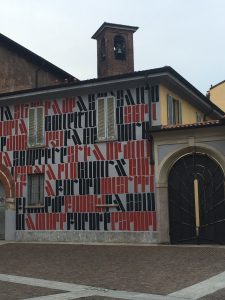
 There was a turning point when we passed an archive building that the whole front was covered in Medieval gothic text. Once we passed this building, the path we were walking was no longer inviting, and felt very stark. We arrived to the Torre Velasca, and the area was basically dead. The tower spread this cold feeling, and there was not many people walking in the area. It was very fascinating to see the transformation of our walk from the beginning to end.