Category: Weekly posts_2016
B + B Italia Milano
Fragile Milano
Studio FM Milano_visit today
Switzerland, Germany, France, and a whole lot of design.
When I arrived in Zurich on Saturday, I needed to eat. A google search for “vegan” lead me to a cafe a few blocks from the main station, but avocado toast was 20 USD! Switzerland is expensive. I found a veggie burger in the area that was 16 with a student discount, but the prices were unexpected.
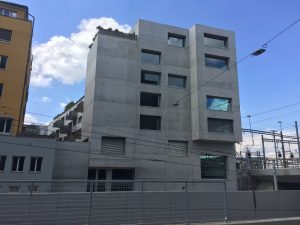
After eating, I had to decide if I wanted to spend the after noon exploring, or try to visit both design museums before they closed. It was three o’clock and they both closed at five, but I walked to Museum für Gestaltung in the Zurich University of the Arts. It was the smaller of the two spaces for the day, and they had an exhibition cover design from branding and graphics, to product design of pens and electronics, to a collection of William Morris print blocks and textiles. The other exhibition in the space covered the design of protest.
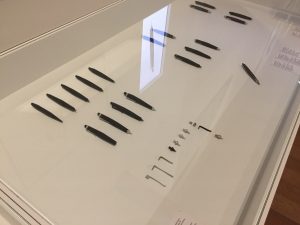
Next, I walked to the new Ausstellungsstrasse location. There, I visited the permanent collection, full of everyday objects from Braun Razors to actual sketches of fonts by the influential Swiss designer Adrian Frutiger (creator of one of my favorite fonts: Avenir).
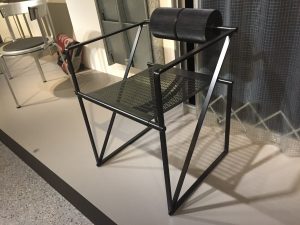
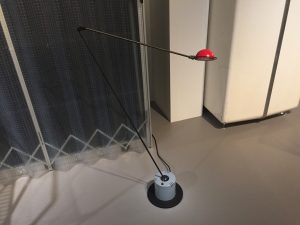
I really enjoyed their collection showing the history of furniture in Europe. In particular, the collection of 80’s post-modern furniture caught my eye and I took the time to sketch a chair and a task lamp.
Sunday was my day to explore. I had a ticket to Basel in the northwest for any time during the day, so I woke up early, checked out of my AirBnB, and walked back toward the interior of the city. My first stop was MAME, a third wave coffee shop owned by a Canadian couple. My coffee was carefully extracted through a V60 and I made friends with a Portuguese man while sipping my floral coffee.
The Swiss National Museum was near the train station so I walked over to see what they had. They had an exhibition about design called “In Search of Style” which traced the development of the Arts and Crafts movement from John Ruskin and William Morris through the Weiner Werkstätte and Josef Hoffman. I took a few hours examining prints from The Grammar of Ornament and seeing important pieces of furniture and product design I’ve engrained into my memory from my History of Design studies.

In the evening I took the one hour train from Zurich to Basel. Rather than taking public transportation to my AirBnB, I walked two hours along the Basel riverfront to Germany and then over to France to meet my host in Huningue. Along the way, I saw kids doing backflips off of a bridge into the river, and walked through a really interesting industrial area where people had turned the abandoned crates and pallets and used them to build small bars and art studios along the riverfront. Huningue was a cute small town. It was hard to believe that Germany was on the other side of a pedestrian bridge and that Basel, a city of 175,000 people, was accessible by walking through Germany for 10 minutes.
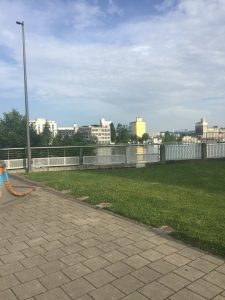
My host offered to drive me to Vitra on Sunday morning, and I arrived on the campus in Weil am Rhein, Germany at 10am. Virta’s campus is a collection of incredible architecture hosting two museums, a 4 story showroom/shop, as well as factory space, a conference center, and a fire station. My day started at the exhibition space designed by Frank Gehry which tracked the interior architecture of night clubs from the 60’s through today. For me, it wasn’t that exciting, but it was my first encounter with Gehry’s architecture first hand, so I walked through the building and found the opening of spaces and surprised around every corner delightful.
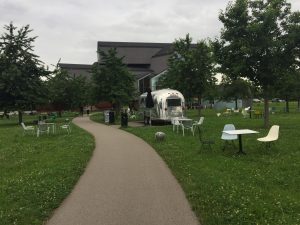
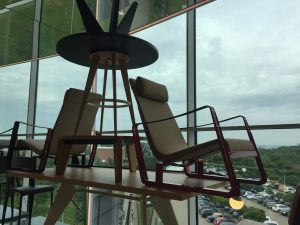
I had an architecture tour of the campus that started an hour and a half later, so next I walked to Vitra Haus, a building designed by Herzog & de Meuron, which looks like a pile of houses stacked on top of one another. I’ve never seen such a collection of designed good in my life. Vitra’s flagship store, it housed tables, chairs, lamps, toys, and everyday objects. I walked through the store for an hour and a half and systematically sat on every chair of interest, including a ton of Eames designed furniture (Vitra was Europe’s manufacturer of Eames’s furniture and had good working relationship with Herman Miller). In Vitra Haus, I kept coming across chairs that I really liked, and on the top floor I found an exhibit about the designer Jean Prouvé — an engineer turned designer.
At 11:30, I met my tour guide and two fellow tour-takers. My new friends were from California, one an interior designer and his partner a doctor. Our tour guide was an architect from Sweden and she brought us into the restricted interior part of the campus. We started at the Buckminster Fuller Geodesic Dome, then a prefabricated and modular building for a gas station designed by my new design interest Prouvé, then walked us over to the real gem of the campus: Zaha Hadid’s first structure. This fire station was a flying collection of heavy concrete magically suspended in air with no parallel lines and no obvious structure. It was absolutely incredible. The craziest thing about this building is that Hadid had her studio for 12 years before she was awarded a project, and this project was a building for a volunteer fire-fighting team that was funded by this private company.
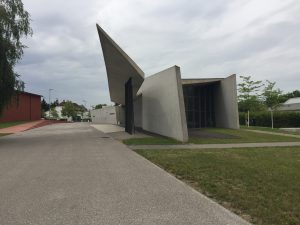
As the architecture tour continued, we learned that the Vitra campus had burned down in the 90’s. Each of the buildings that were put up after the fire had the task of being architectural masterpieces, but had the task of not overwhelming the important building by Hadid. It was really interesting how architects approached the problem. One used a bridge to frame the station, and others used humble materials. Our group was great since we were each well-informed about design, and we casually chatted about our design interests as we walked through the factory and other buildings on campus.
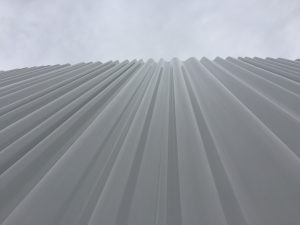
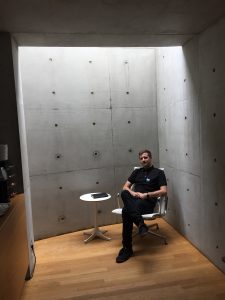
The tour ended at a conference building by Tadao Ando. Before the tour, I had a vague idea that he built with concrete, but I had no idea how unique and memorable his architecture would be. We entered the building through a narrow entryway and entered a conference room finished with warm plywood, board formed concrete, and glass. Our tour guide pointed out the level of detail; the lines from the concrete pour lined up perfectly with lights, windows, and other elements in the architecture. Nothing was left to chance. Ando dug a courtyard into the ground an designed the house from an elliptical base that allowed light to penetrate into the ground floor and basement. The floor plan was asymmetrical, unpredictable, and full of surprises. Natural light penetrated in all of the right spots and narrow entries between curved and straight walls opened up into voluminous spaces.
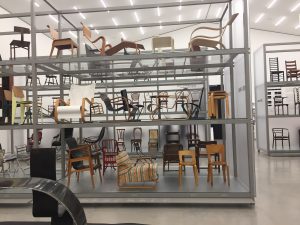
After the tour ended, I spend a few minutes picking wild cherries and exchanged information with my new friends to keep in touch. The last building to visit was the owners’ of Vitra’s personal collection of chairs. I started in the basement and found Charles Eames’s personal office reconstructed. When he died, a large portion of his estate was sent to Vitra and they have a great archive of his work. The ground floor contained stacks and stacks of iconic chairs, much the like that stacks of a library. It was ordered chronologically starting with object by Morris & Co, Frank Lloyd Wright, and moved through mid-century and contemporary designs. I couldn’t believe the collection. Any chair important to the story of design history was in front of me, and I took the time to observe and sketch.
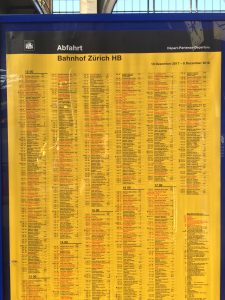
The rest of my day was travel. I grabbed a soup from the cafe and walked twenty minutes in the rain to the nearest tram station. The tram took me over the border to Switzerland and I took the first train to Zurich. I had a few hours to kill before my train to Milan, so I walked to the old town and found a vegan hotdog vendor. I connected to the wifi and found that the birth place of the dada art movement was very close, so I walked to Cabaret Voltaire and walked through the space, imagining the shenanigans that probably took place over the years.
It was an action packed weekend, and when I arrived back to my apartment around midnight I slept.
Campari Gallery, Milano
week 3
The highlight of this week for me was definitely visiting Achille Castiglioni’s studio. His approach to design has a wittiness and economy that I want to implement in my own work. I also enjoyed the Armani Silos museum, the way the lighting enhanced the clothing and the way sound interacted with the spaces to form a seamless sensory experience. 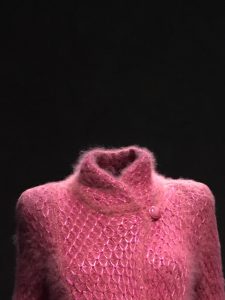
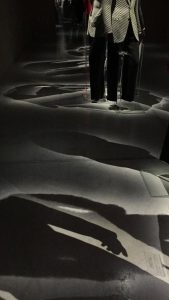
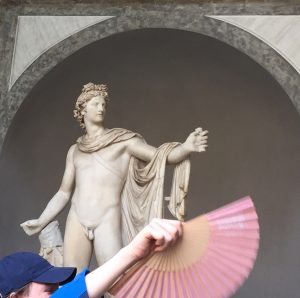
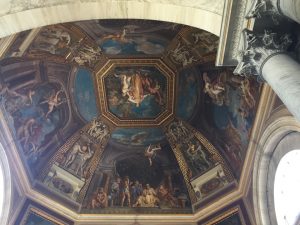
Over the weekend, I went to Rome and visited the RedValentino Flagship store, the MAXXI museum designed byZaha Hadid, the Vatican museums, and St. Peter’s Basilica. The MAXXI museum was not the most inviting space, which I find to be a common motif in Zaha Hadid’s work. Because the museum is like a piece of sculpture and has such a distinct personality on its own, it was interesting to see how its exhibitions and art take on the challenge of complementing/ the space shaped by the building’s architecture.
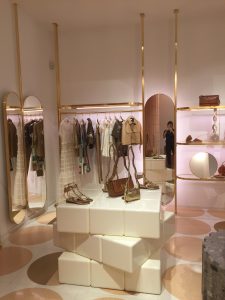
Also the RedValentino Flagship store designed by India Mahdavi was cool to visit, I loved her use of color and confident use of pure forms:
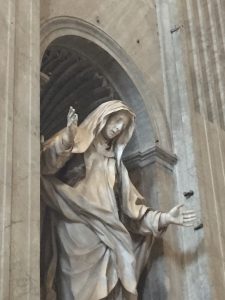
I went on a tour to visit the Vatican museums and St. Peter’s Basilica in order to skip the lines.I kind of hate tours because of their strict nature, and so we basically strolled through the museums with rare and brief moments of admiration in probably under 20 minutes.
week 2
Jesse and I took an airplane to Prague for the weekend. It’s crazy that just under an hour of flying I can enter a country where people speak a different language (from a different language family), with a very different atmosphere because of its Slavic cultural history.
The first thing that struck me was the escalator in the metro station – https://www.youtube.com/watch?v=hJNvNy4bj0g . The posters on the walls were running parallel with the slope of the escalator, instead of their usual orientations in escalators, parallel to the axis of a standing person. It was disorienting, and in hindsight I think this first memory of Prague is a perfect representation of the city’s character.
As we continued exploring the city, we kept running into peculiar objects:
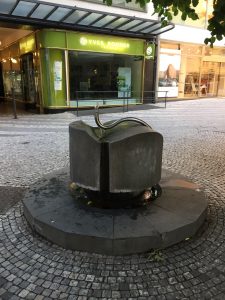
and another fountain featuring threeelegant and relaxed dinosaurs spitting water with great force, in the middle of a small plaza with surrounding restaurants:
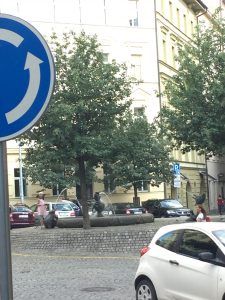
and instead of finding beautiful courtyards when peakinginto a doorway on the street like in Milan, I instead saw people drinking beers at bars (more like dimly litbasements with like one yellow wall lighting fixture on a deep mahogany colored wall).
The variety of different styles of architecture there also felt like an accurate description of how Prague is right now: there is an odd balance/coexistence in Prague of tourists from around the world and Czech natives (who speak a fairly small language and share a very particular culture). Likewise, there was an eclectic mixture of building styles, with new/international jutting up next to historical ones, next to Wes Anderson-like buildings, next to Cubist-inspired ones:
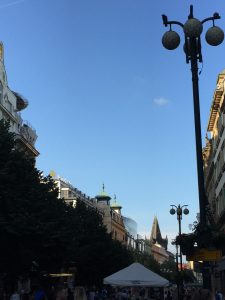
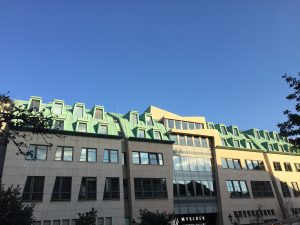
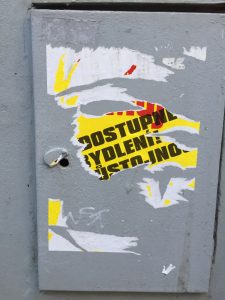
Maybe I’ve just had a previous idea of Prague and it made me look at everything with a lens (that everything is disconcerting and odd). But I really think that’s what Prague is about, from everything I described to the language itself (objectively, the way the letters form together in words clash).
The Armani Factory
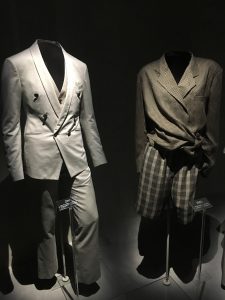
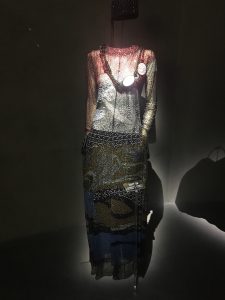
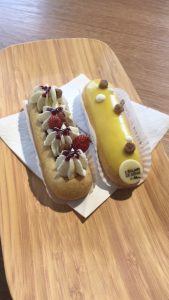
On Wednesday we had a trip to Armani/Silos to look at their clothes. At first, the museum had a series of paintings that told a story about a Jewish guy in Venice with his puppet. After reading the story, there was many mini stories, represented by pictures. They were kind of silly and I didn’t understand many of some of them; still they were nice to look at. On the first floor, there were many accessories laid down. Some of them were nice, but very few would I actually wear. I went quickly through them and headed to the other side where they had the outfits. At first, many of the outfits were suits for men and women, but not many of them were attractive. Some of the items were nice but most of them didn’t even go together. I moved to the second floor and Claire joined me while we went through the last two floors together. We went through every single piece of clothes and judged it: we either buy it, remodel it or don’t buy it at all. Many of the items wouldn’t have been purchased by us, many others were modified and redesigned and very few would have been purchased. For example, we’d either decide to change the material, the patters or the colors as if we were actual designers (we would make nicer clothes if we were.) After that, I watched some of the commercials that they were playing and left. After the museum, I went home, then to Éclair de Genie to have the best éclairs I ever tried. They were colorful and very tasteful. Finally, I got together with my group and we worked on the project together!
Kartell
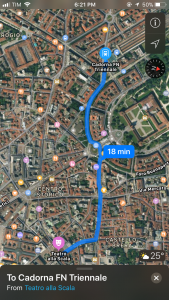
A link to the Museum we will visit on June 13th. http://www.kartell.com/experience/it/museum/