By: Ava Feinstein, Sophie Leung-Lieu, Samantha de Lemos, and Camila Mascorro
Preliminary Research
BUILDING 1: Bosco Verticale
 |
 |
| By: Boeri Studios
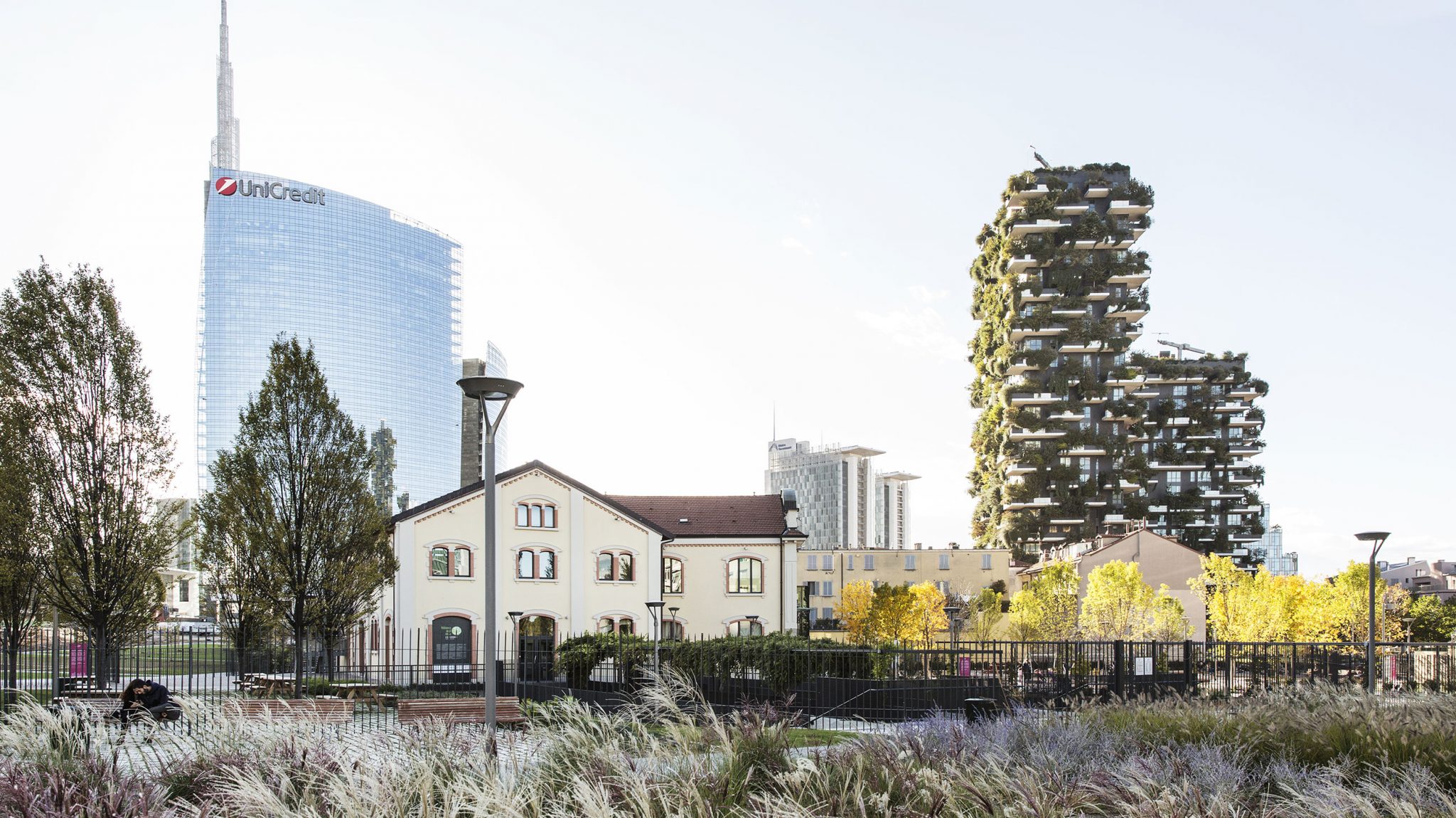
Pictured are the two towers that are Bosco Verticale in the Porta Nuova district of Milano. This image faces the south side of the tower which is primarily planted with evergreen species to withstand the exposure to the south sun. |
By: Boeri Studios
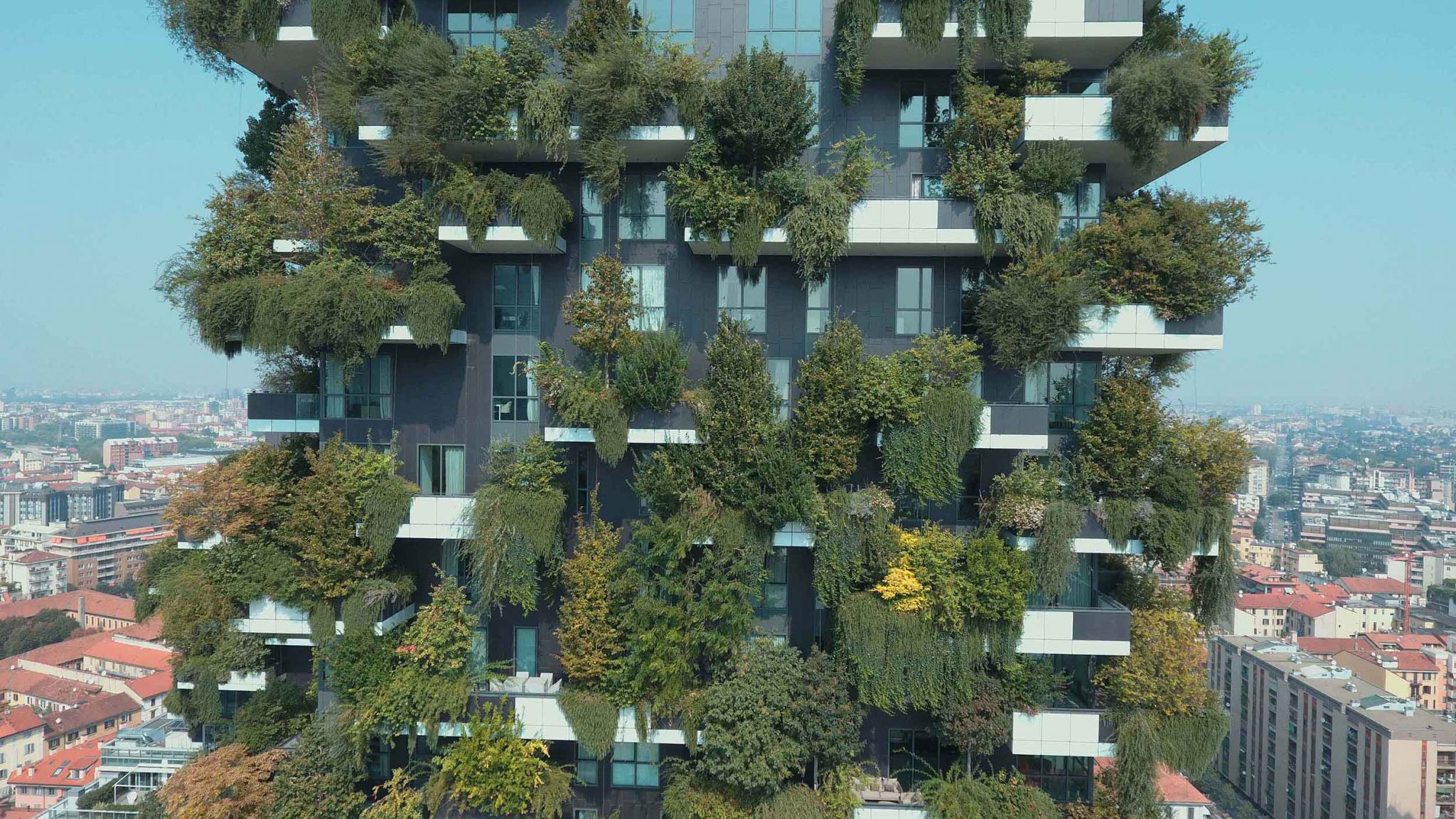
Depicted above is a close up picture, highlighting the staggered formation of the balconies. You are able to see the varying degrees of space necessary for each species of tree to grow into its full canopy. |
 |
 |
| By: Boeri Studios
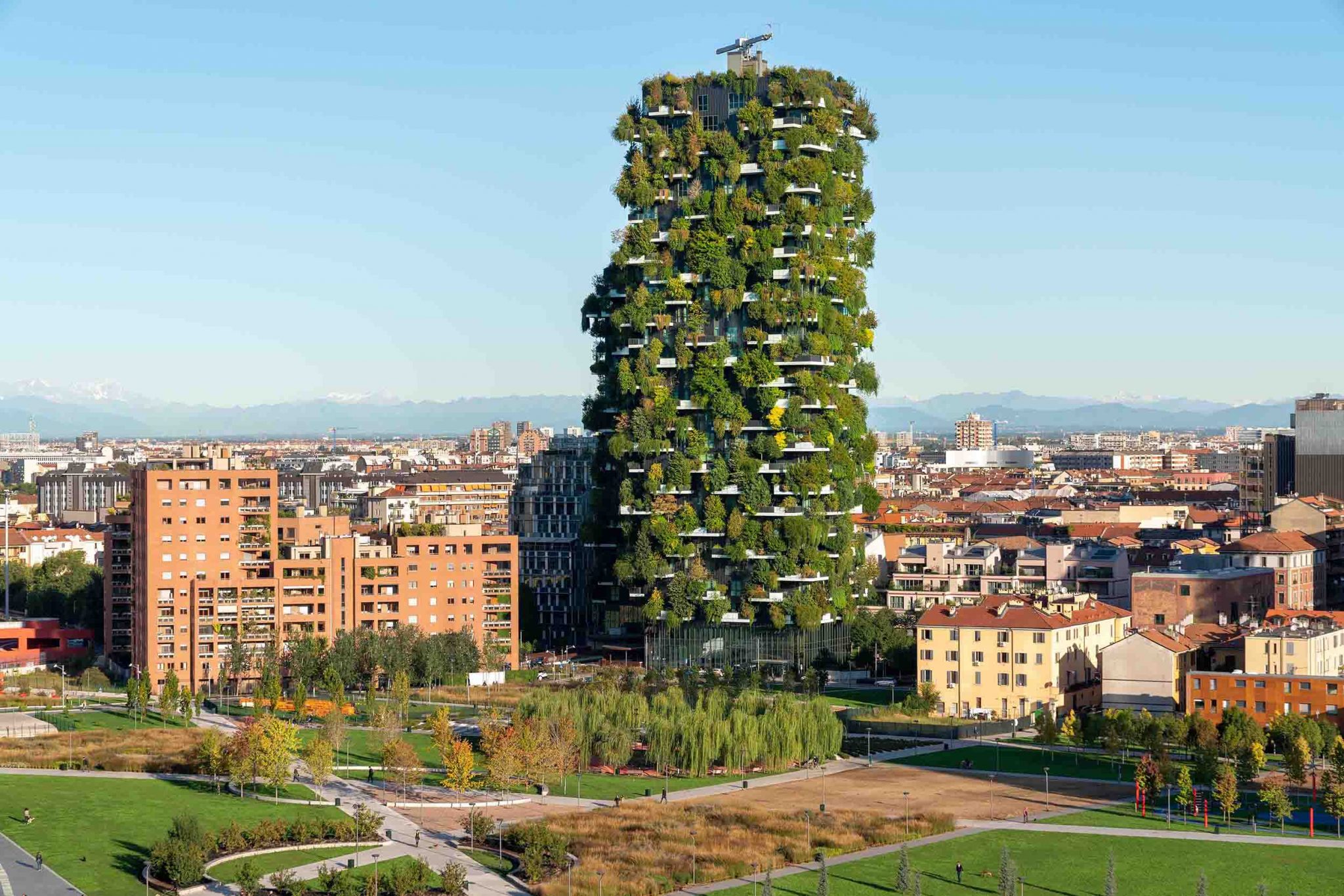
Depicted above is a close up picture, highlighting the staggered formation of the balconies. You are able to see the varying degrees of space necessary for each species of tree to grow into its full canopy. |
By: Boeri Studios
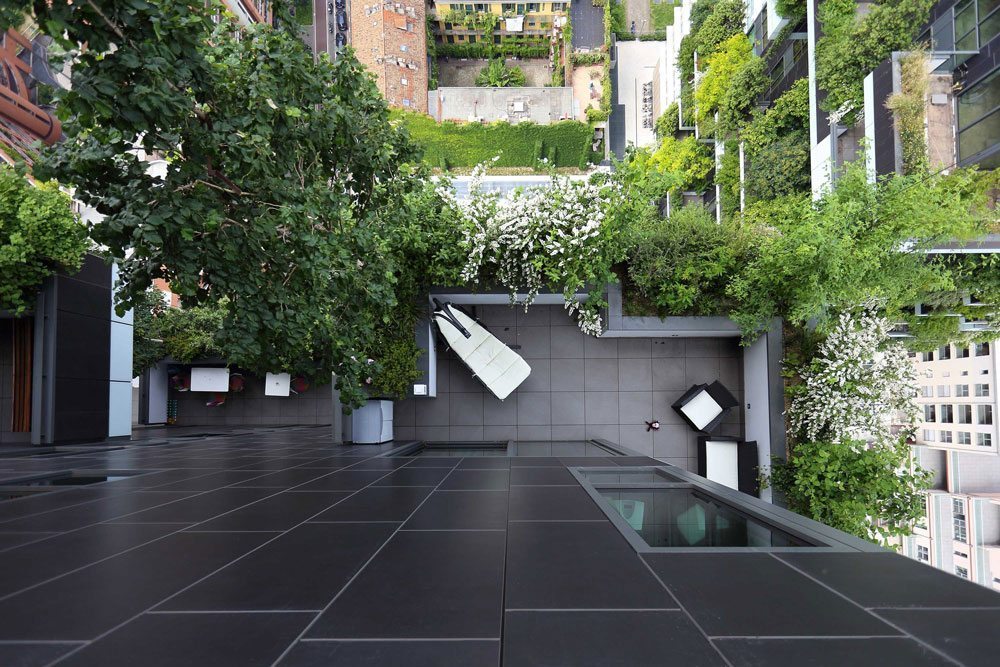
This top view of one of the balconies demonstrates both the height allowed for full canopy development, as well as the bespoke nature of each of the balconies. |
Observations
The Bosco Verticale, otherwise known as the ‘vertical forest’, is a residential tower in Milan’s central Porta Nuova district. The structure consists of two towers, 110 and 76 meters high, and hosts over 20,000 trees and shrubs on its walls. Of this greenery are hundreds of different plant species, distributed according to the sun exposure on the facade.
The vertical forest was designed by Boeri Studio, with architects Stefano Boeri, Gianandrea Barreca, and Giovanni La Varra. The purpose of the building was to contribute to Milan’s efforts of environmental regeneration to densify nature within the city. The vegetation covering the surface of the structure is equivalent to 75,000 square meters of greenery. Because of this, the Bosco Verticale minimizes the city’s carbon footprint, optimizes water management, and contributes to the improvement of the overall quality of life in Milan. The ecosystem allows sunlight to be ‘filtered’ through the building and helps regulate the humidity level and surface temperatures by up to 30 degrees on the Bosco Veticale. This also reduces the energy requirement for air-conditioning inside the residence.
The building walls include overhanging balconies that are staggered, jutting out by about three meters. This design choice was defined to allow for the growth of tree canopies up to three stories high, as the building was created to better condition the predicted plant structures. Apartment complexes on the inside of the building are created with flexible floor plans to accommodate the plants surrounding them. Additionally, the elevators and stairs were placed on the perimeter of the building, as opposed to a traditional placement in the center of the tower.
While the plants are considered a common asset to all tenants in the building, a team of professional gardeners maintains the greenery by climbing the towers with ropes twice a year. It would be interesting to learn more about how residents experience this green space in daily life and whether the concept has influenced other cities to build similar towers. It would also be interesting to explore how sustainable and cost-effective it has proven over time, especially in terms of maintenance and long-term environmental impact.
BUILDING 2: Federazione del Fasci Milanesi
 |
(OK)-21--Milano---San-Sepolcro---600---(3)-Romano--provaPP.jpg) |
| By: Adam Nathanial Furman design
Post-war image of the Federazione del Fasci Milanesi, now repurposed as a State Police Commissioner Center, preserving its layered architectural legacy. |
By: www.artefascista.it
Looking up at the towering façade of Palazzo Castani, the stark verticality and rigid symmetry reflects the authoritarian power structures of the fascist era. |
(OK)-27--Milano---Federazione-fascista-di-Piazza-San-Sepolcro.jpg) |
|
| By: www.artefascista.it
Historic image of Palazzo Castani at Piazza San Sepolcro, the birthplace of the Fasci di Combattimento, where Mussolini launched the fascist movement in 1919. |
By: Fondazione Piero Portaluppi
A view of the Bramante courtyard’s loggias, reopened and reconfigured by Portaluppi with classical columns to emphasize order and heritage. |
Observations
The Federazione del Fasci Milanesi, also known as Palazzo Castani, is a historical landmark that represents a history with the fascist regime. Located at State Police | Commissioner Center, Piazza S. Sepolcro, 9, 20123 MI, Italy, this building has lived through many different phases of historical lives. Through the work of architect Piero Portaluppi, who designed many of Milan’s most coveted architectural masterpieces, the Federazione del Fasci Milanesi was a display of the history that went on within its walls.Portaluppi was a more abstract architect than most absolutists but maintained elements of the fascist style through his use of symmetry, grand proportions, and monumental forms.
The structure originally dated back to the 15th century under the original ownership of the Castani family, which gave it the name “Palazzo Castani.” It underwent significant transformations throughout the centuries, including an extensive Baroque renovation in the 17th century that added dramatic spatial elements while retaining its Renaissance roots. In the 20th century, Palazzo Castani became a landmark after housing the National Fascist Party led by Benito Mussolini. He used what is now known as the Federazione del Fasci Milanesi as a base for early political activities.
On March 23, 1919, Mussolini gathered around 120 supporters in a hall at Piazza San Sepolcro, this exact location, to officially launch the Fasci di Combattimento, marking the beginning of the fascist movement. The most impactful speech for the Italian fascio was delivered at a building adjacent to Palazzo Castani, linking the address to the origins of Italian Fascism. This era became known as Sansepolcrismo. Between 1935 and 1940, Portaluppi remodeled the building, adding a monumental façade and making architectural interventions that emphasized order and power. One of his key contributions was reopening the loggias on the first floor of the Bramante courtyard, previously walled up, and reconfiguring them with classical columns and spatial symmetry. After World War II, the Federazione del Fasci Milanesi was reimagined and repurposed as the State Police | Commissioner Center, transforming its identity while preserving the telling history of its architectural past.
Citations
Bosco Verticale
“Vertical Forest: Milan.” Stefano Boeri Architetti, 30 Apr. 2025, www.stefanoboeriarchitetti.net/en/project/vertical-forest/.
Visser, M. “The Geography of Vertical Forests: Exploring the Green City.” Utrecht University Student Theses Repository Home, 1 Jan. 1970, studenttheses.uu.nl/handle/20.500.12932/35208.
Federazione del Fasci Milanesi
Studio. (2023, February 1). Piero Portaluppi, dall’italia del ventennio alla milano di instagram. Rivista Studio. https://www.rivistastudio.com/piero-portaluppi-milano/ https://www.rivistastudio.com/piero-portaluppi-milano/
Wikimedia Foundation. (2023, December 28). Palazzo castani. Wikipedia. https://en.wikipedia.org/wiki/Palazzo_Castani https://it.wikipedia.org/wiki/Palazzo_Castani
Wikimedia Foundation. (2024, December 27). Piero Portaluppi. Wikipedia. https://it.wikipedia.org/wiki/Piero_Portaluppi https://en.wikipedia.org/wiki/Piero_Portaluppi
Arte Italiana Del, www.artefascista.it/milano__CdF__primigenia__arte__italiana__del.htm. Accessed 12 May 2025 https://www.artefascista.it/milano__CdF__primigenia__arte__italiana__del.htm .