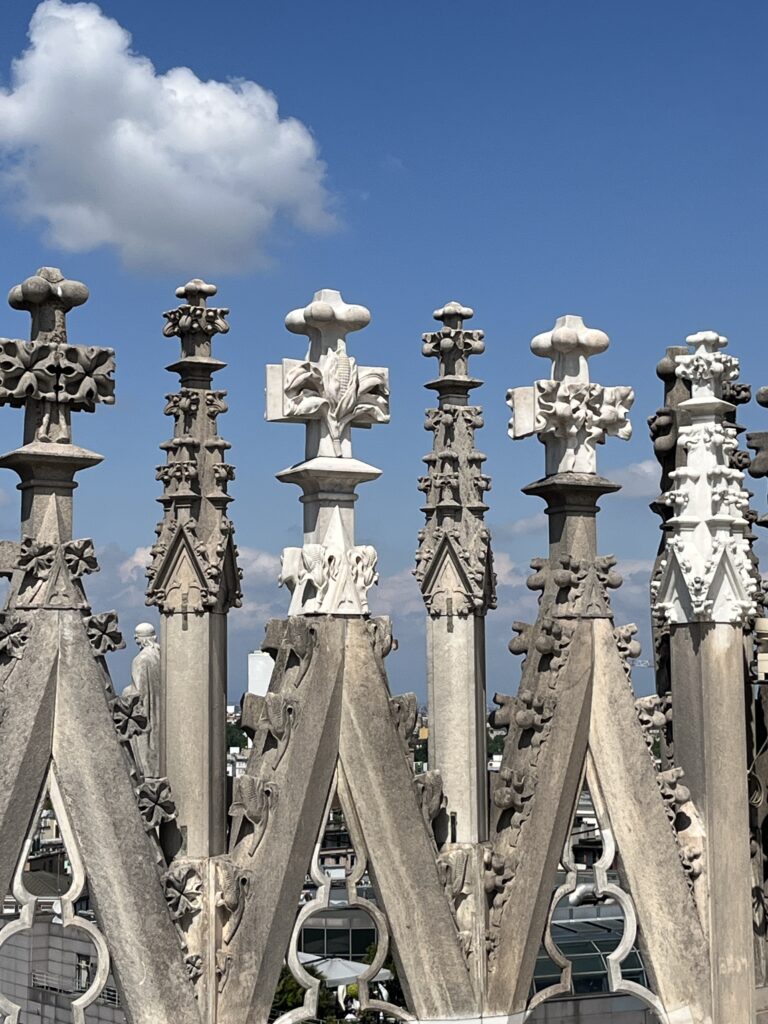
Ciao! This first week in Milano has been nothing short of eventful, exhausting, exciting, rewarding, scary, and fascinating all at once. It was definitely very nerve-racking at first the thought of living in a different country for a few weeks, especially as I have never lived anywhere outside of Austin, having been born and raised there and then going on to attend UT. This has been a very big jump for me so far, but little by little I’ve gotten accustomed to the city while finding things that both it and Austin share, as well as new things that are different from back home and have surprised me. It’s definitely stood out to me how the new and old are blended together throughout the city, something so evident that it was pointed out to us during our tour of the Duomo. Back home in Austin I’ve definitely studied juxtaposition of older buildings or architectural styles with new, modern buildings in areas downtown or even on/close to campus, but here even in one building the new and old can come together to create something entirely new. This especially stood out to me with the different shades of marble in sections that have been replaced with replicas of the original carvings and sculptures and how despite their visual differences, they work in harmony to portray the history of this building while adding new stories at the same time.
Architectural details atop the Duomo, white being new parts that have since been replaced with replicas, along the original sculptures that gray and more faded in color.
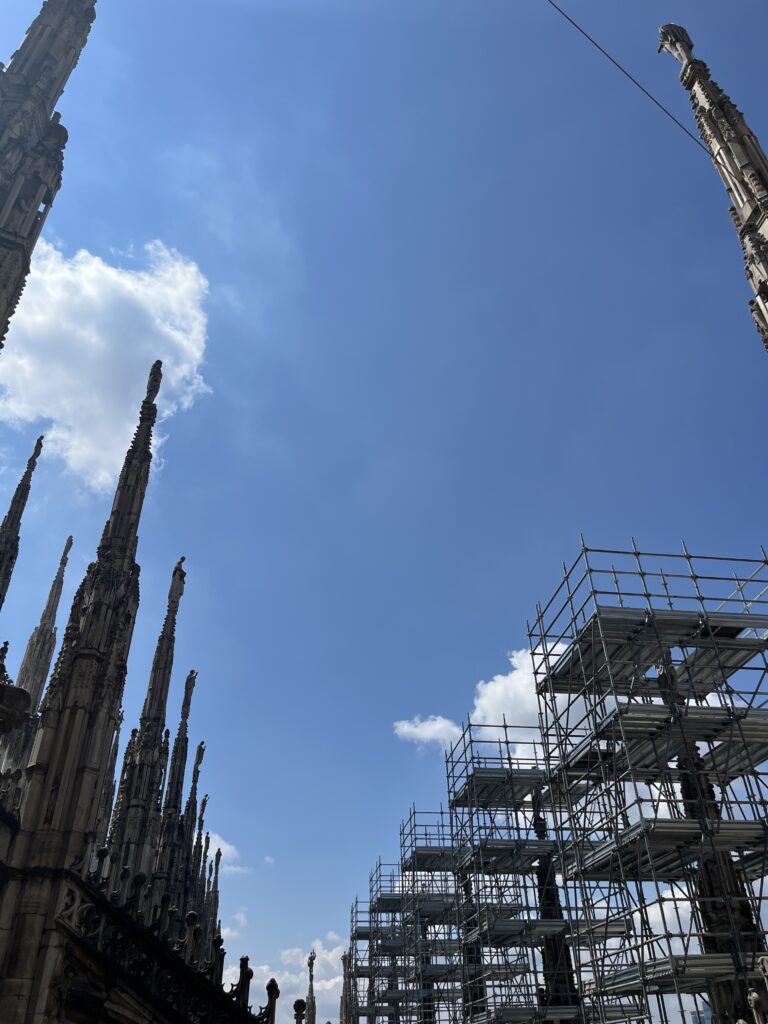
Towering sculptures of the Duomo rise up into the sky alongside scaffolding in place for renovating and restoration.
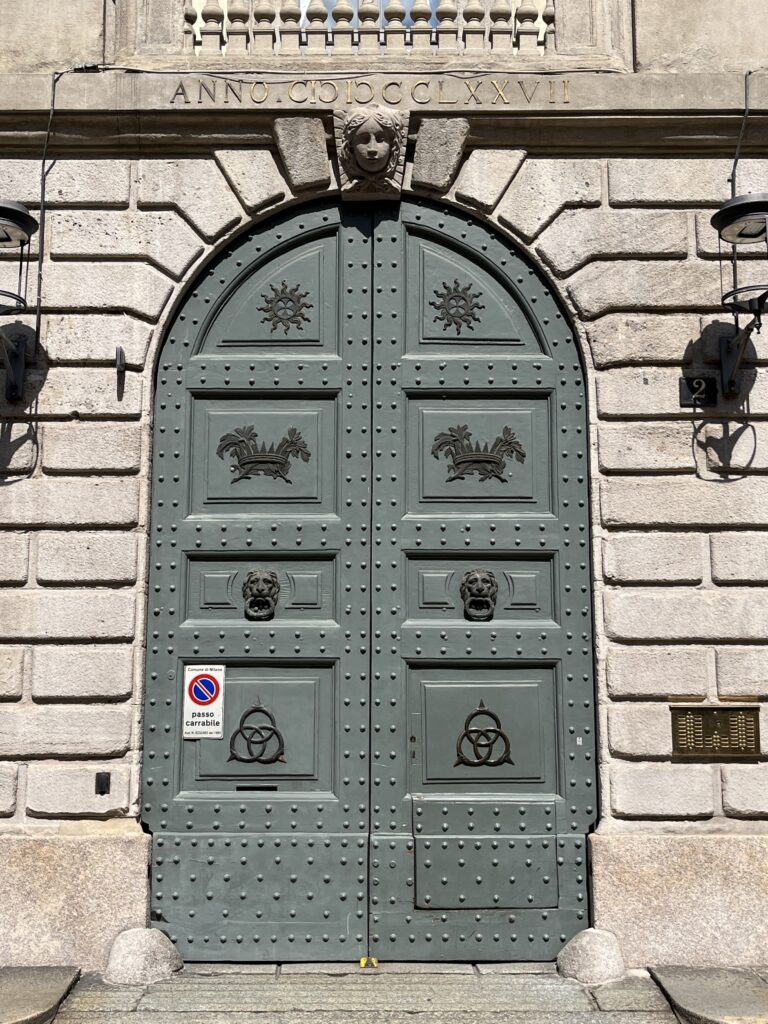
Doors on the Palazzo Belgioioso displaying different graphics and symbols (coats of arms) that stood out to me during our city tour on Saturday.
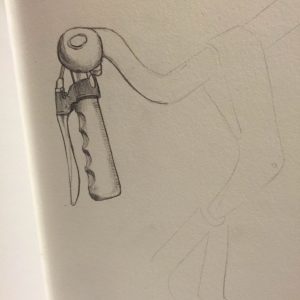
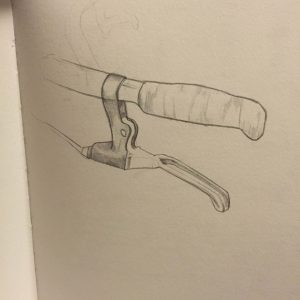
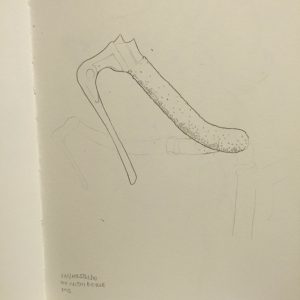
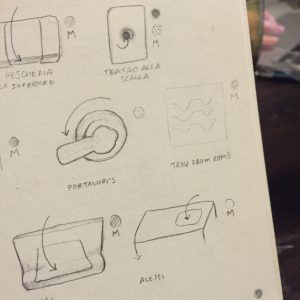
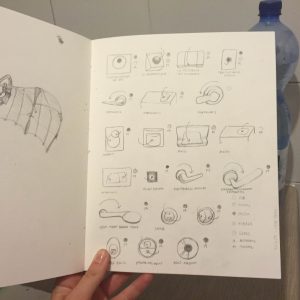
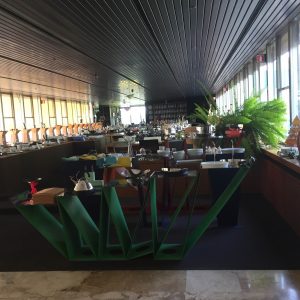
This entire trip my sketchbook has been torn between my love of bicycles, and interest in the variety of appliances (aka toilet handles). The toilet handles have hit a little bit of a plateau and are starting to look the same, which does of course mean I can now start researching the brands and functions. Yet this week, while adding a few new sketches to the flushers (including one very obnoxious one found on the way home from Rome that flushed without warning) I was entirely enamored with a bike exhibit within one of the Triennales we visited.
I figured I’d go ahead and post about my secret obsession (bike handles) because it has been consuming a lot of pages within my book. These bike-handle sketches have also made me realized how unique the craftsmanship and variety is in Milan. I will look more carefully when I return home to Texas, but I swear I haven’t noticed such extravagant bikes in such common areas as I do here. The Triennale show also introduced me to Paolo Manfredi and his talk about about craft-built bicycles in Italy, another venue to look down.
Bike outside apartment-very commonStreet bike with wrapped handles w/ holesMarble + plastic handleThe Urushi Bicycle, 2015Awful + mean trenitalia flusher
This year I had a very special birthday. It entailed a day touring the ground of Artemide, a lighting company. Founded in 1959 by Mundi, they pride themselves on their ingenuity and attention to detail. They focus on the relationship between man and light. How does man interact with light, and how does light affect man’s surroundings and emotions? Their products/projects attend to these ideas.
They produced “The Human Light” (1980-1990) which was an idea that focussed on how light can change the perception of a place. After this they created touch sensitive lighting that changed colors (1900-2000) which gave the user more control and creativity in their lighting process using Metamorforsi Technology. My favorite project was a group of lights that all interacted with each other. They were all bulbs of glass with a single light emitted through one point. As a user touches one in a sliding motion, it dims this light, but all the others as well. In this way one can connect with all of the lights through any point, not simply through a switch on the wall. This is useful, yet also an interesting study in the way that appliances can relate and interact with eachother.
We then discussed the change of their production methods as the LED light was produced. This was a time with innovation met tradition, as LED technology was combined with traditional Italian design such as their glass factory in Venice. With this we were shown a list of patents of that Artemide had acquired. Their passion was transferred not only through design but into the sciences. The Alphabet of Light, Ameluna, LoT, LoT Reflectors were some patents, to name just a few.
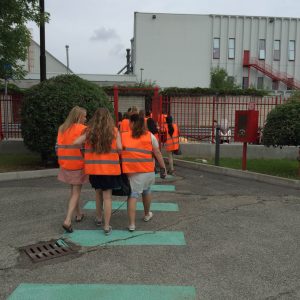
We viewed this passion through their creations and facility. We were allowed to walk through their factory. Here, dawned in our orange reflective vests, we saw metal pellets being spat from the mouths of machines. We saw CNC routers cutting sheets of metal as a man shook out the results. Piles of metal lined the shelves that reached the factory ceiling. Pieces of lamps hung from a rack and moved throughout the building.
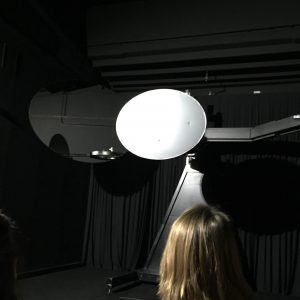
We then removed the vests and traveled to the laboratory. Here we learned just how much attention Artemide paid to details. They had a machine that tested the intensity and light distribution of their products with a rotating mirror and sensors. Another room tested the longevity of the lights. The products were put in devices that heated them and acted as x-many years of outdoor life. Most interesting, there was a machine (looked as a simple sphere on a pole) that received the radiation as a human body would. In this way they can attend to all of the Italian regulations.
Artemide was a wonderful example of collaboration. Designers + scientists + engineers all coming together to produce products that spread light + innovation.
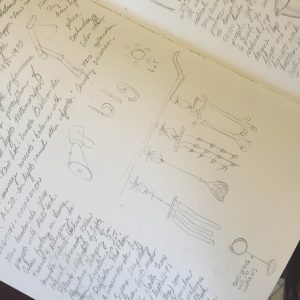
Artemide SketchArtemide: Light TestingThe Little Orange Vest Crew
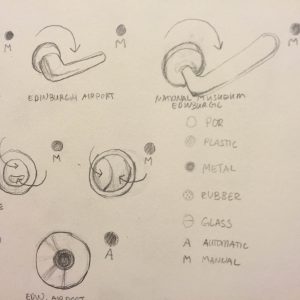
Here you can see the transition to Scottish buttons at the bottom of the pageDetails of divisions of flushers
This week I gathered more toilet handles from interesting places. Portaluppi’s creations housed the most handle (often traditional in America) devices. Terrangi’s kindergarten. Alessi’s bathroom. Such famous handles. Out of the roughly 15 photos/drawings I have made only two even vaguely match up. Terrangi’s and Portaluppi’s handles seem to have the same thin silver handle, unfortunately I did not think to ask the tour guide if these were originally there or later altered (something I will be better about in the future). Also branding, in my rushed moments of taking photos in a bathroom stall, the images of the brands often come out unidentifiable. It’s already so easy to identify how much more variation in branding and form Milan has than the US.
Snapshot sketch of some of the Edinburgh views
Taking photos of toilet handles in Edinburgh, Scotland (on our beautiful weekend trip) also showed a change from Italy’s. Most of them were not handles at all, but a circle push. It’s interesting to see the transition in my sketchbook as the variety of the forms single down to circular shapes.
I may have to do background research and match branding up with the handles post image and online. After this I plan to reserve a page each for all of the different brands I learn about, their history and (if any) company mottos of functionality/design. I have also divided up the devices by material (plastic, metal, glass, rubber) and automatic vs manual. I am starting to take more interest in their locations and what establishment they were found in.
As for the mapping, my group and I have lightly established what we find interesting about the project (although we have been unable to walk to the actual path yet). My idea is that since we have been so heavily focusing on the history of the architecture of Milan, I was thinking it would be interesting to pick out little traces of history (ie: an art nouveau window bar, any remnants of rationalism on a street corner, etc). It could be as specific or broad as we wanted. And then creating a sort of ‘timeline’ that includes our present walk down the street + all of these historical moments (could be with simply typography + line mapping + possibly icons).
This historical map could be combined with our own little intricacies. How we feel at each spot. Where gum got on our shoes. Where I may or may not trip and skin my knee. Where the pasta smells good and garbage smells bad. It could be a huge collaboration of time periods clashing (could be shown in different colors or directions of the lines). Walking the area will most definitely affect my vision, but I’m so excited to have an idea I am passionate about to spark ideas from!
Alessi’s wonders and storiesDisplay area for Alessi’s creations
We were welcomed into Alessi’s large arrangement of items, arranged from the newest, the nicest, and the contemporary ‘pop’ items in the back. These items were what is currently available in their store. What showed us the truer story of Alessi were the stories placed in their upstairs ‘museum’. This museum was out of the ordinary, no name tags, no pedastals. Instead the shelves were full of un-launched projects and designs. In this way, we were told, each object had a greater depth of struggle and of story.
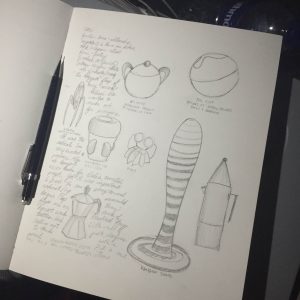
We were shown the Bomb teapot, a rejected Mendini vase, and Stark’s famous lemon squeezers (or non-squeezers what have you). Yet my favorite story of all was that of the collaboration between Alessi and artists, specifically Salvador Dali. Their collaboration (to serve art + design to the lower class at an affordable price) would eventually become what Alberto Alessi would later call the biggest flop of his career. The complex nature of the projects increased their production costs and decreased the interest of the ‘common’ man. This being said, we were reminded that although this project was a flop, it was a revolutionary idea that set Alessi apart. Through this endeavor they proved their willingness to take risks and be innovative, two actions necessary for good design.
The greatest notion I received is that flops are evidence of honest work. Flops are the spice of design. Without them innovation is impossible, and design would remain stagnant.