Here’s what’s on view at Salone 2025


The Gucci Garden had a boutique, gift shop, restaurant, cinema, and exhibitions. When we first stepped into the boutique, I had thought it was the museum exhibit because didn’t really know if we could touch anything or take pictures of the clothing… everything was so fancy and expensive. Plus, the employees watched your every move, as if you were under a microscope.
Getting to the exhibit part, it was actually really cool. There was an intersection of social, cultural and political issues at the time represented into almost each article. The colors, styles, materials, motifs, patterns, and even sizes/lengths of pieces all represented something.


For example, one of the rooms in the exhibit focused on the types of fabrics used… specifically those using animal fur or skin. Zebras, giraffes, foxes — oh my. These are only a few of the animals used for their designer clothing. It is evident that they liked to use “exotic” and limited materials in their designs which elevated their prices and status as a luxury brand.
However, today, using these animals for their products is seen as inhumane in most western societies which has resulted in complaints and protests against the brand. As a result, Gucci recently announced in late 2017 they were going fur-free starting with their Spring/Summer 2018 collections. They will no longer have mink, coyote, raccoon dog, fox, rabbit, and karakul in their clothing designs.
It is interesting to see that although their company’s past had been famous for their unique material choices that they were willing to change portions of their brand to accommodate modern times and issues. They are now utilizing technology to find alternatives for furs and reducing their impact on taking animal’s lives.
Their conscious changes for the future may impact other companies or designers to follow their lead and I hope it does. Gucci is doing a good job of accommodating to change while still remaining a strong and successful brand and I admire that.
If you have a passion for fashion, check out what Gucci has to offer! It is free for students and only a train ride away from Milano.
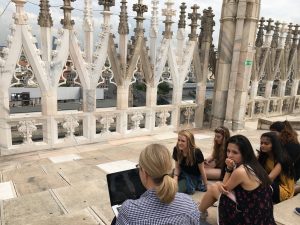
We walked up over 700 steps today to get to the roof of the Duomo. Absolutely worth it!


My sketch notebook theme has changed a few times since we arrived in Milan. At first, I wanted to focus on shoes. I had noticed that Italians wear nicer shoes on the everyday. But then I thought I might get bored of drawing shoes. From shoes, I decided to focus on children’s clothes. But I felt creepy taking pictures of kids to draw later or staring at kids to sketch them. Children in Milan are also dressed so nicely. The are little fashionistas. I was inspired by Humans of New York’s “micro fashion” segment that he shares every week. After I had decided it might be difficult for me to capture exactly what I wanted about my travels through children’s fashion, I decided to change my theme for the third and final time!
Now, I am focusing on chairs. After visiting a lot of designers studios, I noticed that chairs were very important for design. Many designers, designed their chairs, which I was surprised by. Even architects designed chairs! So I started y sketching so designs from the Castiglioni Studio visit and took off from there. I’ve started to notice chairs everywhere now. Designers tend to think about every aspect of the chair, of course, because they are designers! But I have noticed that the mass produced chairs are less comfortable. Their main purpose other than being sat in is usually storage-ability. That is an interesting way to think about designing a chair. It is an important factor for institutions such as museums, schools, restaurants, and anywhere that could need chairs to be stackable, or collapsible.
The Castiglioni and Terragni chairs, however, were designed with other things in mind. Comfort level being one of them. Castiglioni designed a chair that had one leg, which balanced on a half sphere. It had a bicycle seat for a seat as well. The object of this chair was to be uncomfortable. It was designed to keep people on the phone for less time. Phone calls were expense back then, so he wanted to make sure no one talked for long. Terragni, on the other hand, created dynamic and comfortable chairs. He thought of the curve of the back and the angle of recline for sure. The metal bar in the sketch of the chair below had a nice springiness to it that made it quite comfy. The other sketch of the chair pictured was plush and soft. Shaped like a cube, this chair allowed the sitter to rest their arms comfortably while still supporting the back. A+ designer chairs!!


This past weekend in my travels to Edinburgh, Scotland, I found lots of older style chairs. I took tons of pictures so I can fill up my sketchbook with the royalty worthy chairs of Scotland.

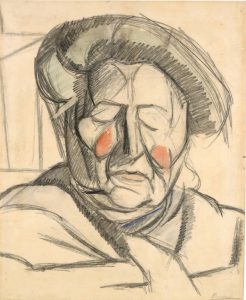
The two musuems, of Palazzo Reale (showcasing Boccioni) and the Museo Del Novecento, offered varying perspectives on the tumultuous time before and during the Futurists. The Boccioni museum gave an indepth account of his life, as a student and then master. Umberto Boccioni, one of the future signers of the Futurist Manifesto, was once a student of Impressionism. In this way, the museum walks viewers through his education, later rejection of this education, and to his new futuristic creations. A piece that struck me was, La madre dell artista (1913). This piece seemed to defy the oft violent nature of the Futurists, and instead depicted a motherly figure (specifically his). Although the lines of the sketch are brash, quick, and bold, the rosiness of her cheeks seem to soften both her face and the entirety of the sketch. It is a moment in which modernity to meets motherhood. One can also note his interest in Picasso’s work intertwined with his own (towards the end of his life) in this sketch..

At the Museao Del Novecento, one can see another female depicted with a Futurist twist in Bambina per Balcone by Giacomo Balla in 1912. The painting is a blur of blocks depicting his daughters motion across the floor. (Interestingly, Balla was a Divisionist teacher of Boccioni’s in 1902 and they later on they both signed the Futurist Manifsto in 1910.) This painting is not the study of a car, or horse, or train’s movement, but that of a little girl. Both pieces showcase a refreshing intervention of femininity into the Futurist movement.

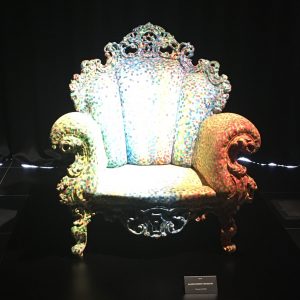

This week I wanted to concentrate on my visits to Museo del Design 1880-1980, and Bar Luce, which is part of Fondazione Prada. While visiting the Museo del Design, I was instantly drawn to Alessandro Mendini’s Poltroon di Proust. This chair was part of the “Made in Italy” movement after WWII. This time period was a “wide diffusion” of artistic experimentation and youth protest which created a new creative energy in Italian Design. Mendini’s “Proust” chair, became a series of redesigns in which Mendini took inspirations from structures and detail of past designs in furniture and design history. The actual structure of this chair was modeled from a Neo-Baroque style chair, and the exterior upholstery is hand-painted, using similar impasto brush strokes from the Impressionists. Mendini perfectly tied the ideas from specific art time periods to help create the radical design movement of post war in Italy.
A few days later I visited Bar Luce at Fondazione Prada. The exterior buildings of the Fondazione Prada is very minimal, and physically walking to the location feels like you are in the middle of nowhere in Milan, with the surrounding area being less developed and is much less populated. The closest comparison I can think of is the contemporary work of Donald Judd in Marfa Texas. At the Fondazione Prada is a bar and cafe called Bar Luce, which was designed by an American film (Raised in Houston) director Wes Anderson. The moment you walk in the bar, you have left the overwhelming feeling of vast contemporary art to a cafe that is modeled after post World War Two Milan. This was were I noticed the similarities of the design from Mendini’s work from the “Made in Italy Movement” and theme of combining old ideas with current times. Bar Luce has a vaulted ceiling, and the upper section of walls display architectural and decorative motifs from the Galleria Vittorio Emanuele. The interior design and furniture are modeled after classical cafe aesthetic from the 1950s to 1960s. The aesthetic and appearance is pushed in new ways creating this time warp that takes you back five decades. The color of the branding is light diner pink, and there are different hues of olive and army greens and yellows that make the pink branding pop. There is a giant record jukebox, several pinball style games that are still in the same appearance as the rest of bar. There are tables, and you can also walk up to the bar and get a quick coffee or drink standing, but also have the option to sit back and enjoy.
In summary I liked both views of the different interpretations of classical post WWII Milan.
My first week in Milan has come to a close, and I cannot believe it! We have done so much already, but there is still so much to do.
Milan is a beautiful city. Everything around me has some sort of history, compared to back home where buildings are still somewhat new, or at least from the last century. Everything is so much more compact here than in Texas. We are used to open spaces and being able to see for miles and miles, but here, looking out the window, all you see is more buildings. I guess it would be similar to living in a large city like New York as well. I am still getting used to such tight spaces. For example, the grocery store! I am used to a large superstore like HEB back home. But here, the store is about as big as my Austin apartment. It is like one long aisle that wraps around like a snake in this itty-bitty building. The stores still have the same type of food, just fewer options than we are used to. Also less junk food or processed food. It almost reminds me of shopping in a gas station store size-wise that is.
Milan also has a really well designed public transportation system. They have so many options! There are trams, trains, buses, and an underground metro! I think Austin could take a hint from Milan. The metro system is very easy to navigate. I understood how to get around on the subway in my first week! Now, that’s saying something, especially since I cannot read or speak Italian. We did have help the first few days, though. Compared to Milan, Austin’s public transportation system is lacking. We only have buses, that sometimes run on schedule, but usually not. We have a rail line, but only one, and it only connects the suburbs to the city center. The people of Milan know how to get around, in my opinion.
I think one of my favorite things about being in Milan so far is that the history just kind of pops up and surprises you. You don’t have to go looking for things because the city was built around the historical landmarks. Like the Duomo for example. Just sitting in the city center, is this massive cathedral! These buildings of importance are not built far from the center of the city like in the US. One reason is that they were usually the first landmarks of a city, rather than added on later. Another reason is that Italy is much smaller than the US and does not have room to space out things. But I love that I can be walking down a street and BAM! History is in my face.
Trains
Trains: are they a necessity or a nicety? Would it be easier to catch a cheap flight or take the drive? Trains were one of the first modes of transportation, so it makes sense that one of the oldest countries holds fast to traditional ways of travel. Trains are especially important to those trying to travel within Italy. Not only is the view spectacular, but many trains travel rather quickly. For example, a train from Milan to Venice is only a two and a half hour ride and around 120 euros.
Great price, great time, and great view.
Metro
Much like every major city, public transportation in Milan is essential. The metro with its multicolored tracks and easily navigable stations remind one of the monotone and hectic station New York City.
After only living in Italy for a short week, the metro has actually become one of my favorite modes of transport. It is easy to use thanks to our metro cards, convenient due to the many stops and stations, and fast moving – transporting both civilians and businessmen alike on a daily basis. Not to mention, it too is a fairly inexpensive way to travel the city.
Tram
I have never ridden a tram before this trip; however after the initial jolt of unease while boarding, i realized it is essentially no different than the bus system. Just know your stop. And take a buddy. Or two.
Buses
Speaking of above ground transportation, the buses are possibly the most confusing of them all. The names of the stops are in small print or not visible at all to the rider. Also, the view of the beautiful city is so awe-inspiring that you can become very distracted and miss your stop completely. Unfortunately, that has happened more than once in the span of three days.
Unlike the buses in Austin, the bus schedule and numbers are fewer and farther in between. Despite having a full month to understand this foreign system, i will most likely stick to the metro.
Taxis/Cars
Finally, the streets of Italy are winding and highly confusing especially to a foreigner like myself. Taxis and other vehicles pull up and even park on the sidewalk; they also drive in insane circular turnabouts all across the city. Although driving in the city may give me a panic attack, Italian drivers and natives are surprisingly calm and cautious. From squeezing between trucks to parking on the sidewalk, cars in Italy have a unique sense of driving that is brand new to me.

Americans wouldn’t be able to handle this.
With so many ways to get around the city, your best bet is to find what is most comfortable, whether it’s by bus, metro, or your own two feet. For now, I will stick to walking to the metro station.
