Category: 2019

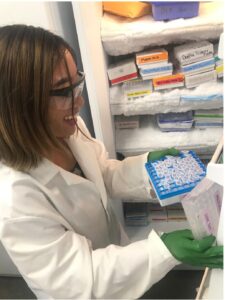
  • “I know that I made the right decision every day that I go into lab and get to do something I am passionate about! “
    Before we start to talk about DIY, I think it is beneficial to take a little time to talk about my initial experience with FRI all together. Like all other freshman I had heard about the freshman research initiative through emails and friends who were thinking about applying for it. I had never been that interested in regular lab research. It also helps to mention that I am very introverted. I am in no way the outgoing type, so the entire idea of FRI was intimidating. That is specifically why I didn’t apply for this program. After the deadline to apply for FRI pasted, I thought nothing about it again until my second day of orientation. This is when I started talking to my TIP scholar advisor about classes. Out of nowhere she asks me if I am doing FRI and of course right away I say no because I didn’t apply. She then proceeds to say that on my record it says that I am. By that point I am extremely confused. She tells me that even though I didn’t apply that I can still be a part of it if I would like to. Of course, she reassured me of all the benefits that came along with being in FRI. I weighed the pros and cons. I knew it would be a waste to throw away such a great opportunity just because I am shy and afraid that I won’t be smart enough to do it. I had to remind myself that if I wasn’t smart enough, I wouldn’t be at UT. In the end I decided to partake in FRI, and it is one of the best decisions I have made in my life.

          If I had not been a part of FRI, I would not be in DIY Diagnostics and that would have changed my life greatly. First off, I am going to be completely honest. I chose DIY Diagnostics because it was one of the more popular streams that was the most interesting. I had heard great things about it, and I knew so many people wanted to get into it. I didn’t even get a chance to visit the lab before deciding which stream I wanted to be in but none of the other labs really sold me. This led me to put DIY as my top choice for streams. I never thought that I would ever get my first choice, but I did. Once I actually got into the lab, I felt so overwhelmed because I didn’t know anything, but the mentors were extremely helpful. I even made friends by the fact that we both felt lost at times. Combining with others though really made the lab less intimidating. I have learned so much from DIY. Whenever I would bring up coding for an app to my friends, they would think it was so cool that I was able to even do that. The 3D printing we did was also so awesome. I was so excited about my print that I would always show people. The number of new things I have learned and done in DIY is extraordinary. 

          I am now in my second semester of DIY, and I am working on my own project. For this project I have chosen to make an at home strep throat test that is more accurate and much faster. My career goal is to become a Pediatrician and this project helps children and parents. The majority of those affected from strep are of a younger age. This diagnostic tool would cut out deciding whether or not to take a trip to the doctor. It would also save time and money. I am just in the beginning parts of my project, but I hope in the end we are able to create an effective diagnostics tool. DIY diagnostics is really the lab to be in. You get so much out of the lab each semester. I know that I made the right decision every day that I go into lab and get to do something I am passionate about! 
  • “I have learned so many great things in DIY, a lot of it which aligned with Chemistry and Biology helping me succeed in my pre-med classes at UT.”

    When I was accepted into the Freshman Research Initiative I was so excited and ready for the coming challenges. I went to the stream fair and I was thoroughly impressed with all the diverse streams, but it was no secret that DIY Diagnostics was a hot commodity. I thought to myself “would I even get accepted into such a sought after stream?” I was so excited the day I got the email saying I was accepted into the stream. I expected this stream to be heavy in individual work hence the name ‘DIY’, but I was so wrong. Even though the work was overall individual and your own, there was never an assignment I didn’t collaborate with other DIYers on. I learned that teamwork is what this stream strives for and that communication is key. In DIY Diagnostics I never grew bored because every week I was presented a new problem I had to navigate through. This is the perfect stream for all of the curious minds in the world.

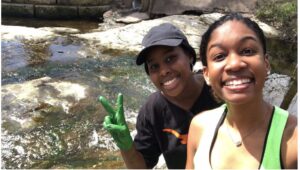
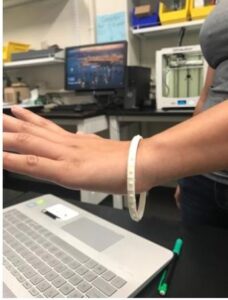
    From studying staphylococcus in Waller Creek water, waiting for incubating mEI and mTEC plates, aliquoting every liquid in the world, using the centrifuge, coding several amazing apps, and using the 3D printer to print my own  jewelry, DIY can really do it all. It makes me proud telling my family that I know how to code in HTML, although it wasn’t the easiest task to learn it’s a nice slight flex to carry around with you. I learned so many great things in DIY, a lot of it which aligned with Chemistry and Biology helping me succeed in my pre-med classes at UT.

    The best thing that I had encountered during this lab was being able to work along with my friends and mentors. Not only do I learn from them, but our collaborative space allows us all to absorb new information. The research done in this lab really changed my perspective on research. Research expands past general chemistry and almost anything can be diagnosed. Even though I love this stream it was through DIY that I learned I do not particularly want to do research full time. I think my favorite memory was using a long contraption in a skill development where my partner Amanda and I had to plate mTEC and mEI plates and after finishing the first batch we realized we had to redo the entire process because apparently breathing/speaking near the plates makes the bacteria on them inaccurate. I think my experience was a lot more fun and enjoyable than other undergrads. The DIY stream has something that others do not, a chance to figure who you really are through the frustration and success. So I will always recommend DIY Diagnosis as the stream to be, what starts here changes the world…what starts in DIY changes the world!

  • “The lab is a collaborative atmosphere that encourages the sharing of ideas and the collective improvement of everybody involved.”

    DIY Diagnostics ignited a spark in me that no other stream ever came close to fulfilling. As soon as I learned what the lab was all about, I knew it was something that I wanted to be a part of. I’m currently studying public health for my undergraduate degree and it was so exciting to find a stream that embodies everything that interests me. 


    This stream is special in that we learn so many techniques⁠ that can be applied to a number of fields of interest— wet lab, computer science, 3-D printing, and an integration of these disciplines. Because DIY Diagnostics does not put any constraints on our research, I get to move in a direction towards creating a diagnostic that can be impactful for developing countries. My philosophy is that if I, an undergrad with about one semester of research experience thus far, can create a diagnostic based on everything I have learned, it will turn out to be simple and affordable. In doing so, the end product will be something accessible to just about anybody. 


    I’m not going to lie, tears were shed. My first day of lab was mortifying. I felt like I was thrown into the deep end, and my mind went completely blank. But hey, that left my mind completely open. I got to truly absorb every experience throughout the semester and now I’m able to write about it. In fact, that was the very first lesson that I learned: write. everything. down. I vividly remember working with the pH meter, following the procedure to the best of my ability, and scribbling down the data on some scratch paper. My intention was to write it all down in my lab notebook in a much neater fashion, but that’s where I went wrong. I got scolded and then, of course, proceeded to cry. As it turns out, not only do you have to record everything that happens, but it has to all be in the right place. 


    This was just the start! Since then, being a part of this stream has changed my work ethic. There simply isn’t enough time to be a perfectionist for matters like this. I no longer worry about fine-tuning the way that my notebook looks or spending my time on other trivial things that can be done more simply and efficiently than I make them out to be. Of course, it is important to stay organized, but the content should speak for itself. Now, I invest all of that effort into actually performing conducting the investigations and running the experiments. This shift in prioritization has made a huge difference in my productivity and the quality of my data collection. Science is messy and mistakes are inevitable. I understood this coming into this stream, but I didn’t realize the gravity of it until actually taking part in the research. So much can go wrong, and I know that feeling all too well now. All I can do from there is accept the errors of my ways and use it to my advantage when I give it another try. 


    DIY Diagnostics changed how I viewed research as a whole. I know that the stream is called Do-It-Yourself, but it’s quite the contrary. The lab is a collaborative atmosphere that encourages the sharing of ideas and the collective improvement of everybody involved. I never had experience in research before, and of course I was eager to take on this opportunity, but I definitely wasn’t expecting this.