

We just published a study in Ecology and Evolution, led by former postdoc Liming Cai, now at the University of Florida, examining mitochondrial respiration and mitochdonrial gene content in a family of parasitic plants, Orobanchaceae. This family has been a great model in Liming’s research because it contains closely related free-living, hemiparasitic (like the cancer roots pictured above), and holoparasitic species (including some independent origins of holoparasitism).
Here, Liming took a look at the nuclear-encoded genes targeted to the mitochdonria (N-mt) genes, which are often ignored in similar studies on parasitic plants. Although the parasitic species had a complete component of genes encoded in their mitochondrial genomes (coming out soon in a companion paper), there was one parasitic group that lost a significant number of N-mt genes, especially in Complex I. See the left hand columns in Fig. 1 of the paper:

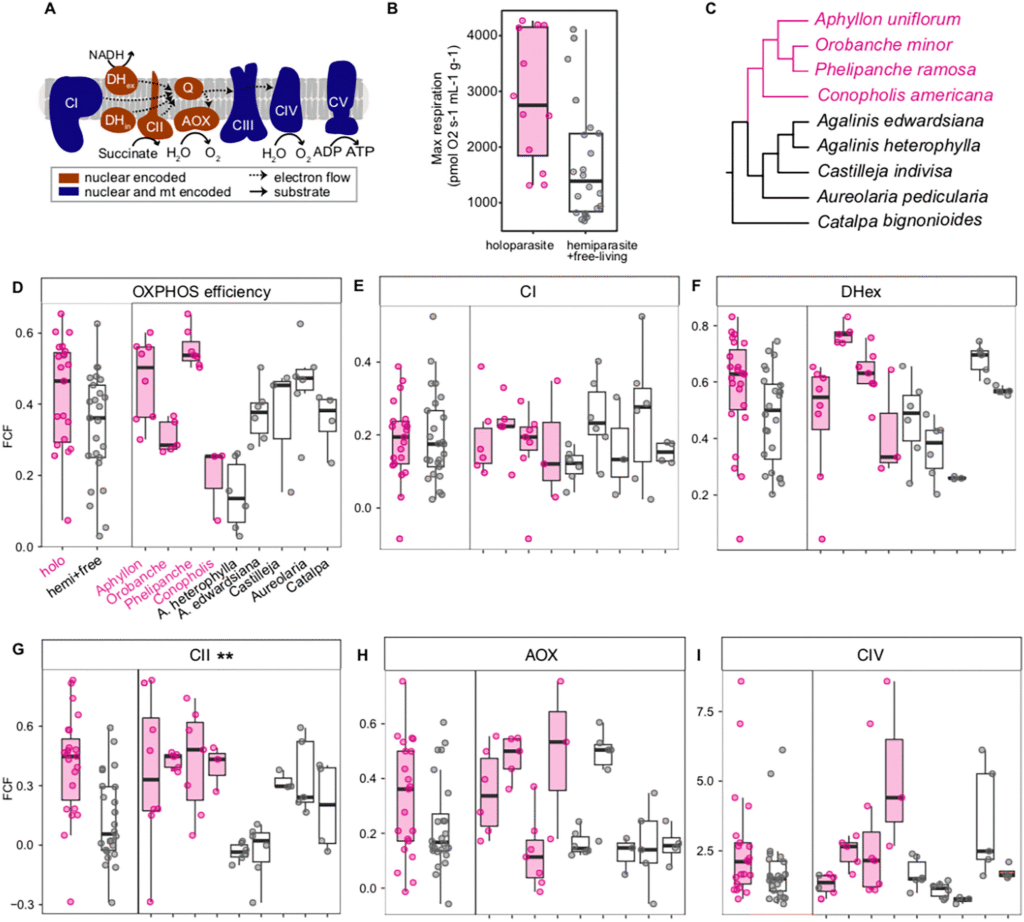
Despite this, we found that even these parasitic plants with unusual N-mt gene loss maintained proper mitochondrial respiration. Things like maximum respiration and Complex I driven respiration were similar between these parasitic species and non-parasitic relatives, although there was a lot of variation. However, there was a trend for parasitic species to rely more on OXPHOS complexes that were made up of entirely nuclear-encoded proteins – CII, AOX, and alternative NADHs. This was only statistically significant for CII, but we think it might indicate some shift in mitochondrial function in parasitic plants.
Check out the respiration data in Fig. 2 from the paper here:
See the paper for more of our thoughts, but this adds to a complex body of literature that’s emerging on parasitic plants and mitochondrial evolution/function. Some parasitic species seem to have drastic changes in their mtDNA-encoded proteins, others are fairly normal. Some have lost Complex I completely, others still have a fully-functional version. This is in contrast to the plastid genome, which is almost universally degraded across parasitic plants.
By taking a look at the N-mt genes in this interesting family, Liming has provided a new avenue for examining these awesome, weird plants.
Stay tuned to her for more research on parasitic plants and mitochdonria!