Seed sovereignty, resilience, and regeneration through ancestral and place-based knowledge in Lebanon.
By Karen Sarkis
Introduction
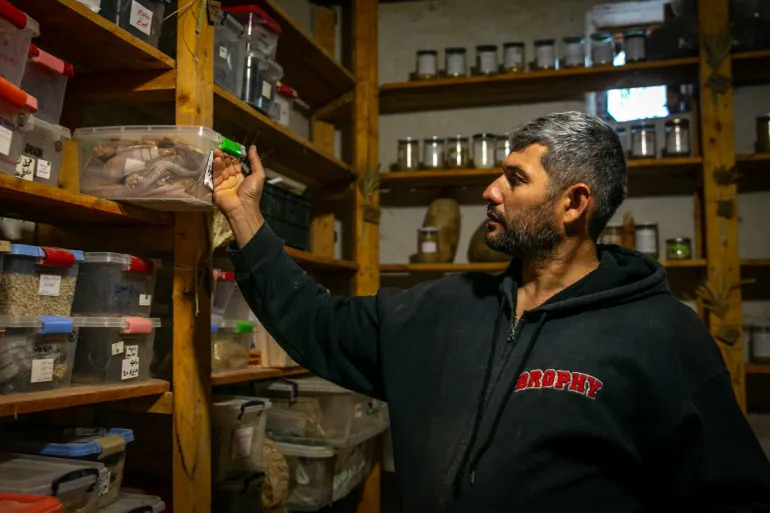
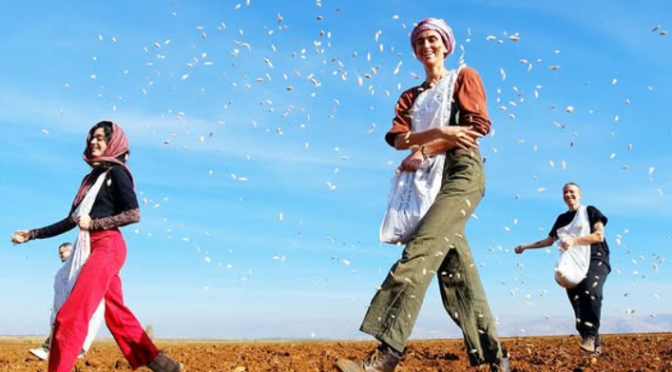
Buzuruna Juzuruna (Our Seeds are Our Roots) is a community-based agroecology and seed sovereignty initiative located in Saadnayel in Lebanon’s Beqaa Valley, an area with a long agricultural history and a large population of Syrian refugees. Founded in 2016, Buzuruna Juzuruna operates an organic seed farm, an heirloom seed library of more than 300 varieties, and a farm-school that offers free workshops on soil health, seed cultivation, composting, and other agroecological practices. The association brings together a diverse group, including Lebanese and Syrian farmers, women, local families, volunteers, and program organizers, who work together in a horizontal structure, each valuing the knowledge the other brings.
Buzuruna Juzuruna emerged as a response to Lebanon’s dependency on imported seeds and food following years of war, political instability, and economic collapse. Hybrid seeds controlled by global agribusiness companies are often expensive and require chemical inputs while decades of upheaval have eroded generational agricultural knowledge. Buzuruna Juzuruna offers an alternative by preserving locally adapted heirloom seeds and building decentralized seed networks that foster food sovereignty, thus legitimizing generational wisdom and agroecology as a valid alternative to current dominant forms of knowledge and agricultural practices. This shift from an industrial to a community-based agroecological model is a significant challenge to development as a discourse that reproduces dominant forms of power, knowledge, and subjectivities (Escobar, 1995). Giving communities control over seeds shifts power from corporate industrial agriculture to local farmers, which in turn leads farmers to shift their self-perception to “seed guardians” and experts in their own right.
Analysis
By providing communities with the tools needed to maintain resilient food systems, Buzuruna Juzuruna can be conceptualized as an alternative development framework that draws inspiration from the Indigenous concept of Buen Vivir. As articulated by Gudynas (2011), Buen Vivir offers an alternative vision of well-being rooted in interdependence among humans, land, seeds, and nature. Instead of prioritizing output or efficiency, Buen Vivir emphasizes diversity, ecological balance, cultural continuity, and long-term stewardship. Buzuruna Juzuruna embodies these principles through its intentionally horizontal structure, where volunteers, farmers, and organizers share decision-making based on expertise rather than hierarchy. This aligns with Buen Vivir’s advocacy for governance rooted in community reciprocity rather than institutional authority.
Additionally, Buzuruna Juzuruna reflects Buen Vivir’s emphasis on ecological and intergenerational time, acknowledging that seeds and soil health need time to develop. Rather than crisis-driven recovery, Buzuruna Juzuruna adopts a long-term regeneration framework that contrasts with the fast-paced, project-oriented focus of traditional development. Furthermore, Buen Vivir promotes diverse sources of value: nutritional, cultural, and ecological. Buzuruna Juzuruna exemplifies this by selecting seeds not solely for yield but also for taste, cultural significance, and generational continuity. This approach reflects a value system distinct from industrial agriculture, making Buzuruna Juzuruna a practical application of Buen Vivir in Lebanon tailored to local ecological and cultural contexts.
By promoting a narrative that legitimizes ancestral, ecological, and context-specific agricultural knowledge, Buzuruna Juzuruna exemplifies a form of memory-based planning. As Hernandez (2019) shows, communities often construct a sense of home through storytelling, memory, and shared histories, especially in contexts marked by displacement or instability. In Buzuruna Juzuruna, heirloom seeds perform this same placemaking function, carrying the stories, flavors, and histories that connect communities to their land. Saving and circulating these seeds becomes a form of memory-based planning that reconnects communities to place as knowledge is passed down from elders to youth and from farmer to farmer. This cultural transmission through seeds challenges what Miraftab (2009) refers to as neoliberal “social amnesia,” where modernization diminishes ecological relationships and ancestral agricultural wisdom.
Implications
The case of Buzuruna Juzuruna has several implications for the struggle for food and seed sovereignty. La Via Campesina (2010) frames autonomy over seeds and food systems as a political right. Food sovereignty emphasizes community control over agricultural resources, suitable crops, farmer-to-farmer learning, and ecological farming to reduce dependency on global agribusiness (Altieri & Toledo, 2011). Buzuruna Juzuruna ensures that seeds remain accessible, reproducible, and under community control, emphasizing the right of communities to shape their own food systems. Farmer-to-farmer knowledge-sharing strengthens this autonomy, allowing skills and practices to circulate independently of formal institutions. This demonstrates how supporting community learning networks and decentralized resource governance are essential elements of critical planning efforts.
Second, this case highlights the value of alternative, community-grounded approaches in unstable contexts. By preserving heirloom seeds and ecological farming methods, Buzuruna Juzurna leads with ancestral and place-based knowledge to support resiliency efforts. Buzuruna Juzuruna shows how communities draw on long-standing relationships with land and cultivation practices to create stability where formal institutions are unreliable. This suggests that planning efforts in crisis scenarios would benefit from turning to local knowledge not just as a supplement to expert input, but as a core planning resource, while incorporating deeper forms of continuity, patience, and ecological care necessary for meaningful, long-term resilience.
Finally, Buzuruna Juzuruna challenges efficiency-driven development models by showing how diversity, patience, and continuity can be assets rather than obstacles. As Sletto et al. (2025) suggest, the process of decolonizing planning involves questioning who dictates concepts like “efficiency,” “progress,” and “improvement” in intervention strategies. Buzuruna Juzuruna prioritizes an ethos of regeneration over development, cultural continuity over standardization, and shared governance over hierarchy. These principles offer planners a way of thinking that moves beyond conventional development frameworks toward more grounded, relational, and community-defined futures. Buzuruna Juzuruna’s work suggests that meaningful resilience doesn’t stop at recovery but expands to the revival of ecological relationships, cultural memory, and collective capacity.
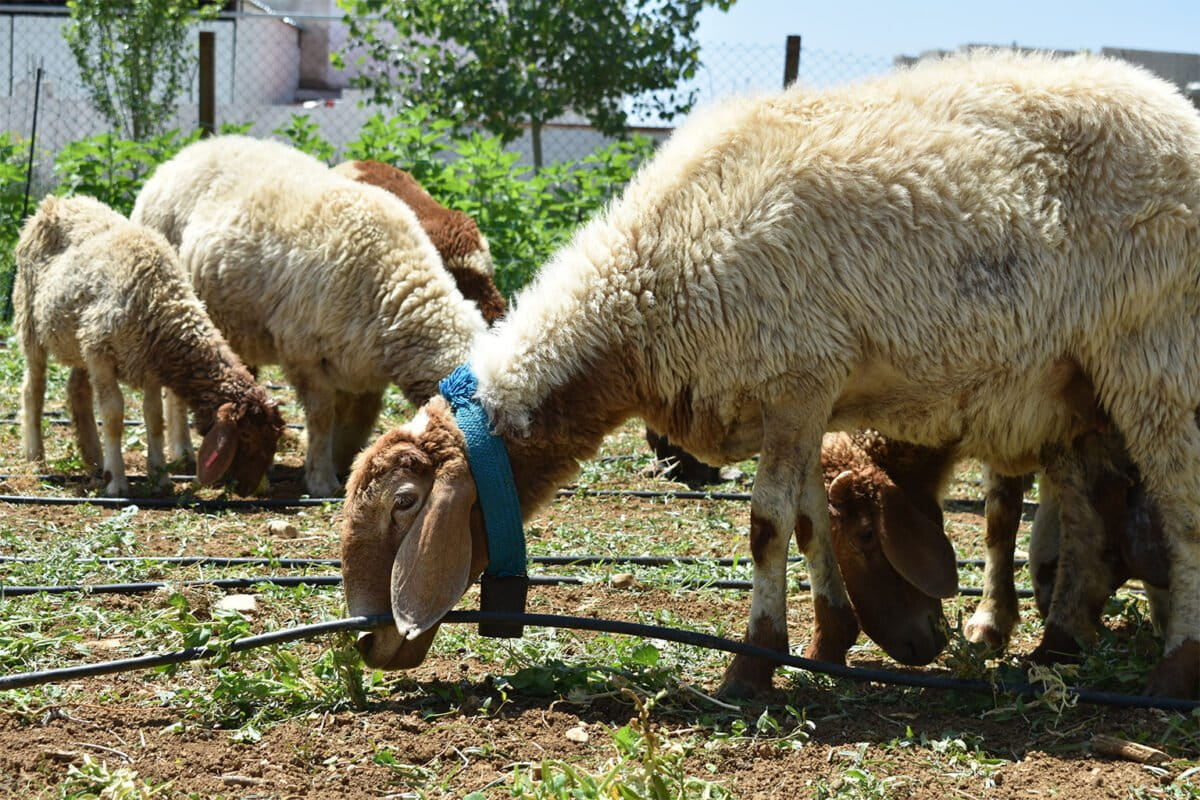
Source: Buzuruna Juzuruna has sheep colleagues who help maintain and prepare the soil for a new batch of seeds to be planted by adding manure to the fields.
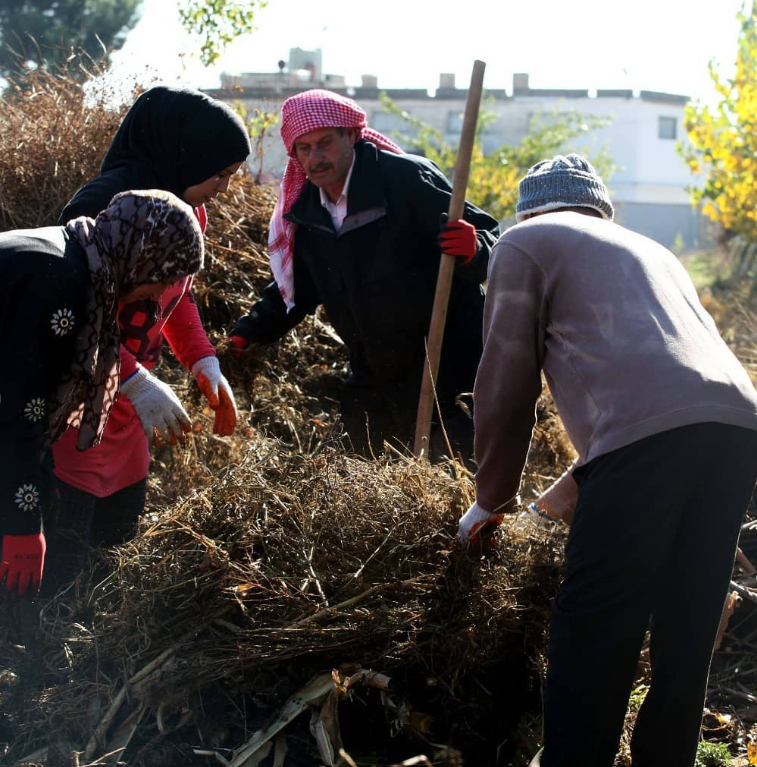
Source: Training to help farrmers and gardeners adopt agroecology techniques