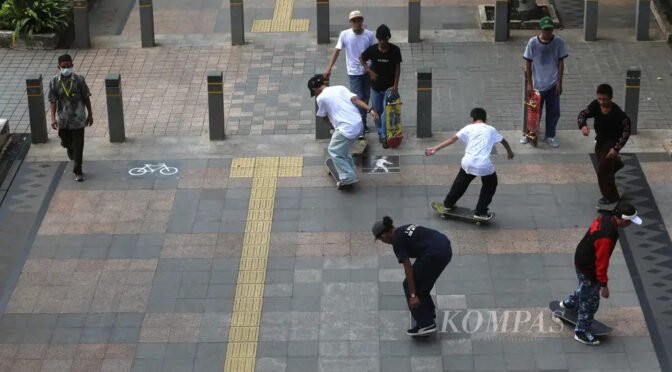
Skateboarding as insurgent citizenship that challenges hegemonic structures in Jakarta, Indonesia
By Brooke Frierson
Introduction
The skateboarding subculture in Jakarta actively challenges the hegemonic construction of a democratic, modern, and orderly image of the global city. This construction of a “modern” and “ordered” city justifies ongoing pathologizing of the urban poor through the clearing of kampungs (villages) and construction of gray infrastructure to portray Jakarta as a modern metropolis (Dovey et al, 2019; Kamete, 2012; Wardhana & Ellisa, 2024). Resistance to the image of the global city emerges through everyday movements of youth skateboarders in Jakarta as they quietly appropriate the urban fabric (Bayat, 2009). By “transforming an environment for unintended purposes” (Cloke et al., 2008), the networks of skaters in Jakarta function as “social infrastructure” Simone (2004) adapted to the complexities of the megacity while challenging state regulation and transgressing social boundaries. The deployment of spatializing practices in youth skateboarders in Jakarta is composed by ongoing efforts to mediate the city as problem-space through movement in public space (Ong & Roy, 2011). By rearranging the urban environment with their boards and bodies in interstitial spaces such as road medians (Wardhana & Ellisa, 2024) skateboarders resist the aesthetic governmentality of a worlding city (Ony & Roy, 2011).
Analysis
Drawing on de Certeau (1984), Friedmann (2010) suggests place can be understood as a transformative event that is open and altered by the performance of its users (Friedmann, 2010). In that sense, the urban fabric in Jakarta is in continuous transformation, contested by skateboarders through their performances, its surfaces becoming a means to challenge the bounding and ordering inherent to neoliberal ideologies. Skateboarders act ‘defiantly’ against the state by taking a railing made for a particular act such as assisting its user and turning it into an object of performance and play. Modification of place in this way is critical to urban social life, creating a performance for others to observe the “deviant” placemaking of interstitial spaces. Such insurgent and informal practices in liminal spaces challenge neoliberal systems that prioritize profit rather than belonging and community, affirming the identity of place through small and ordinary acts and through daily encounters.
The transformation of interstitial spaces occurs with the use of spatial tactics: appealing to empathy, gradual encroachment, and through positive discourse (Geertman, 2016). These small movements are what Bayat refers to as ‘low politics’ or ‘politics of fun’, characterized by non-movements by people who are informally operating without ideology and structure (Geertman, 2016). For example, when skaters in Jakarta use railings and road barriers contrary to their intended usage, they resist the notion that such acts constitute vandalism. In Jakarta, Ma, a participant in Wardhana and Ellisa’s (2024) study, state they perform their tricks when fewer people are around and stop when pedestrians are nearby. The spatial tactics of appealing to empathy and the gradual encroachment of the ordinary are thus deployed in this circumstance. Pausing and waiting to avoid collision and conflict with pedestrians appeals to the empathy of other users of the space. Ultimately, such empathy coupled with their everyday movements can trigger gradual sociopolitical change through the small and quiet encroachment of the ordinary (Geertman, 2016).
Implications
The art of skateboarding as insurgent citizenship in Jakarta situates the worlding city in movement and play, bringing to light the necessity of insurgent practices in a state seeking to suppress them. Skateboarding as insurgent citizenship is not only present in Jakarta but occurs around the world in interstitial spaces of urban life (Holston,1996). These quiet and ordinary movements embody alternative futures that transgress for-profit capitalist structures and trigger gradual sociopolitical change. Skateboarding thus becomes a means of disrupting order and challenging assumptions of what actions are acceptable and unacceptable. Furthermore, skateboarding illuminates how the body is key to remaking urban geographies, transforming processes of place-making as fluid realities ever-present in daily life.
This case offers important perspectives as to who and what we consider the proper agents of critical international planning, demonstrating that urban space is a social product of groups operating without formal structure. In so doing, the case sheds light on the small, invisible, and quiet movements that challenge neoliberal constructions of the urban environment while illuminating the performative dimension of space. More broadly, it is imperative to consider the role of resistance movements in worlding processes. Worlding is inherently creative and imaginative process, and the forms of a ‘worlding’ city already exists in ordinary life (Ong & Roy, 2011). It is important we do not pathologize acts of informality and insurgency but accept them as crucial to placemaking and meaning making.
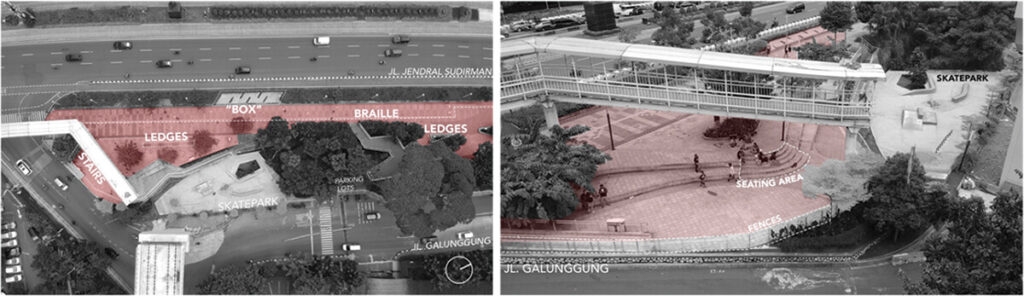
Source: Urban elements used by skateboarders on Sudirman Street, Jakarta, Indonesia, 2022
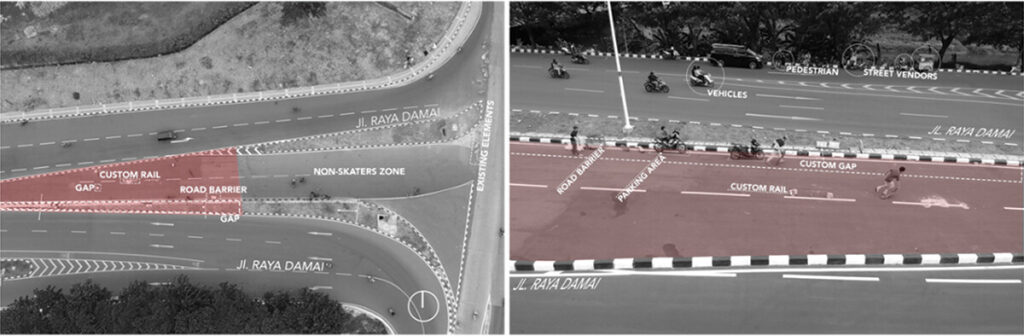
Source: Median used by skateboarders along JL Raya Damai in Jakarta, Indonesia, 2022
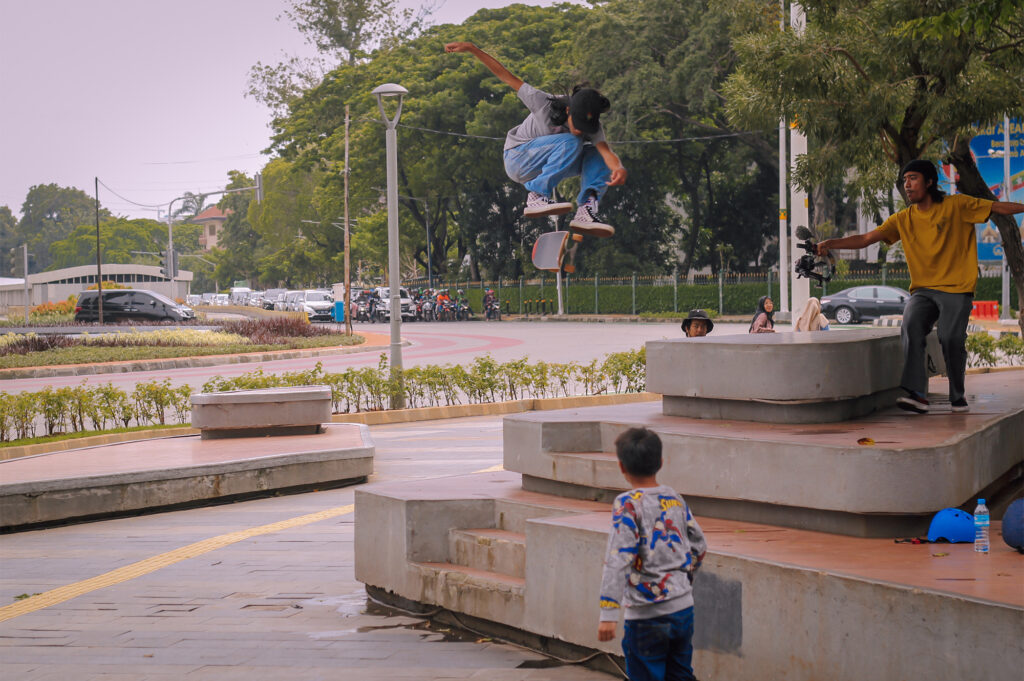
Source: Rubi local skateboarder in Jakarta, Indonesia. Photo by btx, 2021