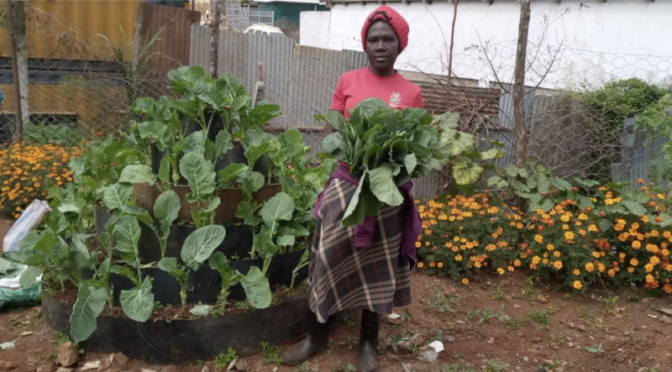
Vertical gardening in Kibera localizes food systems and promotes climate resilience
By Piper Gilley
Introduction
As cities in the Global South continue to develop, modernization favors business developments at the detriment of green spaces that serve environmental and community needs. In particular, rapid urbanization strains the already delicate food systems in informal settlements, making food expensive, inaccessible, or unavailable. The polluted natural environments in informal settlements also impact the quality of food being grown and makes it dangerous for consumption. In Kibera, Nairobi, an informal settlement in Kenya, around 85% of residents experience food insecurity because of limited access to resources and dependence on store-bought food (Otieno, 2025).
However, residents of Kibera are now challenging the colonial impositions of modernization by reclaiming land and utilizing it in ways that best serve the communities’ needs, including for urban agriculture. Grassroot efforts have led to the emergence of NGOs and community-based organizations (CBOs) dedicated to supporting urban farming development. While the challenge of limited and possibly contaminated natural resources is present, urban farming allows the residents of Kibera to grow their own food. While they currently spend more than half of their income on food, the growing urban agriculture in the community offers opportunities to generate income from selling produce at markets or to other members of the community.
Beyond food production, protecting green spaces and encouraging urban farming can be a form of placemaking that revitalizes neglected lands and communities. These places serve as a way for communities to reclaim control of the land while also connecting residents in different communities as they tend to the land, potentially leading to extended networks for food security. Often, modern developments lead to the homogenization of communities while deepening inequalities and diminishing social agency (Bayat & Biekart, 2009). In the face of such homogenization through modern development, recovering small spaces from global forces that prioritize profits can be a radical practice that re-centers community needs (Friedmann, 2010).
Analysis
After the COVID-19 pandemic, concerns arose of long-term and short-term impacts on food access and availability in informal settlements (Nelle et al, 2020). The cost and availability of food greatly fluctuate based on environmental factors and political or economic volatility (Battersby & Watson, 2018). To address these vulnerabilities, residents of informal settlements around Nairobi began urban farming to supply their families and neighbors. This has been a community effort, but women play a particularly important role in maintaining the gardens and building resilient food systems (Otieno, 2025). These efforts to build resilient food systems contribute to creating strong communities that support their neighbors. As one resident in the Kibera community shares: “some people come here and borrow us vegetables, but they do not pay and we understand them” (Otieno, 2025). These localized food systems can provide an extra source of income for some families, but they also sustain life when resources are strained.
While the benefits of urban farming and vertical gardens are great, there are threats to the sustainability of these projects. One of the greatest barriers to farming is land access, because many people do not own the land they live on or garden on, leaving them vulnerable to eviction (Otieno, 2025). There are also environmental challenges such as flooding, drought, and resource contamination from industrial waste. However, there are other urban farming projects in other informal settlements around Nairobi, including Mathare and Mukuru, with other strengths (Otieno, 2025). With each community adapting in different ways, there is a possibility for collaboration and sharing knowledge between these settlements.
Implications
While urban farming in the informal settlements of Nairobi has its challenges, there is a great opportunity to address vulnerabilities in food access while promoting a greater sense of community connection. Localized food systems are built upon the intimate and shared knowledge communities have about their land and culture. Urban agriculture creates economic opportunities for families and is a form of sharing within the community.
The community strength that arises from these projects’ challenges colonial and capitalist ideas of what is important in urban spaces. Rather than prioritizing profits, urban greening and urban agriculture are ways of restoring the balance between urban spaces and Nature while serving community interests. The way communities tend to the land and share their harvests restores “balance between material and spiritual components, which is only possible in the specific context of community” (Gudynas, 2011).
Caring for the land that sustains life fosters emotional connections between communities and in communion with Nature. In these ways, urban gardening is a form of placemaking. While the land may be contaminated or damaged, residents of Kibera continue to care for the space and create meaning. The gardens provide space for “‘gathering, centering and linking’” (Friedmann, 2010), so the community can work together to care for the land and survive. Knowing that the neighborhood faces challenges of contamination and resource scarcity, the neighborhood members “continue to rebuild and strengthen” (Hernandez, 2019) the place they live as a way of survival and mutual care for the community and environment.
As community members care for the land and claim their space in the neighborhood using urban gardening practices, the gardens contribute to a form of healing. Sandercock coined the term ‘therapeutic planning’ to refer to planning practices that create “a dialogic space…for the unspeakable, for talk of fear and loathing as well as hope and transformation” (Sandercock, 2014). While urban farming practices may not create one defined space for hard conversations, they invite conversations to reimagine the future of urban spaces and food systems. In these ways, urban farming is a therapeutic process of revitalizing the land and strengthening community connections by providing for one another through hardship. Gardening is a way for the land and people to heal and offers hope for a new way to imagine urban spaces that value Nature as a sacred part of society.
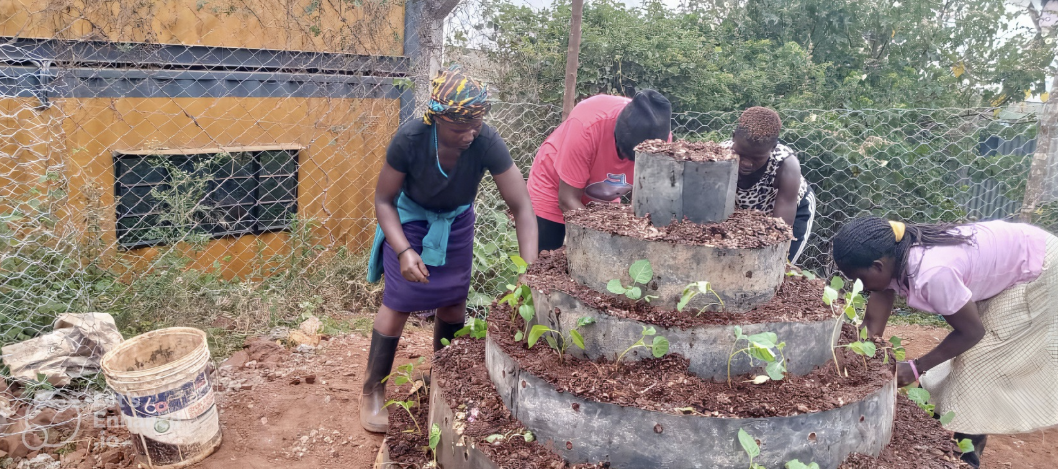
Source: One of the vertical farming structures used by the community (Otieno et al., 2025)
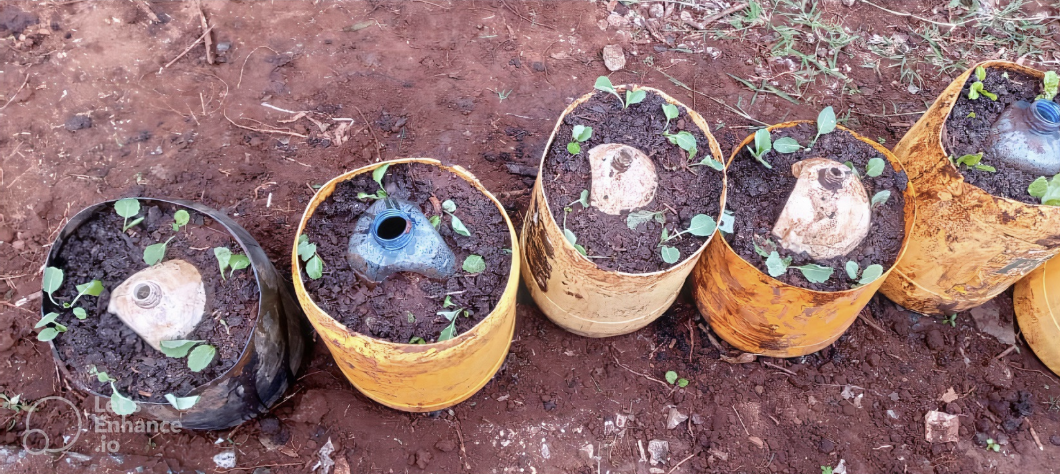
Source: Repurposing recyclable materials for gardening. (Otieno et al., 2025)