

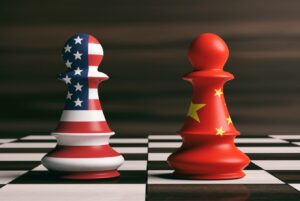
Nuclear fusion is quickly becoming one of the most consequential technological frontiers of the 21st century. Long imagined as the holy grail of clean, limitless energy, fusion is no longer science fiction. It’s an emerging global competition- and increasingly, a geopolitical flashpoint between the United States and China.
Both nations are pouring billions into fusion development, driven by the promise of carbon-free power and the potential to transform economic and security landscapes. But as China progresses ahead, fusion is being absorbed into a broader narrative of US-China rivalry. Without a plan to balance competition with cooperation, the race for fusion could slide into the kind of zero-sum thinking that once defined the Cold War.
And that would be a mistake.
How We Got Here: A Race with Delays, Risks, and Missed Opportunities
China entered the fusion arena in the early 2000s- decades after the US – by joining the massive International Thermonuclear Experimental Reactor project in France, along with more than 30 countries. Today, ITER is the centerpiece of multilateral fusion research. But the initiative faces staggering delays, with operations now projected for 2034, almost a decade behind schedule.
Fusion timelines are slipping at the precise moment when global electricity demand is skyrocketing, largely due to energy-hungry artificial intelligence systems. With China investing roughly $1.5 billion per year into fusion, nearly twice US federal levels, the US risks losing momentum.
That’s why strengthening bilateral US-China collaboration is more important than ever. Cooperation can help recover lost time, stabilize a strained relationship, and keep fusion progress aligned with global rather than partisan goals.
A History of Collaboration Now at Risk
For over 45 years, the US and China have collaborated productively on scientific research. Joint projects in public health, agriculture, energy, and disease prevention have generated breakthroughs that benefited the world. Under the US-China Science and Technology Agreement, research teams for decades have shared data while protecting intellectual property.
But since 2018, cooperation between the two has declined sharply. New restrictions, geopolitical tensions, and investigations have reduced scientific output in areas like superconductors, nanomaterials, and quantum dots. What’s worse, these lost Chinese partnerships haven’t been replaced elsewhere.
If the US wants to lead global science, it cannot do so while cutting itself off from one of the world’s top producers of STEM talent and research.
Yes, Security Risks Exist-but Fusion Isn’t Necessarily a Weapons Program
Concerns about China’s history of technology theft or military espionage aren’t unfounded. Beijing has stolen sensitive US military secrets, including aircraft designs. These realities demand strong national security safeguards.
But fusion is different.
Unlike missile systems or weapons technology, fusion research is for the benefit of all civilians.
Fusion technology operates with open data norms, extensive international oversight, and high transparency. It is monitored by multilateral organizations and published in open scientific literature. While any technology could theoretically be weaponized, fusion is one of the least feasible candidates.
In fact, treating fusion like defense technology could increase global risk. If both countries pursue fusion entirely behind closed doors, mistrust will grow – and scientific progress will slow.
The smarter strategy? Managed competition.
A Dual-Track Plan: Compete Where Necessary, Cooperate Where Possible
The United States doesn’t have to choose between protecting national security and advancing fusion research. It can do both.
A dual-track approach would involve:
- A bilateral US-China fusion treaty
This framework would outline where cooperation is encouraged, where it is restricted, and how information is shared. It would mirror agreements that already exist in other scientific fields.
- Firm safeguards around sensitive technology
Clear boundaries ensure that military-relevant innovations remain protected.
- Confidence-building measures
Joint workshops, personnel exchanges, and collaborative projects in non-sensitive areas can reduce mistrust and build scientific transparency.
Why This Matters Now
Fusion is not just another technological competition. It’s a potential turning point in global energy, climate security, and long-term economic power. If the US and China treat fusion purely as a race, both could lose decades of progress, and the world could lose a desperately needed clean-energy solution.
By embracing managed competition, the United States can:
- accelerate fusion breakthroughs
- strengthen global leadership in science
- prevent fusion from becoming a geopolitical flashpoint
- create stability in one of the world’s most consequential bilateral relationships
Fusion doesn’t have to become the next battleground in US-China rivalry. With the right strategy, it can become a rare opportunity for shared progress in an era defined by tension.