
by Nikita Beloborodov
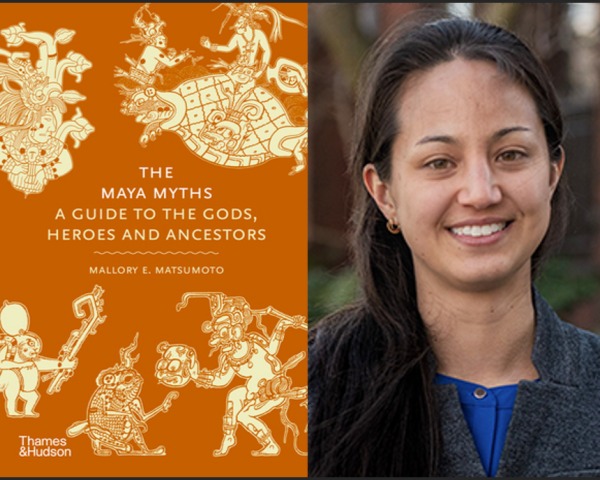
On February 12, 2026, Dr. Mallory E. Matsumoto, Assistant Professor in the Department of Religious Studies, gave a talk about her recently published book, The Maya Myths: A Guide to the Gods, Heroes, and Ancestors (2025, Thames & Hudson), a work that is part of the Thames & Hudson series exploring world myths. The event was organized by the Program in Native American and Indigenous Studies (NAIS) at The University of Texas at Austin and welcomed faculty and students from different departments within the university.
In her talk, Matsumoto focused on the two deceptively simple terms that comprise the title: “Myths” and “Maya.” She highlighted that, although myth is often conceptualized in opposition to history, myths and history do not appear to be as separated in Maya traditions. The concept of “mythohistory” is thus more applicable for the type of narratives the book engages. The term “Maya” is a convenient umbrella label that may become confusing when it comes to tracing the stories so closely related to notions of origins, identity, and community. There are around three dozen Mayan languages, most of which are not mutually intelligible. Maya groups throughout Guatemala, southern Mexico, Belize, Honduras, and El Salvador share significant cultural similarities, yet many local traditions are quite distinct from one another. Besides this linguistic and cultural diversity, the timeline of the Maya is itself a complex and non-linear story, starting as early as the first millennium BCE, continuing with the Classic period of the first millennium CE with its wars, dynastic alliances, and hieroglyphic inscriptions, followed by the Spanish conquest and the endurance of Maya culture through colonization, up through the present day, when Maya communities still remember, tell, and write many of these stories.
Building on this complexity, Matsumoto also seeks to reflect the variety of media that the Maya peoples used for telling their stories. The media include Classic Maya hieroglyphic texts and images on stone monuments and painted ceramics, early colonial paper documents written in Mayan languages—K’iche’, Kaqchikel, and Yucatec among them—composed after the adoption of the European alphabet, and contemporary art created by Indigenous artists. Matsumoto also uses accounts documented by ethnographers in the field, such as Lacandón stories, as well as documents created by non-Maya Indigenous peoples of Mesoamerica that mention or portray Maya groups. Such a polyphony of voices helps Matsumoto trace the thread that connects Maya myths both across traditions and across time periods, revealing the deep continuity while also highlighting the many variations and innovations.
During the event, Dr. Matsumoto shared her experience working on a book within an established public-facing series, emphasizing that the natural constraints and conventions of this project proved as generative as they were challenging. One of the creative solutions built into the series format is the addition of “information boxes” that appear on many pages and serve as closer glances at motifs or concepts she and her editors chose to highlight, or as valuable excursions providing a broader context, which is especially useful for those unfamiliar with details that specialists in Maya studies tend to take for granted. These thoughtfully placed additions guide readers through this complex material, enriching their journey through heavens and underworlds, maize fields and multiple creations, and stories of origin and migration.
Matsumoto’s book is an accessible yet analytically grounded retelling of major Maya narratives and motifs that would introduce readers outside the field of Maya studies to the rich and complex world of Maya myths. For example, for scholars of other traditions, this book can serve as useful material for comparison. That said, Mayanists can still encounter in this book some accounts and stories they may be unfamiliar with, since its author is one of the few scholars with expertise in both Classic-period Maya culture and Maya histories of the colonial period.
The Religiology blog congratulates Dr. Mallory E. Matsumoto on her recently published book and looks forward to her future work.
Nikita Beloborodov is a PhD student in the Department of Religious Studies at UT Austin. His research focuses on Classic Maya religion and writing.