In The Dunciad, Pope exposed the shortcomings of politicians, nobles, preachers, and even royalty. This page will explore some of these “public dunces” and why Pope felt compelled to mention them in his works.
Ambrose Philips (1674-1749), poet and politician
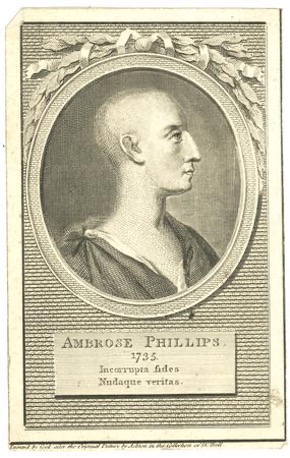
Ambrose Philips was an English poet, playwright, and politician best known for his pastoral poetry and involvement in Irish politics. During his literary career, Philips worked for bookseller and publisher, Jacob Tonson who published his most celebrated work, Pastorals (1708). Today, Philips is largely forgotten, but his pastorals—literary works that romanticize the rustic life of shepherds (see Fig. 2)—and the public spectacle they roused sustain his legacy.
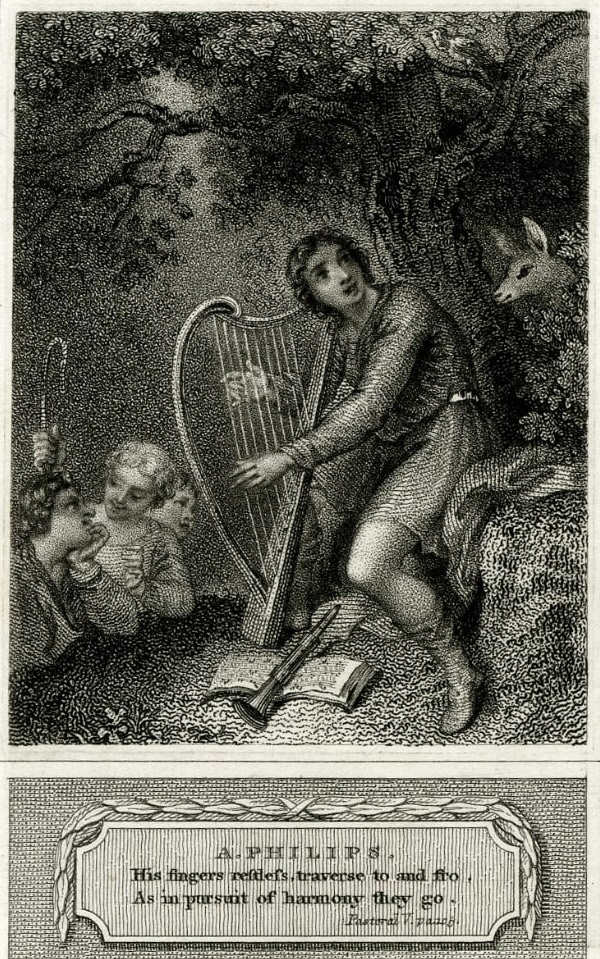
By virtue of being a poet during the 18th century, Philips’ career ran parallel to the Scriblerus Club, and his literary works and personal life became deeply entangled in the opinions and agendas of writers such as Alexander Pope and Henry Carey. The impetus for these feuds was the appearance of Philip’s and Pope’s pastorals in Tonson’s sixth volume of Miscellanies (1709), a collection containing short poems across various genres. In April 1713, the Philips/Pope rivalry commenced with the publishing of The Guardian newspaper Nos. 22, 23, 28, 30, and 32, which praised Philips’s pastorals and recognized him as the only poet fit to fill the shoes of poet Edmund Spenser. Enraged by and resentful of his lack of recognition, Pope retaliated by submitting an anonymous contribution to The Guardian, in which he ironically compared his own pastorals to Philips’s by “censuring himself and praising Philips’s worst passages” (NNMBB).
Though Philips (a staunch Whig) and Pope (a known Tory) battled relentlessly, Philips suffered the most lasting indignity at the hands of Henry Carey, a poet and friend of Pope whose blatant distaste for Philips was immortalized in the poem “Namby Pamby; or a Panegyrick on the new versification address’d to A___ P___.” The identity of the target is unequivocally apparent from the title, and a cruel couplet in the poem containing the degrading name reads: “Namby-Pamby’s doubly mild / Once a man and twice a child … / Now he pumps his little wits / All by little tiny bits” (Carey).
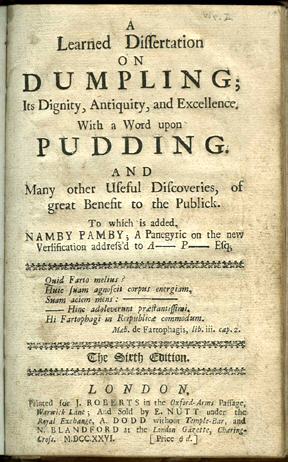
Carey’s poem—derogatorily referring to Philips’s writing as weak and maudlin—and the name “Namby Pamby,” became widely successful to the point where Philips was directly addressed by and associated with the phrase both in his personal life and other poets’ writing. Pope refers to Philips as “Namby-Pamby” in The Dunciad Variorum (1728). Sadly for Philips, in the 21st century, “namby-pamby” still refers to an individual, group of people, or artistic work that is “inclined to weak sentimentality, affectedly dainty; lacking vigour or drive; effeminate in expression or behaviour.”
Lord Hervey (1696-1743), courtier and writer
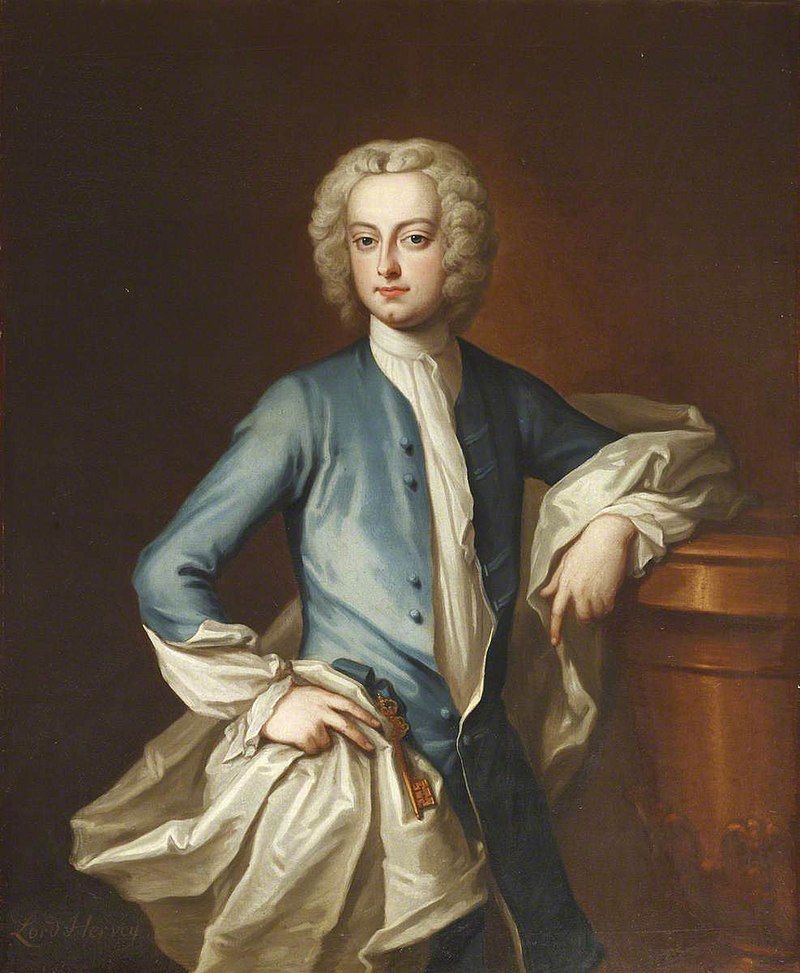
Lord John Hervey, an English nobleman, courtier, and writer, was depicted in The Dunciad as a narcissistic and androgynous flatterer. Outside The Dunciad, he was thrashed so badly in Epistle to Dr. Arbuthnot and The Imitations of Horace that his tarnished reputation as “Lord Fanny” and “Sporus” endures even today.
Hervey was born in 1696 to John Hervey, the first earl of Bristol, and Elizabeth Felton. As a child, he was “excessively handsome, but so effeminately affected that it brought even his sex into question” (Sedwick 14). In adulthood, Hervey wore facial powder “to give his features a fashionable pallor” (Norton 146) and, during his political career, enveloped himself in the “feminine environment of the Queen and princesses, among whom he (was) accepted as one of the girls” (Paglia 359). Despite these oddities, he became a notable writer and politician. His political prowess led to his elevation to the House of Lords in 1733.

Lord Hervey was targeted in The Dunciad after one of his closest friends, Lady Mary Wortley Montagu, humiliated Alexander Pope. In 1728, Pope frequently exchanged letters with Lady Mary, which emboldened him to passionately confess his love for her at what she described as such an “ill-chosen time” that she could not help but laugh hysterically (Quenell, 173). Later that year, Pope featured both Lady Mary and Hervey in the first edition of The Dunciad under the names of pitiful Ancient Greek characters: the promiscuous lesbian, “Sappho,” and the groveling, androgynous pretty boy, “Adonis” (II, 194).
Hervey responded by helping Lady Mary write a slander on Pope’s character and physical deformities, inflaming the situation beyond repair (Montagu). Upon Hervey’s elevation to the House of Lords in 1733, Pope coined the nickname “Lord Fanny,” and it stuck for the rest of Hervey’s life (Imitations 6). In Epistle to Dr. Arbuthnot (1736), Pope dedicates a 28-line stanza just to Hervey (Arbuthnot lines 305–333). His vicious metaphors described Hervey as a frail, prideless, “vile antithesis” and “amphibious thing” (325-26).
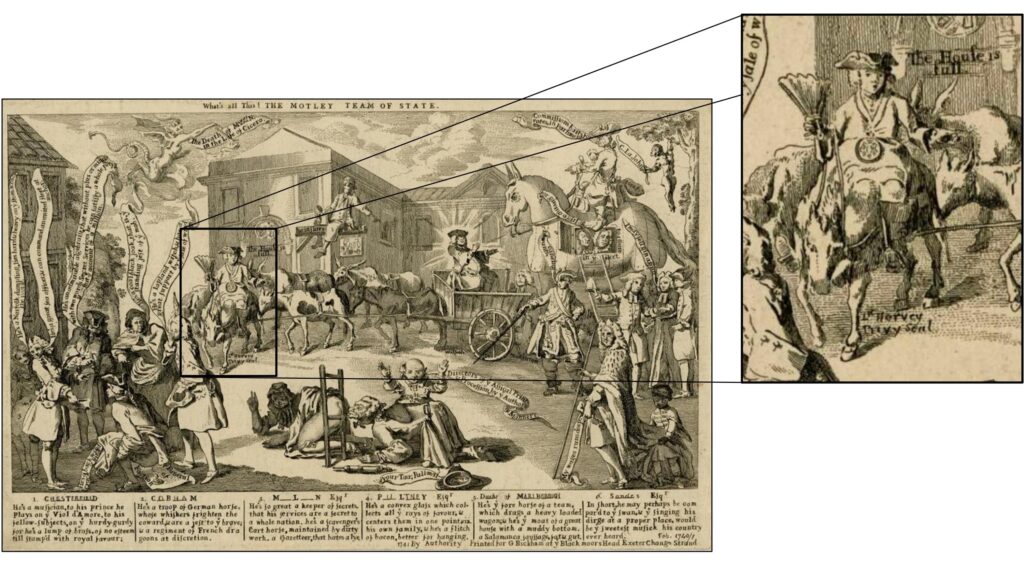
Hervey died in 1743. After hearing the news, Pope simply replied “requiescat in pace,” (“may he/she rest in peace”). The intent behind this notably gender-neutral sentiment is suspect, though the prayer was not uncommon for Catholics such as himself to use. Soon after Hervey’s death, Pope replaced one of The Dunciad’s lines about Hervey, “Impatient waits till — grace the quire,” with “Impatient waits till fool of quality grace the quire” (I, 298).
John Henley (1692-1756), ornate public preacher
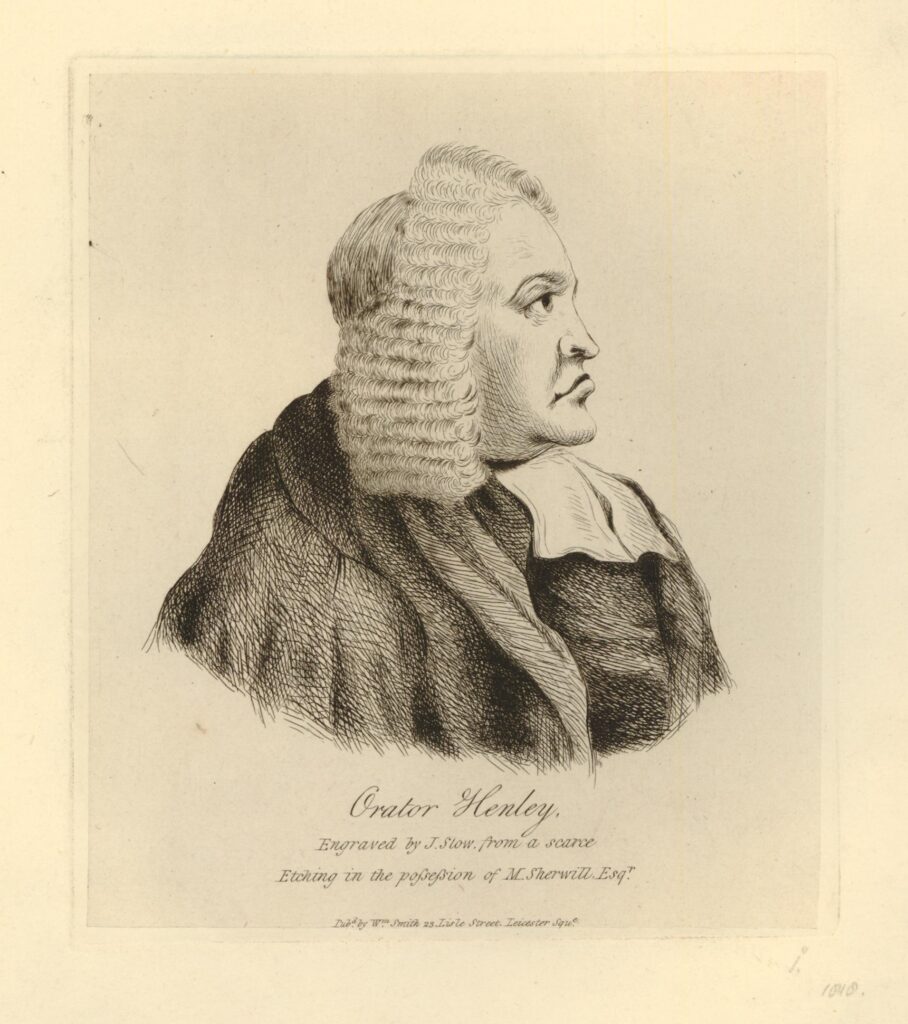
Commonly referred to as “Orator Henley,” John Henley was an English poet, scholar, writer, and preacher known for his eccentric elocution and sermons. After working in ministry from 1721 to 1725, Henley established the Oratory, a private chapel separate from the Church of England. In the years following, his unorthodox beliefs attracted significant attention, making him “a favorite subject of satire by such contemporaries as William Hogarth and Alexander Pope” (Anderson 29).
At the Oratory, Henley gave elaborate sermons on primitive Christianity and educational lectures to anyone willing to pay one shilling for admission (Henley 19-20). Though the fee was a significant source of controversy, frequent newspaper advertisements and Henley’s paper, The Hyp Doctor, drew in large crowds curious to see the self-proclaimed “Restorer of Ancient Eloquence” (Pope 414). Consequently, the Oratory was well-funded and surprisingly lavish despite Henley’s “simplistic” Christianity.
Henley’s nonsensical performances and hypocrisy caused recurring contention between the preacher and his critics, the most damning being Alexander Pope and his poem, The Dunciad, in which he proclaims, “Oh great Restorer of the good old Stage, / Preacher at once, and Zany of thy age!” (Lines 205-206). Though Henley acknowledged that many thought “the Oratory [was] much more like a theatre than a place of worship,” he took offense to Pope’s characterization (Henley 20). In retaliation, he published a pamphlet “so inflammatory and irresponsible that it has helped perpetuate Pope’s view of Henley” (Anderson 29).
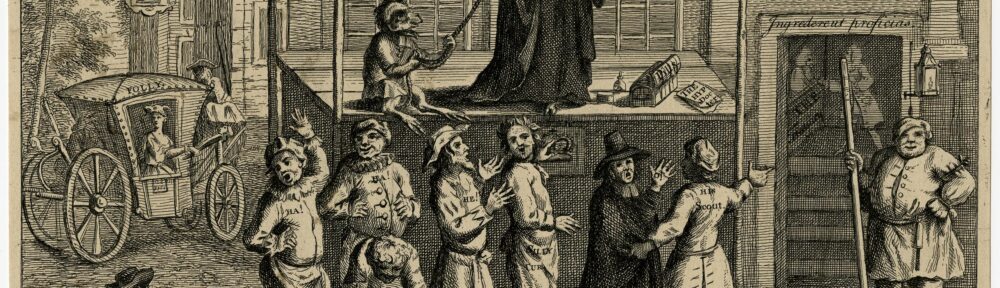
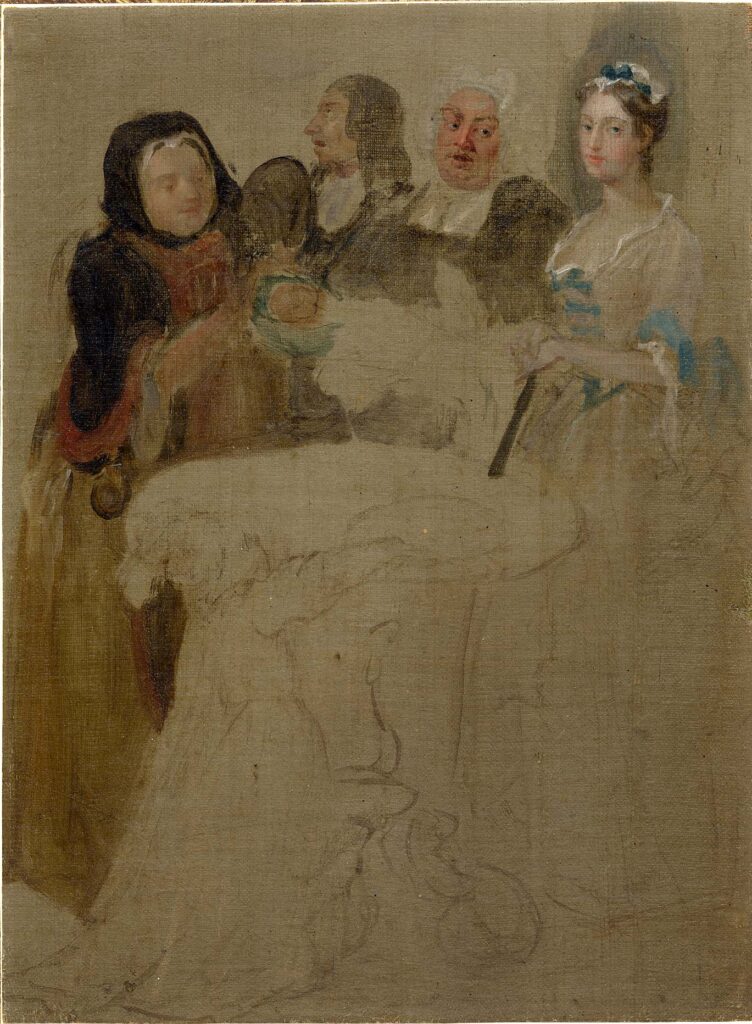
Artists like William Hogarth and George Bickham the Younger took to satirizing Henley with similar critiques. Made in the same year as Pope’s first edition of The Dunciad, Hogarth’s unfinished painting depicts Henley staring at a woman’s chest while christening a child, undermining his ministerial role. In the 1731 print, Henley is leashed to a monkey and has a cloven hoof. Bickham mirrors Pope’s claim that Henley was “a decent priest, where monkeys were gods” (Line 208). The laughing crowd also reinforces Pope’s insult that Henley, “after having stood some prosecutions…turned his rhetoric to buffoon[e]ry upon all public and private occurrences” (Pope 414).

By 1746, Orator Henley’s erratic speeches antagonized the government, and he was arrested for encouraging political dissent. However, he was released on bail shortly after and never faced trial. In Henley’s final years, he often preached to an empty Oratory as his lectures reached new heights of absurdity (Anderson 32). Although few heard his last sermons, Henley’s eccentric personality survives, albeit satirically, through his biggest critics’ famous pieces.
Colley Cibber (1671-1757), actor, dramatist, and theatre manager
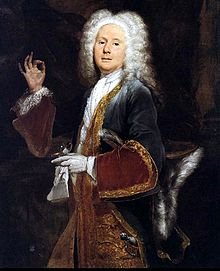
Colley Cibber was an eighteenth century comedian, actor, writer, theater manager, and Poet Laureate. He gained notoriety as the “king of foppery” due to his many theatrical roles satirizing these foolish and vain men. One such foppish part cast him as Lord Foppington in John Vanbrugh’s The Relapse. Critics viewed this role as his most famous, and the one that propelled him into the spotlight. The artist Giuseppe Grisoni immortalized Cibber’s portrayal of Lord Foppington in a painting, seen to the left.
The acclaim given to his comedy skills did not extend to other areas. Alexander Pope even claimed his theatrical productions as poor renditions of other playwrights’ works (Ashley). His writing did not escape scrutiny either. Even though, and perhaps because, King George II appointed him the Poet Laureate in 1730, his written works had more detractors than admirers. His political leanings as a lifelong Whig won him the position, rather than any proficiency in prose (Salmon). Most prominent writers at the time declared themselves Tories, making them ineligible for the role. Cibber himself acknowledged that he did not think much of his own verses in his autobiography, An Apology for the Life of Colley Cibber, a vain, rambling, and cocksure memoir (Roberts).

In 1717, the Scriblerians’ play Three Hours After Marriage cast Cibber as a caricature of himself, criticizing his reliance on foppish roles to retain renown. In retaliation, Cibber staged a burlesque of a scene from their play (Salmon). This dispute began a feud between Pope and Cibber that would last until the end of Pope’s life in 1744. Each side regularly antagonized the other by publishing literature containing veiled insults. This back-and-forth eventually led to the publication of The Dunciad in Four Books (1743) by Pope, in which Cibber was Bays, the main character and King of All Dunces.
Lines such as “She mounts the Throne: her head a Cloud conceal’d / in broad effulgence all below reveal’d / (‘Tis thus aspiring Dulness ever shines). / Soft on her lap her laureate son reclines”, and hailing Bays as the “Great King Cibber”, allowed for little plausible deniability in the identity of the inspiration for Bays (Pope). Pope verbally lambasted Cibber on nearly every page of this poem, and the transparency meant everyone in society knew. Ironically, Pope’s devotion to his hatred of Cibber gave Cibber the only lasting notoriety he ever achieved.
Works Cited
“Ambrose Philips.” NNDB: Tracking the Entire World, 2019, https://nndb.com/people/862/000097571/.
Anderson, Floyd Douglas. “Orator Henley and the Oratory Chapel.” Central States Speech Journal, vol. 17, no. 1, 1966, pp. 29-32.
Ashley, Leonard R. N. Colley Cibber. Twayne Publishers, 1965.
Ashton, Matthew, and Thomas Cook. Ambrose Philips. 1770, The British Museum, London. https://www.britishmuseum.org/collection/object/P_K-63-34
Bickham the Younger, George. The Oratory. 1731. Print engraving.
Browning, Reed. “Hervey, John, second Baron Hervey of Ickworth (1696–1743), courtier and writer.” Oxford Dictionary of National Biography. p. 24. Oxford University Press. https://www-oxforddnb-com.ezproxy.lib.utexas.edu/view/10.1093/ref:odnb/9780198614128.001.0001/odnb-9780198614128-e-13116.
Carey, Henry. A Learned Dissertation on Dumpling – its Dignity, Antiquity, and Excellence, with a Word upon PUDDING, and Many other Useful Discoveries, of great Benefit to the Publick. 1726. http://www.foodsofengland.co.uk/book1726dumpling.htm
Cibber, Colley, and John Watts. An Apology for the Life of Mr. Colley Cibber, Comedian, and Late Patentee of the Theatre-Royal. With an Historical View of the Stage During His Own Time. Written by Himself … The second edition., Printed by John Watts for the Author, 1740.
Cook, T. “Ambrose Phillips”, print engraving, Great Britain, ca. 1800, Harry Beard Collection. https://collections.vam.ac.uk/item/O1263444/ambrose-phillips-print-t-cook/
Ellis, William D. “Thomas D’urfey, the Pope-Philips Quarrel, and the Shepherd’s Week.” PMLA, vol. 74, no. 3, 1959, pp. 203–12. JSTOR, https://doi.org/10.2307/460582.
Fogle, S. F. “Notes on Ambrose Philips.” Modern Language Notes, vol. 54, no. 5, 1939, pp. 354–59. JSTOR, https://doi.org/10.2307/2912354.
Gosse, Edmund W, et al. “The Eighteenth Century: Addison to Blake.” The English Poets: Selections with Critical Introductions, III, Macmillan and Co., London , England, 1881. https://www.bartleby.com/337/633.html
Griffith, R. H. “A VARIORUM TEXT OF FOUR PASTORALS BY AMBROSE PHILIPS.” Studies in English, no. 12, 1932, pp. 118–57. JSTOR, http://www.jstor.org/stable/20779432.
Grisoni, Giuseppe. Portrait of the English actor Colley Cibber as Lord Foppington.1742. Royal Collection Trust. Oil on canvas.
Henley, John. A Guide to the Oratory. W. Osborn, 1726.
Hogarth, William. Orator Henley Christening a Child. 1728. Oil, unfinished, on canvas.
Leishman J. B., The Poems of Ambrose Philips. Edited by M. G. Segar. (The Percy Reprints No. XIV.) Oxford: Basil Blackwell. 1937. Pp. lvi+192. 10s. 6d. net., The Review of English Studies, Volume os-14, Issue 56, October 1938, Pages 475–476, https://doi.org/10.1093/res/os-14.56.475
Montagu, Mary Wortley, and John Hervey Hervey. Verses Address’d to the Imitator of the First Satire of the Second Book of Horace. By a Lady. London: Printed for A. Dodd, and sold at all the pamphlet-shops in town, 1733. Print.
Norton, Rictor. Mother Clap’s Molly House : the Gay Subculture in England, 1700-1830 / Rictor Norton. London: GMP, 1992. Print.
Paglia, Camille A. “Lord Hervey and Pope.” Eighteenth-Century Studies, vol. 6, no. 3, 1973, pp. 348–71. JSTOR, https://doi.org/10.2307/3031690.
Philips, Ambrose. Pastorals, 1710. The English Library at Oxford University.
Pope, Alexander. “The Dunciad.” The Poems of Alexander Pope:A Reduced Version of the Twickenham Text, edited by John Butt, Yale University Press, 1963, pp. 736-759.
—. “The Dunciad: Variorum.” The Poems of Alexander Pope:A Reduced Version of the Twickenham Text, edited by John Butt, Yale University Press, 1963, pp. 371-414.
Quennell, Peter. Alexander Pope. Stein and Day, 1968, p. 173. Print.
Roberts, David. An Apology for the Life of Mr Colley Cibber, Comedian and Late Patentee of the Theatre Royal: A Modernized Text. Cambridge University Press, 2022.
Salmon, Eric. “Cibber, Colley (1671–1757), actor, writer, and theatre manager.” Oxford Dictionary of National Biography. 24. Oxford University Press. Date of access 20 Feb. 2023, https://www-oxforddnb-com.ezproxy.lib.utexas.edu/view/10.1093/ref:odnb/978019 861428.001.0001/odnb-9780198614128-e-5416
Schwartz, Debora B. “Pastoral Poetry and Pastoral Comedy.” Pastoral Poetry, 1996, http://cola.calpoly.edu/~dschwart/engl339/pastoral.html.
Stothard, Thomas, and Vendramini, Giovanni. “A young shepherd playing the harp in the forest”. 1809, The British Museum, London. https://www.britishmuseum.org/collection/object/P_1853-1210-267
Stow, James. Orator Henley. National Portrait Gallery. Print engraving.
The Dryden-Tonson Miscellanies 6 Vols, Edited by David Hopkins and Stuart Gillespie, Routledge & CRC Press, 2008, https://www.routledge.com/The-Dryden-Tonson-Miscellanies-6-vols/Hopkins-Gillespie/p/book/9780415375771.