

by Alex Rivera, F25 Environmental Clinic student
When the European Union (EU) announced plans to accelerate its ban on Russian natural gas imports, it stood as a reminder that energy isn’t just “fuel,” but one of the most consequential geopolitical tools of our modern history. Handled well, it can be a force for diplomacy and era-defining innovation. Handled poorly, it can become a force for state-backed coercion and destruction. Depending on where control is concentrated with respect to production, refining, and distribution, the implications that energy security can have for a country’s stability cannot be overstated. And because the path towards ‘more energy, less emissions’ will inevitably be a non-linear one (as unanticipated developments and crises emerge), energy and climate policy must evolve to move together with foreign policy.
The EU gave a preview of this reality in the wake of Russia’s invasion of Ukraine in 2022. Upon Russia’s invasion, the EU had relied heavily on Russian natural gas for its energy needs. At a time when imports covered 90 percent of gas consumption in the EU, Russia was responsible for providing around 40 to 45 percent of those imports. This was, in part, due to “declining production of EU coal, lignite, and gas” as well as a rise in “domestic production of renewable energy sources.” Despite the rise in renewables, natural gas remained the EU’s second largest energy source, accounting for 20.4 percent of the EU’s gross available energy and 19.7 percent of its final energy consumption into 2023. Thus, when imposing economic sanctions on Russia was on the table, EU policymakers faced a difficult tradeoff: cut off its funding of Russia’s war economy and carry out its commitment to upholding international law, while managing the onset of vulnerabilities and disruptions that would follow breaking away from the supplier of nearly half of its natural gas imports.
By 2024, the EU’s dependence on Russian natural gas imports dropped significantly. Compared to 45 percent in 2021, Russia’s share of EU imports of pipeline gas and liquified natural gas (LNG) decreased to less than 19 percent by
2024, which was made possible by a “sharp increase in LNG imports [from Norway and the United States] and an overall reduction in gas consumption in the EU.”
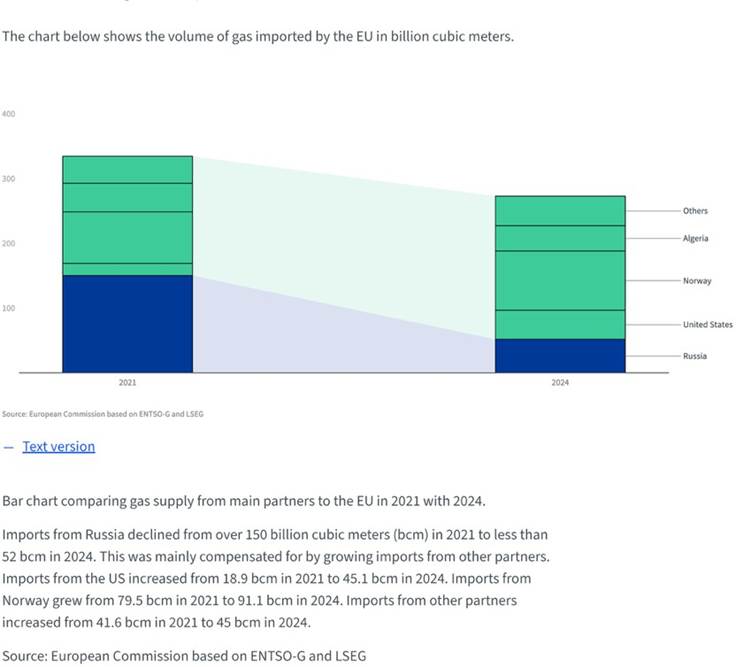
The general effect has been significant, in that the EU and the UK’s fossil fuel sanctions (oil and gas) have cost Russia over $100 billion since 2022. It is worth noting, however, that the measurable effects of direct sanctions on Russia is more complicated than what raw data suggest, due to loopholes (e.g., re-routing exports, re-exports from other countries) and compensatory demand from alternative markets (e.g., China, India, Turkey). Nonetheless, the combined effect of reducing the EU’s overall gas consumption and shifting its import reliance towards Norway and the US has curtailed Russia’s ability to weaponize the EU’s natural gas demand.
Moving forward, the priorities of energy and climate policy face an inevitable merging with (not to be conflated with a subordination to) those of foreign policy.
The EU’s experience with Russia is a cautionary reminder of the seemingly dormant risks that can reawaken when a state actively waging war and lacking democratic accountability dominates the supply chain of a critical resource. It’s worth remembering that the EU’s vulnerabilities were manageable in part because its allies had the capacity to step in at scale and fill its shortfalls, a reassurance that may be less certain in today’s supply chains for renewables. So, as renewables continue to increasingly complement and displace other forms of generation for electric grids, maintaining discipline in accounting for dependencies and potential chokepoints exploitable by authoritarian actors has become more important now than ever.
The articles published on this site reflect the views of the individual authors only. They do not represent the views of the Environmental Clinic, The University of Texas School of Law, or The University of Texas at Austin.