
By Anita Basavaraju, F25 Environmental Clinic Student
Environmental Justice refers to the just treatment and meaningful inclusion of all people in environmental decision-making, with a focus on ensuring equitable access to a healthy environment. The tenets of Environmental Justice gained prominence in the 1980s, when predominantly African American communities in North Carolina protested the building of a hazardous waste landfill near their communities. Since then, the concept has evolved to embrace intersectionality, incorporate global dimensions, and confront new climate realities. Like many scholars, I argue that charting a path forward for Environmental Justice requires a deep understanding of the history of environmental injustice.
Much of this history is rooted in colonialism. From the late 15th century through the mid-20th century, European colonial powers invaded territories across every continent, extracting natural resources and degrading ecosystems to enrich their own economies. In colonies worldwide, colonizers replaced sustainable local farming practices with cash crops like tea and cotton. This led to soil exhaustion, creating barren landscapes where disease-carrying mosquitoes thrived. Deadly outbreaks of yellow fever and malaria caused the death of thousands of people regions such as the Caribbean and Brazil. In India, the British colonial policies prioritized food exports over local sustenance, outstripping the nutrients of the land. This resulted in famine that claimed tens of millions of lives. In the Congo, Belgian colonizers coerced native populations into extracting ivory and rubber, causing the deaths of an estimated 10 million people. Beyond the environmental destruction, colonialism stripped local communities of their ecological knowledge, identities, and cosmologies. The scale of environmental and human devastation caused by colonialism is unparalleled in human history.
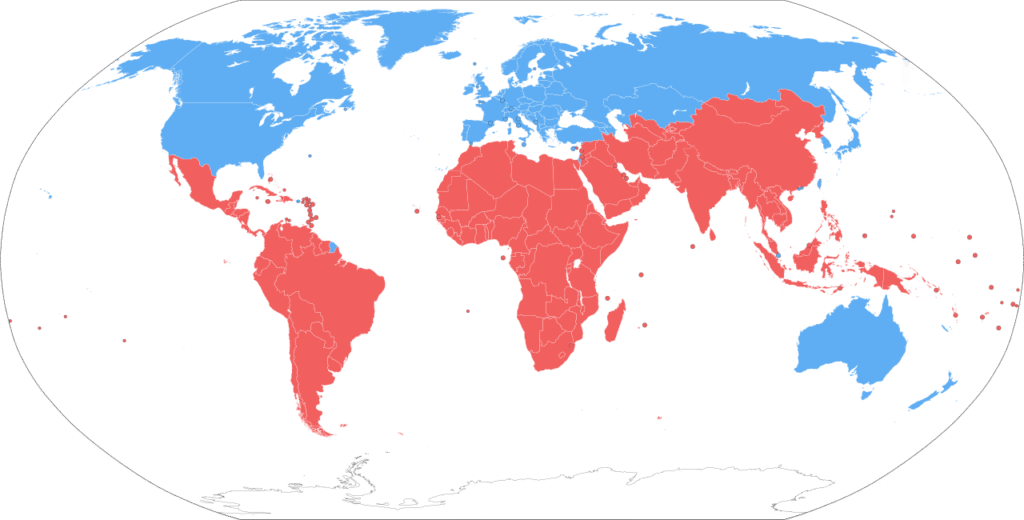
But environmental injustice rooted in colonialism has not just happened, it is happening. Nations built through colonial exploitation, now known as the “Global North,” have developed robust infrastructure that allows them to better withstand the impacts of climate change. Meanwhile, many formerly colonized countries, collectively referred to as “Global South,” still lack adequate healthcare, food security, education, and climate-resilient infrastructure. Centuries of resource extraction and underdevelopment have depleted natural resources and capital.
As climate crisis intensifies, so too does the disparity between the Global North and Global South. The Global South will suffer the worst of climate change, despite contributing the least to the problem. Since 1750, the United States alone has been responsible for 25% of global carbon emissions, more than any other country. Collectively, the 27 EU nations have contributed an additional 22%. Today, per capita emissions in the Global North remain significantly higher than the Global South. This glaring imbalance has given rise to the concept of “climate debt,” a moral and material obligation owed by the Global North to the Global South. Many environmental activists, including myself, advocate for climate reparations. These reparations would support the development of infrastructure to mitigate climate impacts, invest in renewable energy, and assist communities forced to relocate due to climate-induced displacement. A parallel logic applies within the United States, where reparations for Black and Indigenous communities are essential to addressing the compounded effects of environmental racism and historical injustice. Recognizing and addressing this debt is central to Environmental Justice and is essential to building a sustainable and equitable future for all.
References
- https://css.umich.edu/publications/factsheets/sustainability-indicators/environmental-justice-factsheet
- https://link.springer.com/article/10.1007/s11625-020-00789-8#:~:text=Environmental%20justice%20frameworks,Bullard%201990;%20Pulido%201996
- https://www.e-ir.info/2023/02/02/climate-justice-in-the-global-south-understanding-the-environmental-legacy-of-colonialism/
- https://carnegieendowment.org/research/2021/10/how-deep-is-the-north-south-divide-on-climate-negotiations?lang=en
- https://climatenetwork.org/2024/09/20/us5trillion-owed-to-global-south-by-global-north-due-to-the-climate-crisis/#:~:text=A%202023%20study%20shows%20that%20by%202050,owed%20by%20wealthy%20countries%20to%20poorer%20ones.
- https://blogs.law.columbia.edu/climatechange/2025/09/22/toward-structural-climate-reparations-a-legal-agenda-to-address-the-financial-subordination-of-the-global-south/
- https://blogs.law.columbia.edu/climatechange/2025/09/22/toward-structural-climate-reparations-a-legal-agenda-to-address-the-financial-subordination-of-the-global-south/
The articles published on this site reflect the views of the individual authors only. They do not represent the views of the Environmental Clinic, The University of Texas School of Law, or The University of Texas at Austin.