
Source: How everyday people started a movement that’s shaping climate action to this day | NPR
By Shruti Machiraju, Environmental Clinic Student S26
From its earliest days, the U.S. environmental movement has largely been shaped by leaders from relatively privileged backgrounds. Consequently, environmental law and policy became heavily influenced by racist and classist narratives. While modern environmentalism has significantly moved away from this racist and classist history, environmental law and policy continues to exclude low-income communities and communities of color. Environmental justice, spearheaded by many people of color, has made great efforts to bring in marginalized communities into national environmental decision-making. However, some aspects of racial and economic inequality persist in environmental law and policy today.
Early conservation efforts, which heavily influenced U.S. environmental protection laws, were spearheaded by men who “infused early American environmentalism with racist rhetoric.” John Muir, coined the “Father of National Parks,” contributed heavily to the preservation of America’s wild places by fueling the formation of the National Park Service. Muir’s preservation efforts, although generally successful in keeping development out of wild spaces, deeply undercut the work of Indigenous communities in environmental stewardship. In fact, Muir strongly disliked Indigenous people, calling them “‘dirty,’ ‘garrulous as jays,’ ‘superstitious,’ ‘lazy.’” Theodore Roosevelt, who established the U.S. Forest Service, encouraged efforts to keep indigenous peoples out of wild places, stating, “Somehow they seemed to have no right place in the landscape, and I was glad to see them fading out of sight down the pass.” This resentment towards indigenous people among key conservationist figures led to millions of people being evicted from their homes in order to create national parks.
In addition to exclusionary practices, early environmentalist efforts shifted blame onto marginalized communities. For example, some environmentalists believed overpopulation majorly contributed to environmental degradation. This led to large-scale family planning efforts that disproportionately targeted poor women and women of color. For example, mass sterilization initiatives arose, affecting hundreds of thousands of women in the U.S. and Global South from primarily minority and low-income backgrounds. While mass sterilization is not common today, prominent international organizations still push population control initiatives to promote resource conservation, and poorer women of color continue to be the targets of these initiatives.
In addition to early conservation efforts, environmental laws that intended to protect everyone often protected white communities at the expense of marginalized communities. In the 1970s, “not in my backyard,” or NIMBY emerged in white suburbs to oppose the development of polluting facilities in suburbs across the United States. These predominantly white communities were highly successful in using NIMBY to keep polluting facilities out of their neighborhoods. However, their efforts caused developers to relocate their hazardous facilities to urban communities, leading these facilities to be disproportionately placed in communities of color.
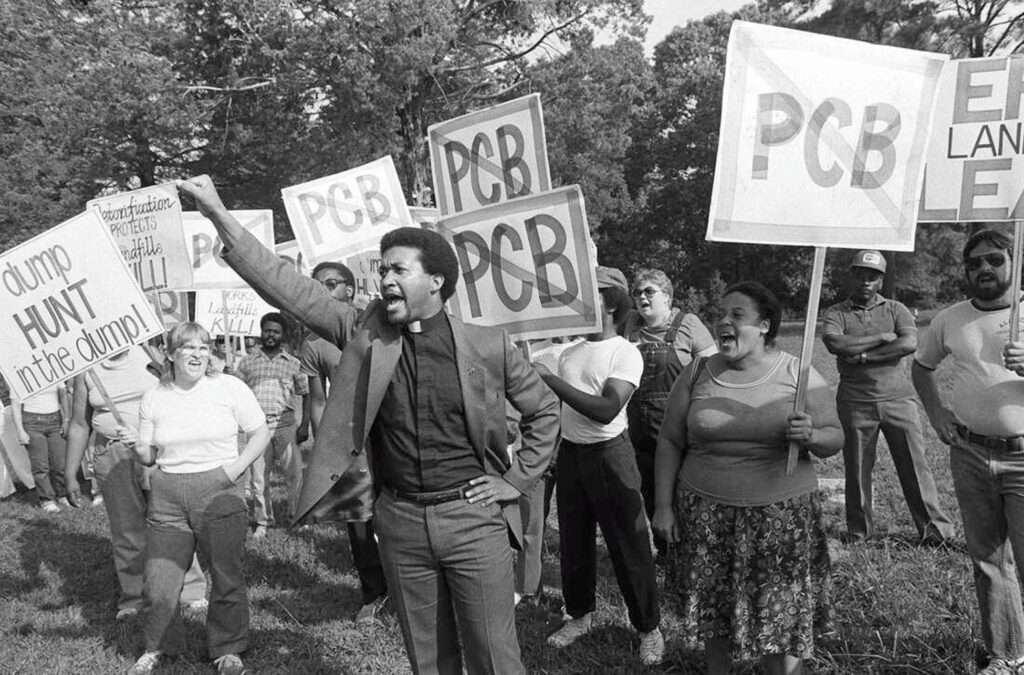
The environmental justice movement emerged in response to this gap in environmental protection. In 1982, the community of Warren County, NC, a predominantly black community, protested to prevent “the state government from dumping 6,000 truckloads of soil laced with toxic chemicals into a nearby landfill.” At this time, many local efforts led by people of color had emerged and were emerging in other parts of the country to oppose decisions to place hazardous facilities disproportionately in communities of color.
Despite the successes of the environmental justice movement, mainstream environmental decision-making today does not always address the experiences of marginalized communities. Groups at the forefront of environmental justice tend to work locally and have limited funding. In contrast, bigger environmental organizations that have more robust funding and often more influence in national environmental decision-making are led disproportionately by white professionals and do not exclusively work on environmental justice. This imbalance has limited the voices represented in environmental decision-making, leading to policies that do not always fully address the needs of communities most affected by environmental harm.
The history of the American environmental movement demonstrates environmental protection has not always been pursued with the equity in mind. Despite advances from environmental justice efforts, many structural challenges remain today. Truly addressing environmental inequality will require large-scale efforts to ensure marginalized communities have meaningful representation in environmental decision-making as well as the autonomy to make decisions that impact both their lives and the environment. Only by integrating environmental protection with social equity can environmental law and policy fully safeguard the environment and the communities that depend on it.
References:
Green 2.0, Reports & Resources
Iwuala, Fairbanks, Pandey, How White Supremacy Perpetuated Environmental Hazards in Communities of Color
Nobel, The Miseducation of John Muir
Sierra Club, The Overpopulation Myth and its Dangerous Connotations
Grist, The whitewashing of the environmental movement
Knox & Tronolone, Environmental Justice as Environmental Human Rights
De Luca Zuria, Overpopulation discourse: A feminist and necropolitical approach from the Global South