
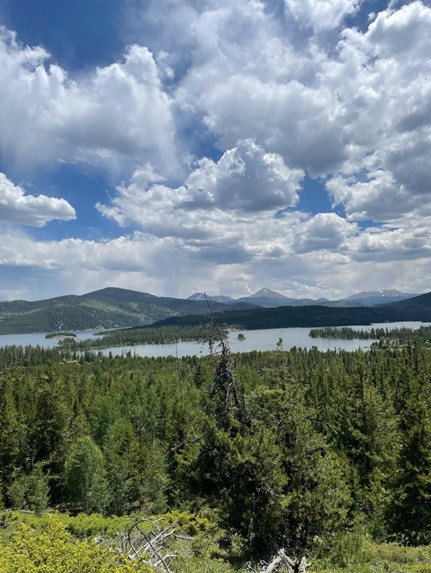
A picture I took hiking this past 1L summer when I was working in Colorado. This is the Dillon Reservoir near Dillon, Frisco, and Silverthorne ,CO. It is a freshwater reservoir for the city of Denver under the control of Denver Water.
By Helen McLachlan, S26 Environmental Clinic Student
An instream flow (ISF) right is an in-channel appropriation of water for maintaining minimum flows between specific points on a stream. It is a right to protect water in a stream for an environmental purpose, rather than for a consumptive one. This beneficial use is provided for in the Colorado state constitution that “[t]he right to divert the unappropriated waters of any natural stream to beneficial uses shall never be denied.” Colo. Const. art. XVI, § 6. What constitutes a beneficial use is flexible as codified by the Water Rights Determination Act of 1969 which declared beneficial use to include for “the benefit and enjoyment of present and future generations, the appropriation by the state of Colorado in the manner prescribed by law of such minimum flows between specific points or levels for and on natural streams and lakes as are required to preserve the natural environment to a reasonable degree.” C. R. S. §.§ 37-92-103(4). This change to the Colorado constitution was critical for allowing the preservation of minimum flows to protect the rivershed.
ISF rights are of major environmental significance because historically they did not exist in Colorado and the doctrine of maximum utilization called for appropriating 100% of the flows of a river. Prior appropriation means that most of the streams in Colorado had already been appropriated by the time of the 1969 change to the constitution. What this meant practically was that the stream, in theory, can be drained absolutely dry. From a hydrological, wildlife, and soil science standpoint this is a horrible situation for the rivershed. Drained rivers can cause significant soil erosion and sediment build-ups. Draining all the water also causes extensive flora and fauna die-off. This is a major issue for fisheries. Maintaining sufficient water levels is also crucial for diluting pollutants and maintaining tourism and recreation. For the river stream as a whole it is important to keep a minimum flow to prevent this degradation of the land and biodiversity. This is challenging, however, when the stream has already been fully appropriated.
In response to this problem Colorado granted the Colorado Water Conservation Board (CWCB) the ability to lease ISF rights for maintaining minimum flow levels. The CWCB is the only entity legally authorized to hold instream flow rights. The CWCB was authorized after the 1973 creation of the instream flow program to appropriate or acquire instream flow rights and is administered within the state’s water rights priority system. They have had the “exclusive” authority to acquire and hold ISF rights since 1987. CWCB may acquire rights through purchase, bequest, exchange, or other contractual relationships – including leasing. Short term leases allow for a lessee’s water right to be used for an ISF water right for 5-years in a 10-year period, whereas long term allows for the right to be used for an agreed upon term period. As of 2024 the CWCB is also allowed to lease from agricultural water rights holders.
There is significant debate over whether ISF rights comport with Colorado’s doctrine of maximum utilization. There is tug-and-pull especially in regards to agriculture that this water is desperately needed for farming, drinking, etc. People who argue that all the water needs to be used are failing to understand the science of the rivershed, however. It will be worse for agriculture and even domestic water users if there is an immense amount of soil erosion due to over appropriation. ISF rights are incredibly important for the survival of Colorado as both an agricultural state and a tourism hotspot. Recognition and continued protection of ISF rights should be a top priority for the Colorado Legislature, Colorado Water Courts, and people and environmental groups worldwide.
The articles published on this site reflect the views of the individual authors only. They do not represent the views of the Environmental Clinic, The University of Texas School of Law, or The University of Texas at Austin.