
By Adam Greiner, Spring 2022 Environmental Clinic Student
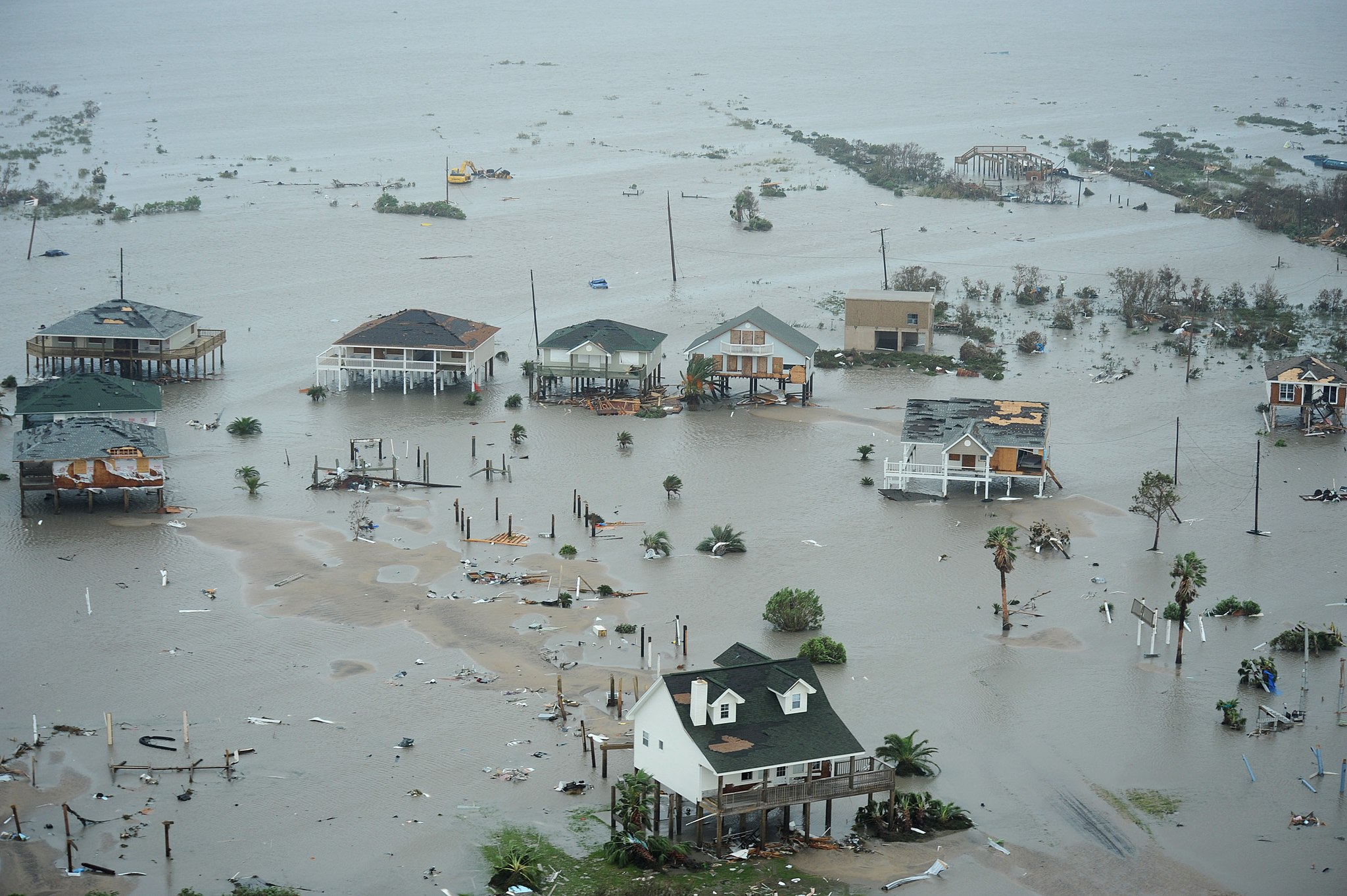
In the wake of widespread rainfall and a minor flooding alert in the Houston and Galveston areas this past week, alongside developments in the Texas Coastal Spine Project[1], it seems like the time is ripe to circle back on the conversation surrounding a ‘managed retreat’ from parts of the Galveston Coastline. For those of you who are lucky enough to not have run into the term ‘managed retreat’ before, it refers to a kind of relocation program commonly utilized in the wake of severe storm damage. These programs generally use federal and local government funding to pay vulnerable homeowners the pre-disaster value of their damaged homes, relocating them to an area with lower risk of flooding and storm damage.
With this disaster-response mechanism as a backdrop, there have been vocal proponents for instituting a managed retreat program in the Galveston area in response to climate change and chronic flood damage. After Hurricane Ike in 2008, for example, as funds from FEMA’s Hazard Mitigation Grant Program were being dispersed to mitigate future flood and storm damage in Galveston County, some argued that the funds could instead be used in part to conduct a managed retreat of parts of the Galveston Coastline. Rather than spending Federal Emergency Management Agency money on rebuilding and reinforcing the homes damaged by the hurricane, instead relocate the homeowners farther inland to an area with lower flood risk. The value being that relocation would put an end to the cycle of rebuild and destroy that plagues communities in these flood areas, while mitigating the direct impacts of climate change and storm surges by restoring the natural wetlands and beaches otherwise smattered with housing developments.
Journalists and environmentalists on a local and national level have returned to the proposition of managed retreat in recent years, due to the impact of Hurricane Harvey in 2017 and increasing concern about the effects of climate change on rising sea levels. As Yuliya Panfil noted in her 2020 Politico article on the subject of managed retreat, there is a growing fear that nearly half of the Galveston area could be victim of rising sea levels in the coming decades. In a 2018 projection analyzing the effects of moderate sea-level rise on housing by 2100, Galveston was one of the most affected cities in America. Nearly 10% of Galveston homes are projected to be in high flood risk zones by 2050, and 46.4% are projected to be in high flood risk zones by 2100.
Given this increasing concern, it might be time for at-risk residents of Galveston to begin the process of getting FEMA funding to relocate. It usually takes FEMA more than 5 years to complete a property buyout project, and that’s with a much slower pace of buyouts than what will likely be necessary in the coming decades with rising sea levels. With FEMA relocation programs the way they are now – underfunded, inefficient, and inequitably applied – even starting now will not guarantee relocation by 2050.
Although steps are being taken, through the Texas Coastal Spine Project, to protect the Galveston area from storm surges, flooding caused by heavy rain and sea level rise will remain largely unchecked by the Project and communities in Galveston are still at risk. With this in mind, Galveston County officials and other members of the Galveston community should consider other ways to mitigate flood damage. Proactive relocation of vulnerable homeowners in the Galveston area, using FEMA funding or other means, should be considered in addition to, or as an alternative to, increased spending on storm surge measures alone the coast.
[1] The Coastal Spine Project is an almost $20 billion proposed project to address storm surge that includes building massive barrier gates between Galveston Island and the Bolivar Peninsula and a ring levee around the city of Galveston. See, https://coastal-texas-hub-usace-swg.hub.arcgis.com/.
The articles published on this site reflect the views of the individual authors only. They do not represent the views of the Environmental Clinic, The University of Texas School of Law or The University of Texas at Austin.