
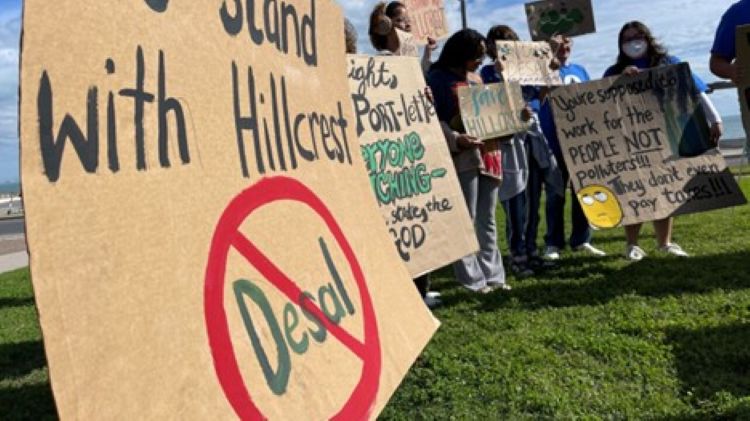
Source: DESALINATION: Environmental groups protest Corpus Christi facility | KRIS 6 News
By Taylor Cox, S26 Environmental Clinic student
Public participation is central to many federal and state environmental permitting processes. In Texas, for example, the Texas Commission on Environmental Quality (TCEQ) provides opportunities for public notice and comment on air, water, and waste permits. Many permitting processes also provide opportunities for public meetings, allowing concerned community members to address the issues that affect them directly and on the record. These procedures are intended to promote transparency and improve agency decision-making by inviting input from affected communities. In practice, however, public participation can also operate as a powerful constraint on development, as the process itself can introduce increased costs, delays, and uncertainty.
Beyond filing written comments on proposed permits, TCEQ authorizes citizens, local governments, and advocacy organizations to request contested case hearings (CCHs) so long as the requester is an “affected person.” These adjudication-like proceedings can result in permit modification or, in rare instances, even permit denial. Although outright denials are uncommon, the low likelihood of permit denial does not diminish the significance of public participation. In reality, developers often view the prospect of a CCH as a significant risk. Project financing, contractual obligations, and market conditions depend on predictable timelines, and procedural delays can threaten a project’s viability. Furthermore, even if the agency ultimately issues the permit, the expanded administrative record created through public engagement may form the basis for subsequent judicial review, extending uncertainty well beyond just the agency decision.
Public participation also has financial implications that extend beyond schedule disruptions. Agencies are legally obligated to respond to substantive comments, and participation could force supplemental studies, additional consultations, or revised permit conditions. Each of these steps carries transaction costs. Moreover, heightened regulatory risk can increase the cost of capital or deter investors altogether. Organized opposition campaigns may generate reputational consequences, negatively influencing consumer perception and potentially a company’s bottom line. In some circumstances, the cumulative prospect of hearings, appeals, and prolonged uncertainty leads applicants to withdraw before a final decision is issued.
Critics often frame these dynamics as evidence of excessive administrative burden. Yet public participation is embedded in permitting frameworks precisely because the environmental and public health harms are often long-lasting and borne by communities rather than project developers. Providing affected community members with procedural leverage can slow development, but it can also create space for information gathering, coalition building, and negotiation. In some cases, delay facilitates meaningful mitigation measures or community benefit agreements that would not have emerged absent sustained public engagement.
Public participation redistributes bargaining power to communities. As a result, more and more developers are shifting their behavior to engage with the public long before the permit application is formally filed. Early outreach meetings, voluntary impact assessments, and community benefit agreements increase a project’s public perception and act as risk management. Developers may commit funds to local infrastructure, environmental mitigation projects, workforce development programs, or neighborhood amenities in an effort to build trust and reduce opposition. While such investments are often framed as corporate responsibility, they also reflect a pragmatic recognition that community resistance can materially threaten project timelines and financing.
Ultimately, public participation is a critical mechanism for ensuring that environmental decision-making reflects the interests and concerns of the communities most affected.
References:
TCEQs: Public Participation in Environmental Permitting: English (GI-445)
Environmental Law Institute: Goodbye, Public Participation
Sierra Club: The Contested Case Hearing Process Works Well – No Major Changes Needed
Niskanen Center: A closer look at the role of litigation and opposition in transmission projects undergoing federal permitting
Primary Market: How Investments are Affected by Regulatory Risks
University of Minnesota Extension: Five reasons to involve others in public decisions
Utility Drive: How community benefits agreements can reduce project delivery risk
The articles published on this site reflect the views of the individual authors only. They do not represent the views of the Environmental Clinic, The University of Texas School of Law, or The University of Texas at Austin.