
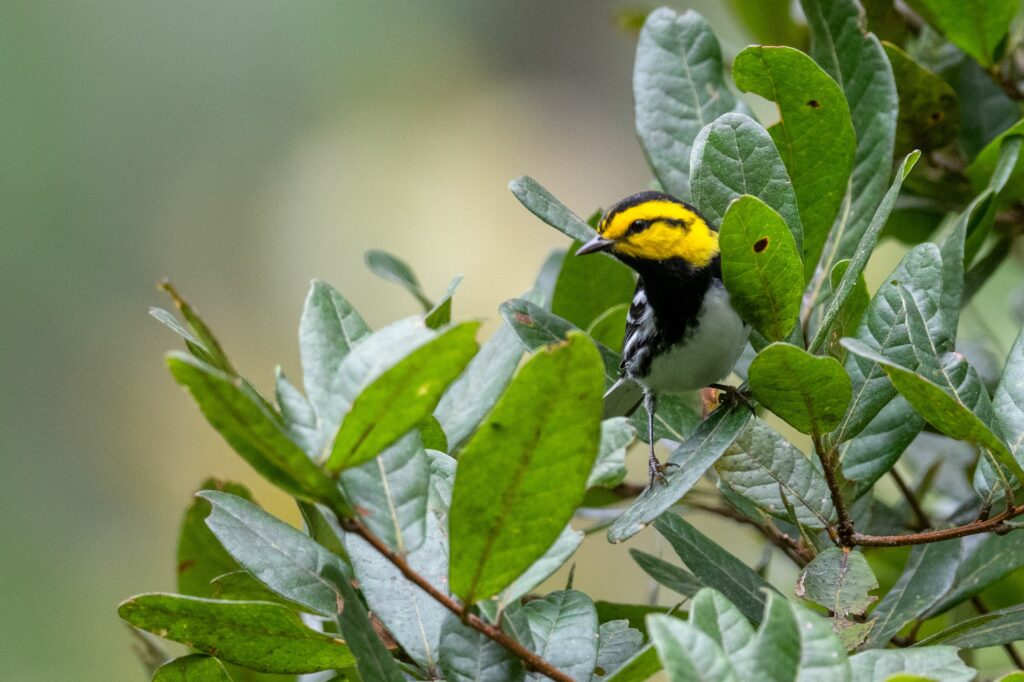
Credit: John Cahill
By Dan Covert, S26 Environmental Clinic student
The golden-cheeked warbler (Setophagia chrysoparia) is the only bird species to have breeding habitat exclusively in Texas. It has been listed as endangered under the Endangered Species Act (ESA) since 1990, when the U.S. Fish and Wildlife Service (FWS) found that habitat degradation had seriously threatened the songbird’s survival. At time of listing, fewer than 5,000 individuals remained. Golden-cheeked warblers nest only in the Ashe juniper and mixed live oak woods of central Texas, making the species vulnerable to habitat destruction spurred by urbanization, pasture expansion, and prairie restoration from the 1970s on. FWS cited studies indicating 15-45% habitat loss in only ten years after the beginning of major juniper culling. With the warblers’ remaining woods thoroughly dispersed, FWS refrained from designating critical habitat, instead protecting the songbird wherever it was found.
In January 2025, however, FWS published a proposed rule that would change the golden-cheeked warbler’s conservation status from endangered to threatened. The ESA continues to protect threatened species, those not facing imminent threat of extinction, but the strong “anti-take” prohibitions of Section 9 of the ESA do not apply. The proposed rule followed on the heels of FWS’s last five-year review of the warbler and its 1992 recovery plan, a 90-day opinion with public comment, and a private petition to delist. No final rule has been adopted, and the Service is yet to publish its mandatory one-year review, after whose public comment period a final rule could be published. That finding was slated for publication in January 2026, but FWS is currently managing a significant backlog.
For the warbler to be delisted, four criteria would have to have been maintained for ten years, as laid out in the species’ recovery plan: (1) protection of sufficient breeding habitat to ensure survival in eight different regions established by FWS, (2) retention of gene flow across regions between demographically self-sustaining populations, (3) existence of sufficient and sustainable non-breeding habitat, and (4) substantive protection of all populations of warblers on public lands. The most critical criterion in the warbler’s recovery, and thus for any finding supporting delisting, is habitat recovery. Since listing, FWS has instituted policies to recover the warbler. For example, the Balcones Canyonland Conservation Plan was created to protect habitat of the golden-cheeked warbler, black-capped vireo, and six karst invertebrates, while allowing an incidental take permit. The associated Balcones Canyonland Preserve protects over 33,000 acres of warbler habitat within Travis County. The service has also promoted other responsible land management practices and conservation banking, by which landowners who clear would-be warbler habitat can purchase other lands to set aside for conservation. These projects have largely succeeded, with warbler habitat, as measured by FWS, expanding from fewer than 600,000 acres in 1992 to over 4 million acres today. Habitat restoration, along with better understanding of the warbler’s nesting habits—in particular the species’ tendency to avoid otherwise suitable nesting sites if they are too near the edges of wooded areas—has resulted in a serious rebound in the warbler population, from fewer than 5,000 individuals in 1990 to more than 110,000 today. Warbler range has also been notably restored, with a breeding pair being spotted as far north as Dallas County for the first time in decades.
Critics of the plan to delist worry, however, that the move is premature and would undo three decades of progress. Warbler habitat is still perilously fragmented, with relatively little of it being old enough to represent the high-intensity habitat that picky warblers are more likely to actually roost in. Urbanization trends have also continued, cities in central Texas taking more and more land. With global warming and deforestation threatening the birds’ winter habitats in Central America, supporters of the warbler suggest that it would be irresponsible to lift protections in Texas so shortly after the apparent recovery of the species. Regardless, nothing is set in stone, and future public comment periods will offer Texans and bird lovers nation-wide the opportunity to present ecological evidence showing continued threats to the songbird. Though potential delisting has opened many questions, the last thirty years of population and habitat recovery should leave us cautiously optimistic about the prospects of the golden-cheeked warbler.
The articles published on this site reflect the views of the individual authors only. They do not represent the views of the Environmental Clinic, The University of Texas School of Law, or The University of Texas at Austin.