
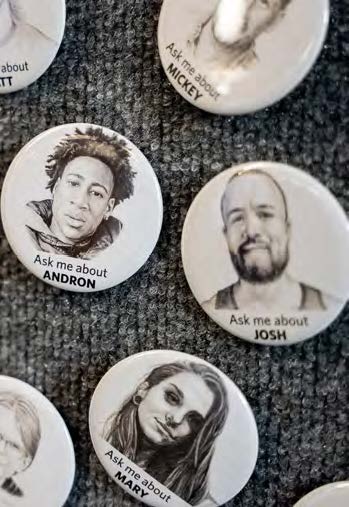
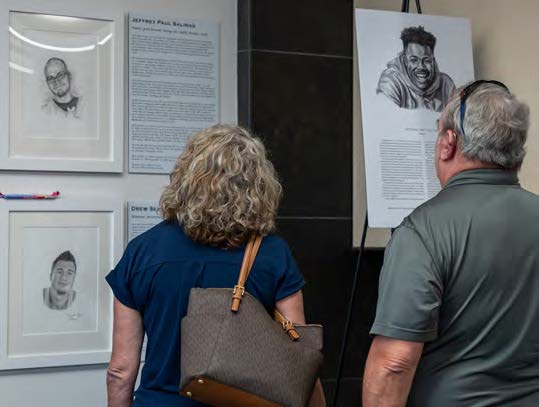
The laughter of students tumbles down the stairs. The common room of Walter Webb Hall is always a hive of activity: Guadalupe humming outside, students cycling in and out, study groups spilling into school-wide events. But quietly tucked into the room, folded in among the conversations that color college student life, 34 black-and-white portraits stand vigil.
“INTO LIGHT — Drug Addiction: Real People, Real Stories” is an art exhibit that puts faces to Travis County’s overdose crisis. Each pencil-drawn portrait shows a moment in the life of someone lost to overdose, paired with a biography shared by their family.
The solemn juxtaposition of still portraits against student life can be jarring. And that’s the point. Each story unfolded in the midst of ordinary and extraordinary lives being lived, in front of family and friends who might not have understood or recognized what was happening.
Addiction and substance-use struggles can often be hard to identify. The disease itself is a master of disguise and manipulation, fooling everyone into thinking the struggle is just a blip that can be overcome with enough willpower. It often occurs where we least expect it because we often look for the tropes and stereotypes of substance use, not recognizing the real struggle in the faces of those we hold most dear.
Now in 21 states, INTO LIGHT aims to break through the stigma of drug addiction to tell the stories behind the loss and spread awareness about addiction and substance use.
Behind The Portraits
Tiffany Anschutz — UT Social Work alumna, advisory council member, and founder of Sage Recovery & Wellness Center and Sage Recovery Villa — helped bring the exhibit to the school. Anschutz’s stepsister, Roxana Cain, who died in 2019, is also part of the exhibit.
Theresa Clower, artist and project founder, lost her son to an overdose in 2018. After drawing a portrait of Devin, working from a picture taken five hours before he died, she decided to use portraits to connect with others who had lost someone to overdose. An art project was born.
The Austin exhibit features 34 Central Texans, ranging in age from 16 to 54, a small fraction of addiction-related deaths in the area. Travis County saw 380 deaths in 2024, down 22% from 2023, mirroring the first national decline in years. It’s still the leading cause of accidental death here, and fentanyl remains a deadly threat.
“This exhibit is not only a tribute — it’s a call to action. It invites us to confront addiction as a public health crisis and to respond with compassion, understanding, and advocacy,” said Dean Allan Cole at the unveiling of the exhibit during the School’s 75th anniversary celebration.
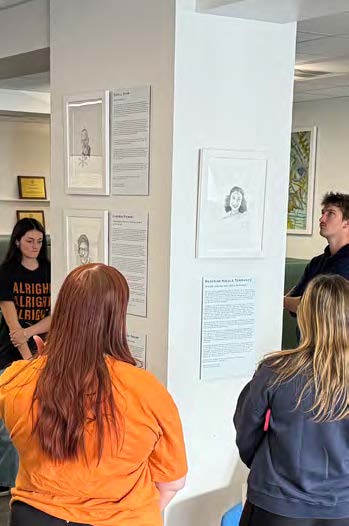
the people behind the portraits
Sharing The Stories
Since it has been up, the exhibit has generated meaningful media engagement. ATX Dispatch on KOOP Radio featured an on-air conversation with Clower and Annie Hernandez of the Christi Center, a local grief support center for families navigating loss. Hernandez joined a grief support group after losing her son, Joshua Bell, to an overdose in 2019. Bell is one of the portraits featured in the exhibit.
KUT News, Austin’s NPR station, amplified the exhibit’s impact across Central Texas, highlighting interviews with Clower, Hernandez and Lisa Lasch, who met through the grief support group. Lasch’s son Brandon, who died in 2022, is also featured in the exhibit. The story also featured an excerpt of an interview with Dr. Kasey Claborn, director of the Addiction Research Institute.
Carrying It Forward
The exhibit finds a natural home at UT Social Work, where the late Dr. Lori Holleran Steiker founded SHIFT in 2019 to transform the student substance-use culture. That legacy lives on in the Lori Holleran Steiker Endowed Faculty Chair in Substance Use and Recovery, established this academic year and held by Dr. Mary M. Velasquez, and in the researchers carrying her work forward.
Claborn, the inaugural recipient of the Lori Holleran Steiker Award, credits the recent decline in overdose deaths to the widespread distribution of naloxone and other overdose-reversing treatments. Awareness campaigns like INTO LIGHT matter too. “Research has shown that stigma proliferates in spaces where we don’t have connections, where we don’t have direct understanding of human experience,” she said.
The nation remains in a dangerous phase of the opioid crisis. Only around 20% of the 48.7 million Americans with a substance use disorder received treatment in 2024. “Overdose impacts the entire family system,” Claborn said.
That work continues. ARI doctoral student Jake Samora recently received an NIH R36 Dissertation Award, and postdoctoral fellow Dr. Katie McCormick received a K01 Career Development Award from NIH. Their work directly advances overdose prevention initiatives.
The exhibit closed at the end of May. Families will keep the portraits, and the hope moves forward.