Building Resilience Before Crisis Strikes
The Institute for Military and Veteran Family Wellness (IMVFW) addresses the full spectrum of challenges military and veteran families face, from behavioral health to social support. Its mission is to transform research into practical, evidence-based solutions that strengthen the health and well-being of service members, veterans, and their families.
IMVFW’s impact extends through the doctoral and MSW students it attracts and mentors, as well as its partnerships with the Department of Defense, the VA, and a broad network of national and local military- and veteran-serving organizations. As military and veteran families navigate new challenges, IMVFW continues to expand and strengthen programs and create support networks designed to sustain families through every transition.
From Research to Real Impact
IMVFW’s current initiatives reflect its commitment to turning research into meaningful, real-world change.
One initiative is the REACH Peer Support Study: Funded by the Department of Defense, examines how peer support influences mental health and quality of life through an eight-week, curriculum-based program designed for military spouses at Fort Hood.
Another initiative is the Military & Veteran Spouse Wellness Survey: a first-of-its-kind study assessing spouse wellbeing across eight dimensions, identifying critical gaps to inform future programs and policy initiatives.
Another, the Veteran Spouse Network, offers free, evidence-based programs that foster connection and wellbeing through peer support, education, and communitybuilding for military and veteran spouses and families.
“We study what military and veteran families actually need, build peer support programs that strengthen their support systems, and connect them to effective local and national resources,” said Dr. Elisa Borah, IMVFW director. “Our goal is to conduct research that creates evidencebased programs that truly support military-connected families.”
National Funding for Suicide Prevention
The institute’s work has also attracted national attention and funding through its Veteran Spouse Network (VSN). Most recently, Face the Fight, a national initiative founded by USAA, Reach Resilience, and the Humana Foundation to prevent veteran suicide, awarded $16.5 million in grants to 27 organizations as part of more than $42 million distributed across 83 suicide prevention projects nationwide. This support comes amid an urgent reality; the rate of veteran suicide is nearly 60% higher than the national average, and the second leading cause of death among veterans under 45.
Through this funding, the Veteran Spouse Network (VSN) will expand its provision of free, evidence-based suicide prevention trainings, empowering military and veteran families to recognize early warning signs and take action to prevent crises.
To date, VSN has delivered suicide prevention trainings to over 1,250 participants, including individuals who may have completed more than one training component. Among surveyed participants, 78% reported increased knowledge about crisis warning signs and confidence in assessing risk and intervening. According to dynamic data modeling, Face the Fight projects 6,500 lives to be saved by 2032.
Valuable National Partnerships
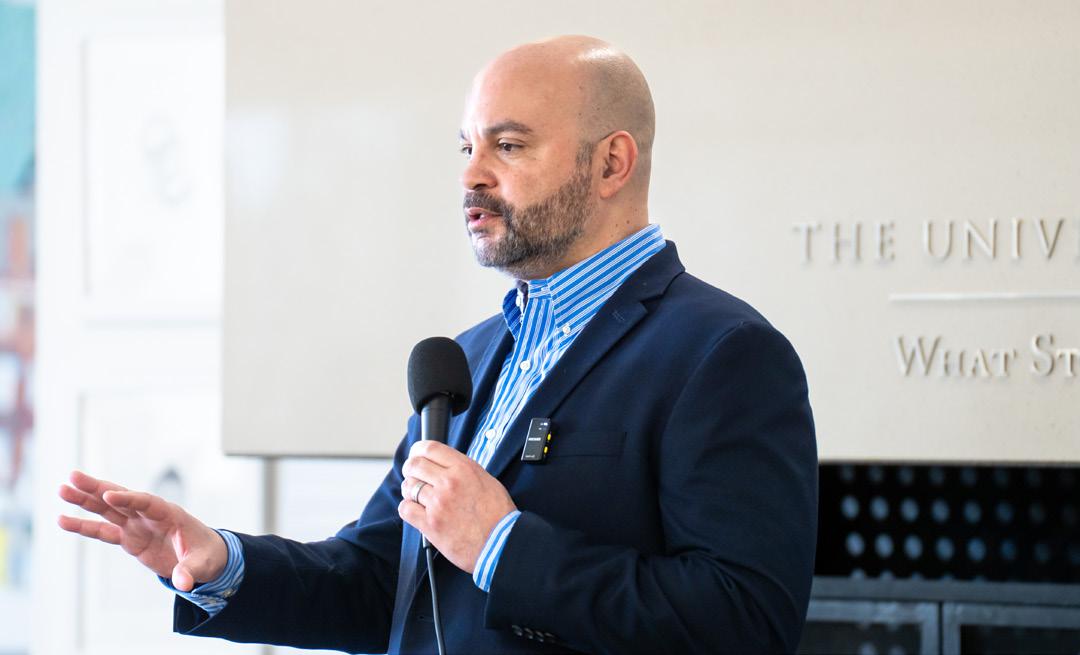
This fall, Dr. Nathan Keller — a licensed clinical social worker, retired Army colonel, and longstanding IMVFW collaborator — delivered UT Social Work’s Distinguished Speaker lecture on the field of military social work and the extensive leadership role that social workers play in the military ecosystem. Keller highlighted the complementary values at the core of military service and social work.
“The military focuses on structure, discipline and achieving the mission,” Keller explained. “Social work emphasizes empowerment, empathy and transforming individual lives.” While the tools differ — one rooted in command hierarchies, the other in therapeutic relationships — both are grounded in shared commitments to loyalty, duty, respect, and service to others.
In another example, UT Social Work recently celebrated the appointment of COL Dr. Lataya Hawkins (Ph.D. ’21), LCSW-S, BCD, to dean of the Graduate School at the U.S. Army Medical Center of Excellence at Fort Sam Houston in San Antonio. In this role, she leads one of the military’s most comprehensive allied health education systems.
Hawkins oversees 13 graduate programs in partnership with three universities, all of which rank in the top 15% nationally. In November 2024, she was promoted to full colonel, joining an elite group of only 10 full colonel social workers across the Army.
“My relevancy doesn’t come from the uniform,” Hawkins reflected on her time at UT Social Work. “It comes from how I show up in the world — the impact you make on the world.”
Military Social Work Practice
UT Social Work offers a certificate in military social work practice. The program equips students with specialized skills to serve military-connected communities, including an in-depth understanding of military culture, the unique challenges faced by this population, culturally responsive care practices, and navigation of complex military and veteran health systems. The certificate prepares students to do impactful, high-stakes work — where informed care, cultural competence, and evidence-based practice can meaningfully improve outcomes for military and veteran families.