
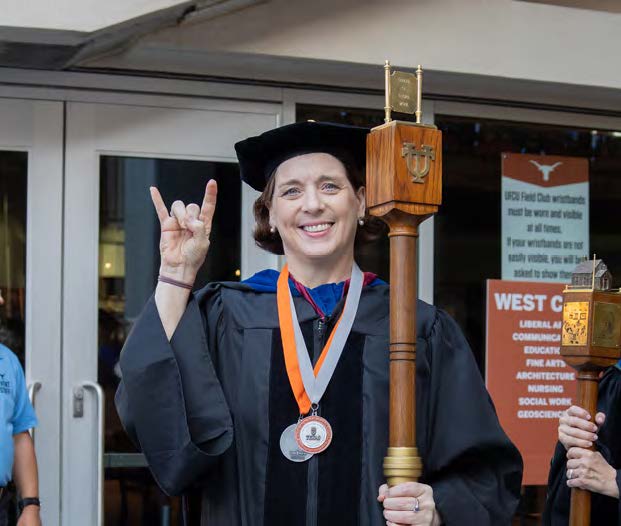
When Noël Busch-Armendariz arrived at The University of Texas at Austin in 2000, she brought more than an academic résumé. She had spent years in direct practice — working with incarcerated women who had killed their abusive partners, engaging in global social work, and teaching the next generation of practitioners. She knew the terrain as a scholar and a practitioner — someone whose research was grounded in the realities she had encountered directly in the field.
When then-dean Barbara White asked her to figure out how the School of Social Work could engage the Austin community on domestic violence and sexual assault, Busch-Armendariz didn’t start with a strategic plan. She started with a question.
“Like good social workers,” she said, “our work is community-engaged no matter what we’re doing.”
She reached out to Annette Clay, executive director of the Texas Association Against Sexual Assault and Kelly White, the CEO of SAFE (then Safe Place). Kelly White had recently grown SAFE from a small nonprofit to a $22 million operation with 120 employees, tracking. Their response set the tone for everything that followed.
They convened about 25 leaders from across the Austin community — domestic violence and sexual assault organizations, faith communities, advocates for people experiencing homelessness, funders. The question on the table: what should a university do to address interpersonal violence in Texas?
The answer shaped the Institute on Domestic Violence & Sexual Assault, which marks its 25th anniversary this year. “The institute really grew from this community,” Busch-Armendariz said.
From that founding conversation, two commitments emerged that have guided IDVSA ever since: let the community set the research agenda and make the findings consumable by anyone who needs them — from survivors to high school teachers to policymakers.
That second commitment turned out to matter enormously. IDVSA built a reputation not just for rigorous research, but for making it usable, like reports designed. Reports designed with infographics and findings translated across audiences.
Counting What Counts
In 2003, IDVSA conducted the first statewide prevalence study of sexual assault in Texas, embedded within a broader survey called “The Health and Well-Being of Texans.” The framing was deliberate: sexual violence is a public health issue and situating it alongside data on blood pressure, mental health and workplace productivity made that case concretely.
When IDVSA repeated the study in 2015, the findings were sobering. The estimated number of Texans reporting a lifetime experience of sexual assault had increased from 1.9 million in 2003 to 6.3 million.
“As with any scientific endeavor, the field had learned a great deal about how to measure this crime more accurately,” Busch-Armendariz said. “At the same time, Texas strengthened its legal definitions of sexual assault. Together, those changes meant that more Texans recognized their experiences in the behaviorally specific questions we asked.”
Reporting to law enforcement had dropped from 20% to 9%, a figure shaped by victims’ fears of not being believed, difficulty defining their own experiences, and distrust of formal systems. In cases where the perpetrator is known or related to the victim — which is true more than 70% of the time — the emotional and psychological complexity of reporting is profound.
Another sobering number: 413,000 adult Texans have experienced a sexual assault crime in the past year. According to Busch-Armendariz, this crime alone costs the state more than $8.8 billion.
Texas-specific data helped drive real policy change. Before 2009, sexual assault survivors in Texas could not have their forensic evidence collected without reporting to law enforcement. Now, survivors can have forensic evidence collected, tested and stored without filing a formal report with law enforcement for up to five years.
“It gives survivors time to decide what they want to do without losing important evidence. It might take them a year,” Busch-Armendariz said. “It might take them four years. But it’s their choice, and the evidence is still legitimate.”
Same Model, New Ground
Busch and IDVSA directors Caitlin Sulley and Margaret Bassett have stewarded more than 95 projects over the past 25 years, reflecting the Institute’s broad and evolving contributions to research, training, policy, and practice. This body of work has included studies on campus sexual assault, stalking, human trafficking, untested sexual assault kits, and other forms of interpersonal violence, as well as IDVSA’s longest-running training program: preparing prosecutors, forensic nurses, advocates, and other professionals to serve as ethical expert witnesses who bring scientific knowledge about interpersonal violence into Texas courtrooms.
Over time, the Institute’s work has also expanded in response to what communities, practitioners, and survivors identified as essential. About fifteen years ago, as partners increasingly called for greater attention to resilience, healing, and restoration, IDVSA broadened its approach to include programs and practices that recognize not only harm and accountability, but also the full human experience of recovery, resilience, and repair.
Still Showing Up
After 25 years, Busch-Armendariz is clear-eyed about how far the work extends — and how much remains. A new prevalence study is in development. The institute is still serving the community, an important pillar of a flagship institution.
The work isn’t finished. IDVSA has demonstrated that research produced in service of a community and made accessible to that community can change what happens to real people.
“We have survivors among us in every room we sit in. Their courage, wisdom, and continued presence give me tremendous hope. People survive; many do more than survive — they thrive. And still, the deepest measure of success would be communities in which this work is no longer needed, because the violence, exploitation, and harm that gave rise to it have ended.”