
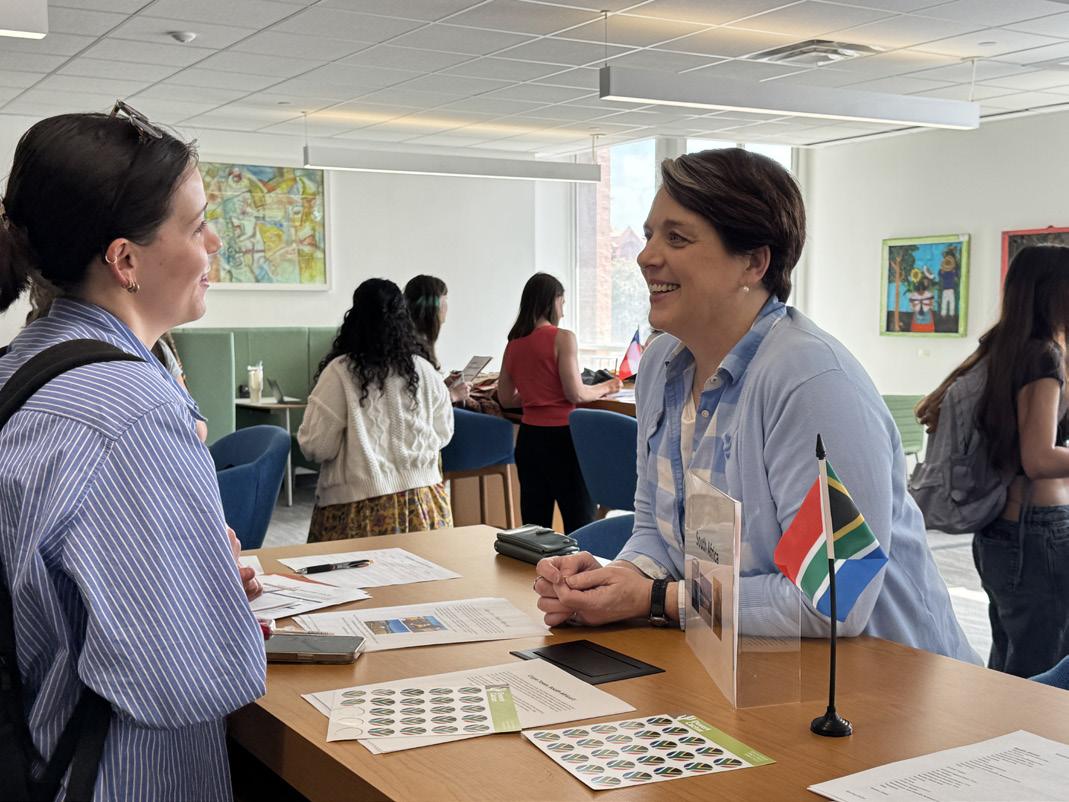
The Office of Global Engagement offers students, faculty and staff opportunities for global research, academic exchange programs and practicum education. The mission is clear: strengthen the School’s priorities by fostering strategic partnerships on campus and internationally, cultivate a thriving community of international students and scholars, and create opportunities for Longhorns to connect with peers and institutions worldwide.
“Social workers address society’s greatest challenges at home and abroad,” said Dr. Noël Busch-Armendariz, associate dean for global engagement. “When a member of our social work community engages globally, we believe they leave to learn and return to lead.”
With more than 40 years of international experience — including living or collaborating on projects in Albania, Dubai, England, India, Ireland, Lebanon, Scotland and South Korea, as well as Romania as a Peace Corps volunteer — Busch-Armendariz leads the Office of Global Engagement with a collaborative, restorative and reciprocal approach. This philosophy drives the work of the global engagement team that currently spans four continents — from long-standing partnerships in India and Estonia to a new Signature program launching in Northern Ireland. The team also includes Tanya Voss, assistant dean for global engagement, and Caitlin Sulley, director of operations.
This fall’s International Education Week at UT Austin offered a chance to showcase how those partnerships prepare students for the challenges ahead — and revealed what’s next for our students and the program.
Systems Thinking in Action
Through Projects with Underserved Communities (PUC), nearly 300 Longhorns from UT Social Work and the Cockrell School of Engineering have collaborated on community-based projects across four continents since 2009. In early November, Farya Phillips, Ph.D., joined an interdisciplinary team of faculty and students at the President’s Award for Global Learning showcase to present findings from a summer research project in Tamil Nadu, India.
Over the summer, students partnered with Church’s Auxiliary for Social Action, a nonprofit, to develop protocols for engaging with rural communities and evaluate the long-term effects of three earlier PUC initiatives. The team evaluated a children’s library built in 2021 in the village of Kallathupatti, now serving 3,000 residents with tutoring, lessons and educational resources. They also assessed a housing project for a nomadic community launched in 2015, created community engagement protocols to guide future service-learning effort and produced a documentary on service-learning and a book of community stories capturing the legacy and resilience of local residents.
“The showcase was more than a presentation — it’s a celebration of what happens when students listen deeply, collaborate across disciplines and learn from the communities they serve,” Phillips said.
An Estonian Partnership Comes Full Circle
What began with an unexpected email in 2014 has fundamentally shaped how Diana DiNitto, Ph.D., understands resilience. DiNitto answered a call for someone to teach in Tallinn University’s social work doctoral program.
Her first semester sparked connections that have endured across six visits and more than a decade. DiNitto taught policy and research to doctoral students from multiple countries, co-supervised a dissertation that received a national award from the Estonian Research Council — the first time a social work student had received that recognition — and witnessed how social work revitalized across the Baltic states following the restoration of independence in 1991.
This April, the collaboration comes full circle. Two of DiNitto’s Estonian colleagues will present at UT Social Work as part of an Erasmus grant partnership between Tallinn University and UT Austin — the first time the Estonian faculty have visited Texas. Merike Sisask, Ph.D., a public health researcher specializing in mental well-being and suicide prevention, and Karmen Toros, an expert in child protection, will discuss their work and the evolution of social work since the restoration of independence.
“Seeing social work thrive following Soviet occupation, seeing students successfully defend their dissertations and make their own contributions — I am so glad I answered that email,” DiNitto said.
From Texas to the Troubles
In late October, UT Social Work and the Office of Global Engagement hosted “Constructive Dialogue, Poetry and Social Imagination,” featuring four distinguished Irish writers from the Seamus Heaney Centre at Queen’s University Belfast. Novelist Glenn Patterson, poets Leontia Flynn and Dawn Watson, and visual artist Rachel Brown shared their experiences of growing up during Northern Ireland’s decades-long conflict. Robert Hull, Consul General of Ireland, Austin and Jenny Browne, a former Michener Center Fellow, State of Texas Poet Laureate (2018), and Distinguished Fulbright Scholar of Creative Writing at Queen’s University in Belfast (2020) collaborated with OGE to bring this dialogue to campus.
The conversation reflected themes central to UT Social Work’s “From Texas to the Troubles,” the Office of Global Engagement’s Signature program, launching in summer 2026. The program will immerse students, faculty, and staff in Austin, Dublin and Belfast as they study constructive dialogue and leadership in divided societies, working with community leaders and practitioners shaped by the Troubles.
Learning Across Borders
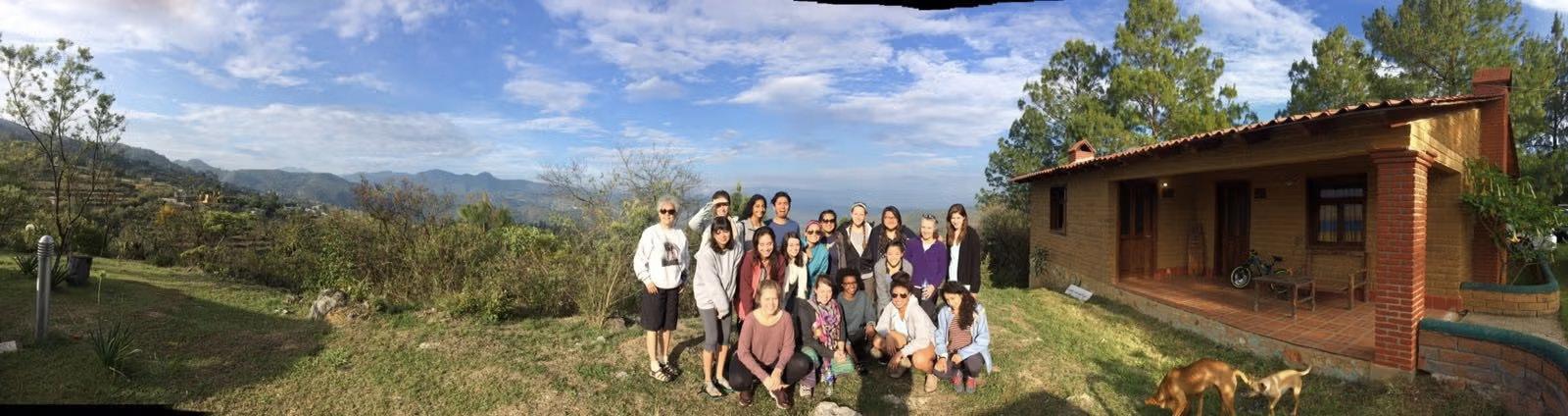
These partnerships extend beyond special initiatives into ongoing practicum opportunities. The Office of Global Engagement coordinates semester-long internships for graduate social work students in Santiago, Chile; Oaxaca, Mexico; Wellington, New Zealand; Cape Town, South Africa; and with the United Nations High Commissioner for Refugees in Geneva, Switzerland and Budapest, Hungary.
“Now more than ever, it’s vitally important that we educate our students about different ways to find solutions to our common problems,” says Tanya Voss, assistant dean for global engagement.
“We all need moments that widen our horizons. Experiences reveal how art, nature and movement — even in the midst of our most pressing social challenges — can transform conflict and open space for authentic, constructive dialogue across difference. With Dean Cole’s vision and global engagement as a priority of the School, we are committed to deepening these transformative opportunities for our students, faculty, and staff, while extending them to our alumni and life-long learners so that our entire community can grow in this work together,” Busch-Armendariz said