

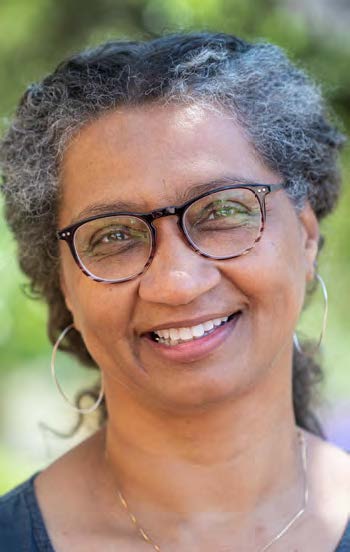
 Before she ever stood in front of a classroom, Diane McDaniel Rhodes (Ph.D. ’14), spent decades working inside the systems social workers navigate every day.
Rhodes taught abuse prevention in schools, directed a shelter for the Center for Battered Women, worked across Austin’s network of social service agencies and eventually served as chief operating officer for SAFE, one of the state’s largest domestic violence organizations.
“It’s hard to help kids when their parents aren’t on board,” she said — a line that captures both the frustration and the persistence that defined her career in direct service.
Rhodes has been a familiar and welcoming face at the School of Social Work for years. She came to UT in 2009 to pursue a Ph.D., not entirely convinced she’d get in. “I thought it would be a test run,” she said with a knowing grin. It wasn’t. Rhodes earned her doctorate in social work, adding it to an undergraduate degree in English and a master’s in theology — a combination that explains a lot about how she thinks.
The dissertation that launched her academic career started, improbably, with a vampire movie.
When the first “Twilight” film came out, Rhodes — then a mother of four with decades of domestic violence work behind her — read the books and recognized something her students needed to see. “He kills you and you live happily ever after,” she said of the franchise’s central romance. The relationship, she argues, is a textbook portrayal of intimate partner violence dressed up as devotion. That analysis became the foundation of her dissertation on popular culture and social problems — and a classroom entry point that students don’t forget.
Her work has had real-world consequences. Rhodes contributed to the effort that resulted in Texas Education Code 37.0831, which requires school districts to adopt and implement a dating violence policy, including a definition of dating violence and reporting procedures for students experiencing it.
The classroom, it turns out, is just another venue for the same work. Rhodes teaches core BSW courses such as generalist practice and social work practice in organization and communities, and will add a graduate theory course in the fall. She brings the same energy to both. She once taught all eight major social work theories through the life of Eleanor Roosevelt. “I just like to play in the sandbox,” she said.
One of her first jobs was in an infant room at a daycare. She laughed, remembering it. That same energy — curious, unselfconscious, eager — is what she sees in her students. What she wants most for them isn’t abstract. “I really want them to have skills and know how to apply them,” she said, “so they can spend the rest of their time in school practicing.”
Underneath that is something harder to teach: the social work value that every person is worthy of attention and help, no matter how chaotic the circumstances.
Rhodes is a Provost’s Teaching Fellow, a graduate of the Stanford school Teaching and Learning Studio — the university’s design-thinking program applied to education — and holds certification by the Association of College and University Educators in Effective College Instruction. She also loves to write fiction, harbors a fascination with forensic anthropology and models openness about her own challenges — including rheumatoid arthritis — part of what drew her to UT’s flexibility when she joined the faculty.
She comes from a family that takes scholarship seriously. Her father taught at the McCombs School of Business for 40 years. Her mother was at the Texas School of Law. When Rhodes graduated with her Ph.D., her father placed the hood on her shoulders.
Rhodes has since created her own mark on the Forty Acres, and continues to leave a significant impact on UT Social Work’s classrooms and culture.