
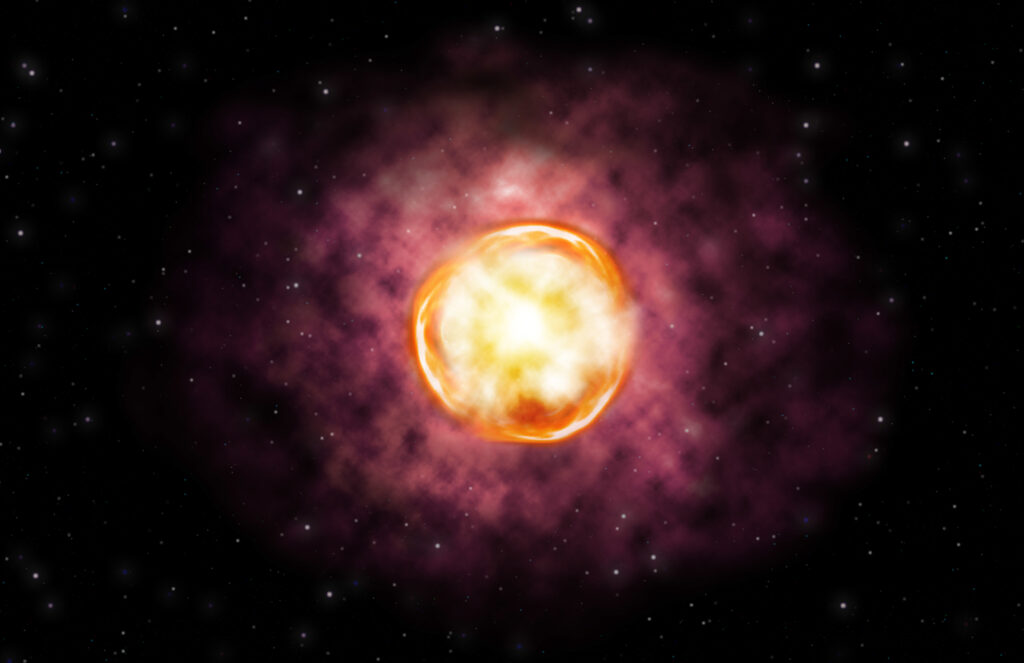
Credit: Gemini Observatory/NSF/AURA/ Illustration by Joy Pollard
Supernovae mark the explosive deaths of stars and play a fundamental role in shaping the Universe by producing heavy elements, driving galactic evolution, and influencing future generations of star formation. While most supernovae follow well-understood observational patterns, rare “exotic” supernovae challenge existing models of stellar evolution and explosion physics, offering insight into the most extreme stellar environments and progenitor systems.
SN2016iet is a peculiar supernova discovered in 2016 by the Gaia mission. Since its discovery, we have followed the supernova with optical photometry and spectroscopy to track its long-term evolution. This supernova stands out for several reasons: an exceptionally long-lasting light curve still visible more than 700 days after explosion, a large offset from its host galaxy, and models suggesting an extremely massive progenitor star of roughly 150–260 solar masses.
Current work also includes analyzing Hubble Space Telescope imaging to study the supernova environment and host galaxy, helping us better understand the progenitor system and the conditions that produced such an extreme explosion.