
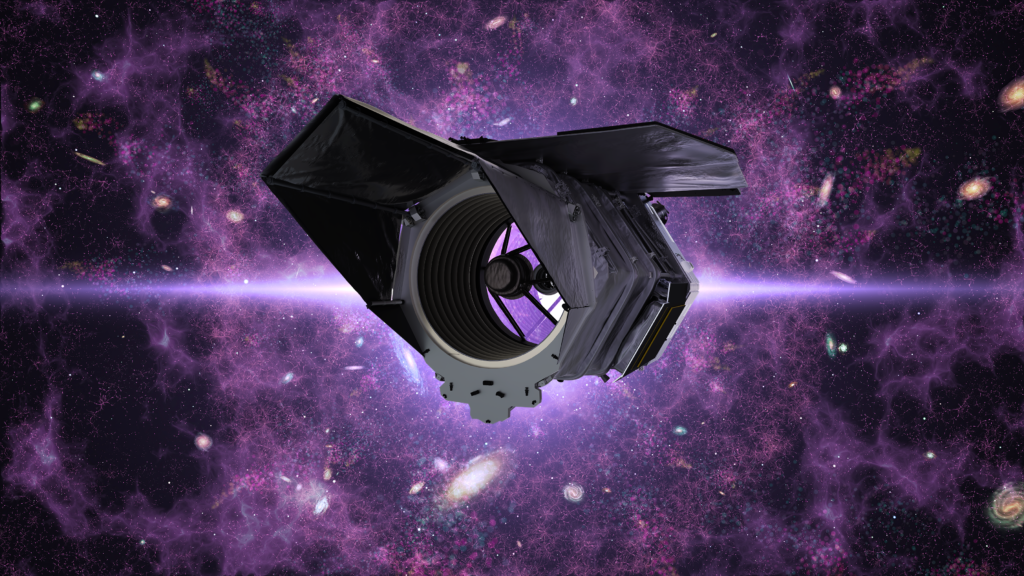
Credit: NASA / IPAC
The Nancy Grace Roman Space Telescope, scheduled for launch this August, will conduct wide-field infrared surveys designed to address fundamental questions in cosmology, galaxy evolution, and time-domain astrophysics. One of its flagship observing programs, the High-Latitude Time-Domain Survey (HLTDS), will repeatedly image large areas of the sky to discover thousands of transient and variable astrophysical events across cosmic time.
Dr. Gomez is the Principal Investigator of NASA Roman Space Telescope Program #19081, a Cycle 1 analysis program focused on identifying and characterizing rare luminous transients discovered by the HLTDS.
The project targets two key classes of transients: superluminous supernovae (SLSNe) and tidal disruption events (TDEs). SLSNe mark the deaths of some of the most massive stars in the Universe and can be observed at extreme distances, making them powerful probes of star formation and stellar evolution in the early Universe. TDEs occur when stars are disrupted by supermassive black holes, providing a unique method for studying black hole growth and evolution across cosmic history.
The team will use machine-learning classification techniques to analyze Roman transient discoveries in real time, enabling rapid follow-up observations with both ground- and space-based facilities. The project will also produce probabilistic catalogs of SLSNe and TDEs to recover faint transient populations and maximize the scientific return of the Roman survey.