…


My graduate supervisors are Lorena Moscardelli and Leopoldo Ruiz Maraggi, and my master’s thesis is on the subsurface energy storage potential of salt domes in the Netherlands, funded by the Jackson School of Geosciences and the GeoH2 Industrial Associate program at the Bureau of Economic Geology at The University of Texas at Austin.


My research explores the interconnection of geoscience, energy, sustainability, and environmental policy. I’ve contributed to a range of projects spanning hydrogen storage, the regulatory challenges of green hydrogen deployment, regional climate action planning, and groundwater-surface water interactions in arid regions. My work has integrated geospatial data analysis, field data collection, and policy frameworks to address complex environmental and energy challenges. Below is a selection of research experiences that reflect my commitment to advancing low-carbon solutions and environmental resilience.
Anna Romina Cervantes, Leopoldo M. Ruiz Maraggi, Lorena G. Moscardelli, Ander Martinez-Doñate, Joaquim Juez-Larré
The University of Texas at Austin – Bureau of Economic Geology
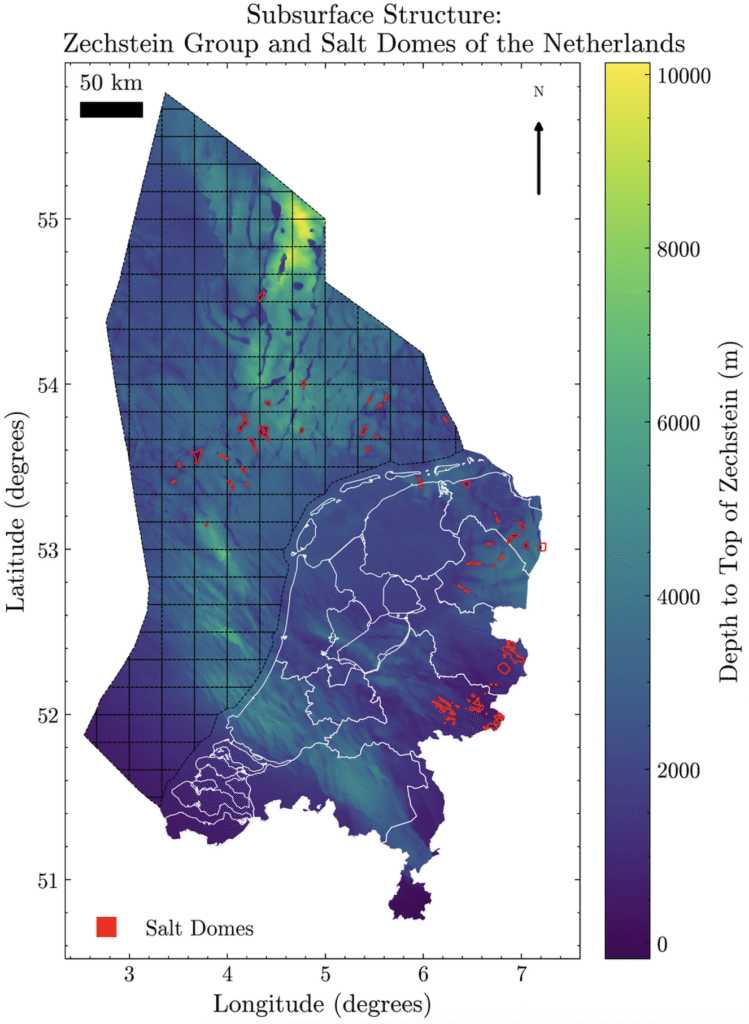
As part of my graduate research, I evaluate the suitability of salt dome formations in the Netherlands for large-scale underground energy storage. The study examines the geologic and technical parameters governing the development of subsurface storage caverns and assesses storage potential for hydrogen, natural gas, and hydrogen–natural gas blends. Using geospatial analysis, site-screening criteria, and interpretation of subsurface datasets, this research estimates regional storage capacities and identifies strategic locations capable of supporting a flexible, low-carbon energy system in the Netherlands.
Recent progress includes the construction of 3D subsurface models for representative onshore and offshore structures. These models are being used to visualize storage capacities for hydrogen, natural gas, and hydrogen–methane blends under multiple development scenarios.
Updates 01/13/26:
As I enter my final semester, I am continuing to refine and advance my thesis research. At this stage, I am finalizing key figures and analyses, with the goal of completing the first three thesis chapters in the coming weeks!
Methods Snapshot:
City of El Paso, TX – Office of Climate & Sustainability
I contributed to the development of El Paso’s first regional climate action plan through research, data synthesis, and community outreach. This work supported a broader EPA Climate Pollution Reduction Grant and helped lay the foundation for policy that addresses environmental justice and resilience in underserved communities.
U.S. Department of Energy – Energy Efficiency & Renewable Energy – Hydrogen & Fuel Cell Technologies Office
As part of the DOE’s Minority Educational Institution Student Partnership Program, I investigated the regulatory and permitting hurdles facing electrolyzer deployment in the U.S., with a special focus on water-related constraints. I analyzed project case studies, mapped permitting pathways, and proposed best practices to streamline the implementation of green hydrogen infrastructure.
U.S. Department of Energy – Pacific Northwest National Laboratory – Mickey Leland Energy Fellowship
At PNNL, I collaborated with a research team to assess the viability of hydrogen storage within existing natural gas reservoirs. My work involved identifying geologic and engineering parameters that influence storage efficiency, developing a screening methodology for potential storage sites, and presenting findings at a DOE technical forum. This research contributed to advancing hydrogen as a sustainable energy carrier.
UTEP Senior Capstone Project
For my undergraduate capstone, I worked with a team to examine salinity variations along the Rio Grande and their impact on agricultural productivity. We used historical data, GIS analysis, and stakeholder interviews to explore solutions such as desalination and upstream flow regulation to improve water quality for irrigation.
UTEP Field Geophysics Course
In a field-based course, I applied geophysical methods such as resistivity, seismic refraction, and GPR to monitor groundwater systems in Valles Caldera, New Mexico. The experience deepened my understanding of subsurface hydrology and the practical application of geophysical tools in environmental investigations.
Undergraduate Research – UTEP Department of Biological Sciences
I studied the genetic diversity of the Arctic plant Carex bigelowii to understand how climate change may be altering vegetation patterns. My role involved field data processing, DNA extraction, and PCR analysis. I presented this work at campus research symposiums, highlighting the implications for Arctic ecosystem resilience.