SHA-3

Via The Register, NIST has chosen a winner in its competition to select a new secure hash algorithm, SHA-3. The winner, Keccak, was apparently selected at least in part because it doesn’t belong to the MD5 family of hash algorithms that SHA-1 and the four SHA-2 algorithms belong to. One of the four authors of this algorithm, Joan Daemen, was also a coauthor of the Rijndael algorithm that was selected for AES.

Also, NIST seems to be saying that SHA-3 should supplement but not replace SHA-2, which is still considered quite secure. (Cryptography guru Bruce Schneider, whose Skein algorithm was one of the five finalists for SHA-3, said last week that he hoped NIST would decide not to pick a new algorithm, because “We didn’t know [in 2006 when the SHA-3 contest was announced] how long the various SHA-2 variants would remain secure. But it’s 2012, and SHA-512 is still looking good.” He seems OK with the result, though.)

2012 Ig Nobel prizes awarded

This year’s Ig Nobel prizes were awarded last night, you can see all the winners. My favorites:

LITERATURE PRIZE: The US Government General Accountability Office, for issuing a report about reports about reports that recommends the preparation of a report about the report about reports about reports.

REFERENCE: “Actions Needed to Evaluate the Impact of Efforts to Estimate Costs of Reports and Studies,” US Government General Accountability Office report GAO-12-480R, May 10, 2012.

PHYSICS PRIZE: Joseph Keller [USA], and Raymond Goldstein [USA and UK], Patrick Warren, and Robin Ball [UK], for calculating the balance of forces that shape and move the hair in a human ponytail.

REFERENCE: “Shape of a Ponytail and the Statistical Physics of Hair Fiber Bundles.” Raymond E. Goldstein, Patrick B. Warren, and Robin C. Ball, Physical Review Letters, vol. 198, no. 7, 2012.
REFERENCE: “Ponytail Motion,” Joseph B. Keller, SIAM [Society for Industrial and Applied Mathematics] Journal of Applied Mathematics, vol. 70, no. 7, 2010, pp. 2667–72.

ATTENDING THE CEREMONY: Joseph Keller, Raymond Goldstein, Patrick Warren, Robin Ball

I was just commenting to my wife the other day that every time I see a girl running by with a pony tail, I wonder how much energy it takes to make the pony tail bounce up and down. I guess I wasn’t the only one.

NEUROSCIENCE PRIZE: Craig Bennett, Abigail Baird, Michael Miller, and George Wolford [USA], for demonstrating that brain researchers, by using complicated instruments and simple statistics, can see meaningful brain activity anywhere — even in a dead salmon.

REFERENCE: “Neural correlates of interspecies perspective taking in the post-mortem Atlantic Salmon: An argument for multiple comparisons correction,” Craig M. Bennett, Abigail A. Baird, Michael B. Miller, and George L. Wolford, 2009.
REFERENCE: “Neural Correlates of Interspecies Perspective Taking in the Post-Mortem Atlantic Salmon: An Argument For Multiple Comparisons Correction,” Craig M. Bennett, Abigail A. Baird, Michael B. Miller, and George L. Wolford, Journal of Serendipitous and Unexpected Results, vol. 1, no. 1, 2010, pp. 1-5.

ATTENDING THE CEREMONY: Craig Bennett, Abigail Baird, Michael Miller, and George Wolford

Not a bug

Apparently the problem that I blogged about last week where Knight Capital lost $440 million in 45 minutes was not caused by a software bug. Instead, it looks like the program written to generate fake transactions while testing in the lab was accidentally included in the package when the trading program was moved to a live test. I wouldn’t want to be the person who put together that package.

Innards

While IBM’s John Ward was upgrading the memory on our z10 BC Sunday morning, I took some pictures.

Front of the z10 BC Central Processor Complex drawer

The front of the Central Processor Complex drawer on our z10 BC

Starting from the left, there are power supplies, then two service processors (little computers that manage the configuration and microcode and such), then six slots for I/O fanouts (only two are populated, since we only have two I/O cages and no coupling links), and then two timing circuits.

Top of Central Processor Complex drawer without memory

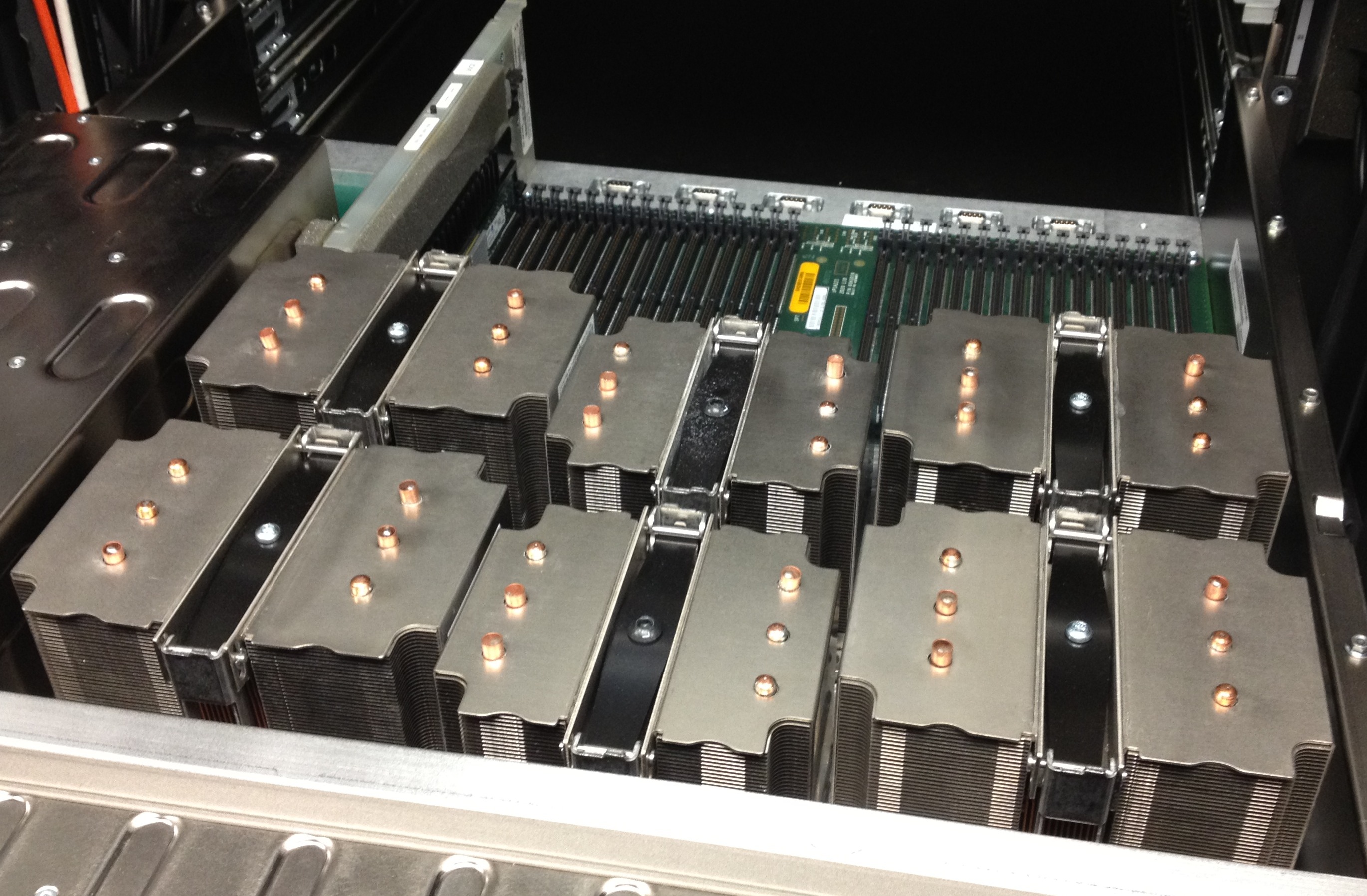
Top view of the CPC drawer with all memory removed

Here is the top of the drawer after John removed all the old memory cards. In the front you see the top of the heat sinks for the processor and controller chips. The four chips on the left and right are the processor chips while the two in the middle are system controller chips (they manage the clocks and memory accesses and contain L2 cache.) To the left are the tops of the power supplies. At the back are the empty slots for the memory cards.

Filled memory slots at the back of the Central Processor Complex drawer

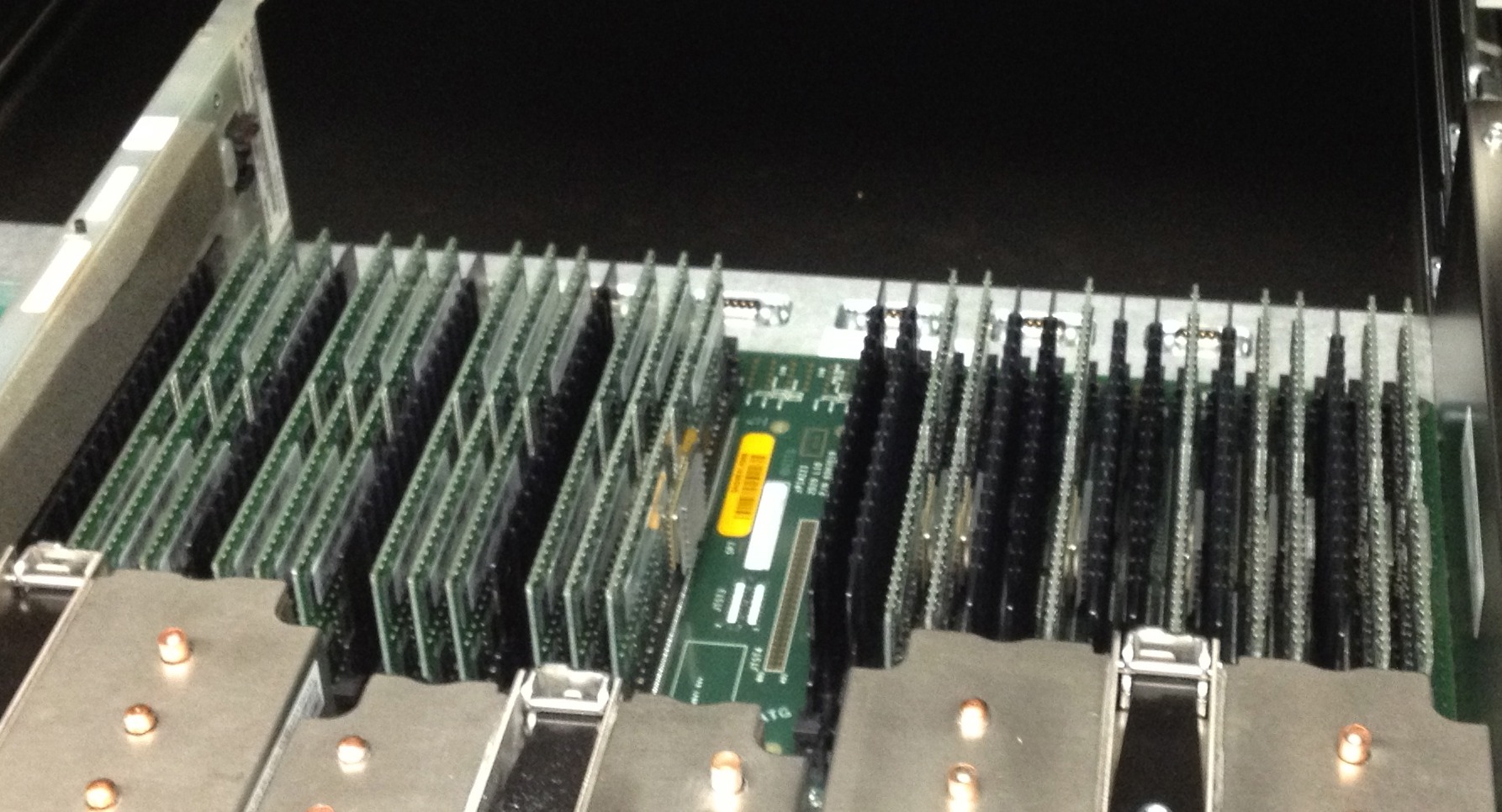
The new memory cards after installation

Here’s the back of the drawer after John has finished installing the new memory.

*UTQA

I was thinking about viewing SPOOL files, and I thought I’d share the story of how *UTQA came to be written.

COM-PLETE comes with a SPOOL utility, *UQ. Some time around 1990 or so, we got a new release of COM-PLETE that significantly changed the appearance of the output of the A subcommand, the one that shows active jobs. Lots and lots of developers were complaining, with some reason since the old version had showed drained and idle initiators while the new one doesn’t. We had recently installed the first version of Natural Process (since renamed Entire System Server) and I was figuring out what could be done with it. As I read about the SPOOL-related views, I thought, “I could write a simple program that replicated the old behavior of *UQ’s A screen.” So I did. I gave it what I thought was the obvious name, *UTQA, since it was a UT utility that replicated the old *UQ A subcommand. I showed it to John Camden and he wanted it expanded to replicate all the functionality of *UQ. I didn’t see much point in that, since everything else in *UQ still worked like before. However, Marshall Thomason, our DBA at the time, decided to run with it, so he wrote the rest of this application. A few other people have maintained it since then; in particular, Jim Bullock added support for sending output to “green print” a few years ago.

So that’s the story. If you’re wondering what I use, I usually use Natural ISPF. I’ll go to *UTQA when I want to see idle or drained initiators, or to use the green print function. I still use *UQ to scan SYSLOG, or for its non-SPOOL functionality.


Kuali

The past few days we’ve had folks from the Kuali Foundation here giving us an overview of their projects, so I thought I’d post my reactions.

I think the Kuali business model—developing open source software in a consortium of similar organizations—makes the most sense for the University. Our current model of developing everything on our own seems less and less sustainable as time goes by; even if we were to continue developing what we’ve already done indefinitely we’d want to try to find other partner institutions to share development efforts with eventually. I think it would be easier and cheaper to convert to something open source like Kuali rather than a vendor product where we would have to rely on their documentation rather than being able to look at the source code to see what’s actually going on. Also, as a member of a consortium we would have more influence on product directions and features than as mere customers of a vendor. The only real advantage of going with a vendor from a management perspective is you have someone else to blame when things go wrong.

Given that the business model seems good, the only question is how is the quality of the product. Now, it’s hard to judge that just on presentations and demos, but they seem to have done a reasonably good job of designing and implementing their systems. So if it were up to me, I’d say we should plan to convert to Kuali.

IT Labor

Just to provide some support for point 1 in my last post:

Cringely: A lesson on IT labor economics from Memphis

When ServiceMaster announced its decision to cancel its contract with IBM and to in-source a new IT team, the company had to find 200 solid IT people immediately. Memphis is a small community and there can’t be that many skilled IT workers there, right?  ServiceMaster held a job fair one Saturday and over 1000 people attended.  They talked to them all, invited the best back for second interviews, and two weeks later ServiceMaster had a new IT department.  The company is reportedly happy with the new department whose workers are probably more skilled and more experienced than the IBMers they are replacing.

Read the whole thing. No, really, read it.

Labor costs represent a very high percentage of IT support costs. Managers who note this usually think the solution is to find cheaper labor. This is invariably wrong.