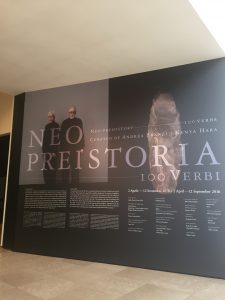
“By combining 100 tools and 100 verbs, we attempted to delineate the history of human desires as fixed form of poetry… This exhibition is the result of considering, with Mr. Andrea Brandi, what lies ahead in this kind of human evolution, and whether there is really any hope.”
One of the most striking aspects of the Neo-preistoria exhibit at Treinnale was at the sheer rawness of the entire experience. The exhibited consisted of a series of boards (numbered from 1-100, as mentioned in the quote above) which each explicitly stated a verb that in some form was reflective of human behavior. This entire experience was organized to make the individual feel as if they are experiencing the greatest and most troubling aspects of the human condition,which are infinite faults and ambitions of achieving progress.
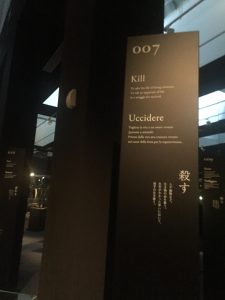
Something that truly made an effect on my own experience while walking through this exhibit was how brutally honest Brandi and Hara were in their description of human progress. For example, number 7 within the exhibited reflected on “Kill[ing]”. They described this as, “To take the life from living creatures. To rob an opponent of life. In a struggle for survival.” To me, the key words within this poem is the idea that killing is automatically linked to “surviving”, and that in order to survive, one must kill. Other words such as “Obey” included a similar connotation, Brandi and Hara write that obey is to, “To accept the power of the strong without resistance.” In essence, each board seemed to innately posses a theme of hopelessness, which is an interesting concept due to the fact that Brandi and Hara created this entire space in order to analyze if there is any hope for the human condition. Of course, one should remember that experiencing the exhibit from a crystalized point of view is simply impossible, seeing that Brandi and Hara have attached their own definitions to the experiences.
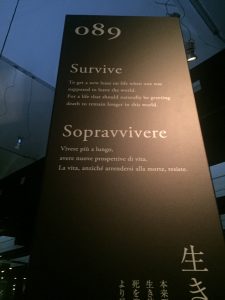
This highly structured way of analyzing human progress was especially prominent in number 89, which was labeled “Survive”. Brandi and Hara define Survive as, “To get a new lease on life when one was supposed to leave the world. For a life that should naturally be greeting death to remain longer in this world.” Accompanied by a range of faux drugs on display, Brandi and Hara form a complex identity of survival through their simple words. This is achieved by bringing to surface that to survive is to also cheat death. And through doing so, humans are creating an imbalance within the world. Although survival is often linked with awe and positivity, Brandi and Hara highlight an often overlooked aspect of surviving, that through the act of survival, humans are disalining the natural order of the world.