After our walks and examination of the two areas, City Life and the Rustic House, we moved onto how we wanted to represent our observations and question about modernity in an effective and efficient way.
While trying to answer the question about what modernity is and how both City Life and the Rustic House could somehow fit into this category, we also wanted to focus our presentation on different ways of living in Milan. This city is constantly developing. It is a lively area with a whole bunch of history but also a whole bunch of building. Because of this combination of new and old, and the fact that almost every decade is represented in the architecture as you walk down the street, Milan is called a patchwork. And this patchwork is constantly growing. New developments are not necessarily trying to change Milan but simply to add on a new way of living in the city.
Modern is relative term pertaining to a certain instances in time. Over the years, many movements have claimed to be modern. So what is modern? If modern acts as a time capsule for different movements, we question what certain modern styles can tell about the people attracted to it or the residents who choose to live within it? Is there a type? We observed the area between two contrasting community to evaluate the individuals who choose to make up the community and to test whether each building attracts the like-minded people who share the same values as the movements.
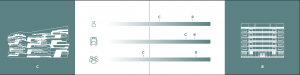
These two residencies, and all other apartment buildings, offer the people of Milan different ways to live their lives. The surrounding green areas, sounds, smells, gates, parking, colors, and many other factors affect the way people live in their communities. It also affects the type of people who would decide to live there. In order to represent this, we decided to divide our observations into three main sections: people, commute and community.
For people, we looked at the residents. In City Life, although children are seen in the area, it does not appear to be a family oriented environment. The residents need to have a certain economic standing in order to afford the luxury apartments. It is even known for housing professional athletes and musicians. The apartment prices can reach over 2 million euro. The Rustic House
The commute also affects how people interact with the spaces. In terms of driving and parking, City Life is the largest car free area in Milan and one of the biggest in Europe, however it offers underground parking space for over 7,000 vehicles. Rustic House on the other hand has a bunch of parking in the surrounding area and offers free access at any place with loose gravel. For underground transportation, the closest metros to City Life are Amendola (5 minute walk, 400m) and Tre Torri (9 minute walk, 650m). The closest metro to Rustic House is Gerusalemme (5 minute walk, 450m), the second closet is nearly 20 minutes away (walking). It seems that City Life is much more welcoming to people taking the metro.
The last section is community. We analyzed this in terms of the community within each residency and the larger community surrounding it. In City Life, the gated community promotes exclusion of outsiders more than the safety of the residents. Because it is trying to become self sufficient and the communal parks are located at the center of the property, the builders of City Life are more focused on enhancing the community with the space than with the community outside their gates. On the other hand, the courtyard of the Rustic House is open on one side, available to both the residents of the house as well as the surrounding metropolitan area. And to kill two birds with one stone, there are bridges across the one open side that promote community within the building as well.