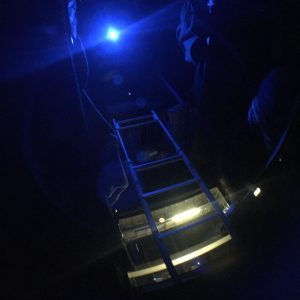
The overnight train from Paris was packed; six travelers stacked into 6 bunk beds for 11 hours with frequent stops and persistent blue light. Barely enough space for my body, I arrived in Milan exhausted.. Milano Centrale welcomed me at six in the morning with a vegan brioche and a soy cappuccino. I started my sketch notebook and noted the the travel mishaps and the surprises of Paris in the days previous.
Discussing the Futurists this week led me to examine my own past. As a teenager, I was inspired by similar propaganda which called for a break with history, though strongly against the misogyny and nationalism of the Marinetti. Looking back at the writings from one of the manifestos from my teenage years, I found writings in accordance with the Futurists, with the same sense of urgency as the Futurist Manifesto.
“It is thus that each of us is dominated by history: the past lies upon us like a dead hand, guiding and controlling as if from the grave. At the same time as it gives the individual a conception of herself, an “identity,” it piles weight upon her that she must fight to shake off if she is to remain light and free enough to continue reinventing her life and herself. It is the same for the artist: even the most challenging innovations eventually become crutches and clichés. Once an artist has come up with one good solution for a creative problem, it is hard for her to break free of it to conceive of other possible solutions. That is why most great artists can only offer a few really revolutionary ideas: they become trapped by the very systems they create, just as these systems trap those who come after. It is hard to do something entirely new when one finds oneself up against a thousand years of painting history and tradition. And this is the same for the lover, for the mathematician and the adventurer: for all, the past is an adversary to action in the present, an ever-increasing force of inertia that must be overcome.”
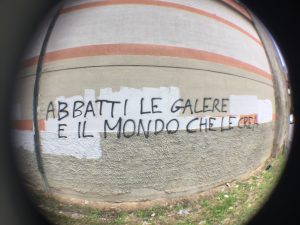
And so I’ve found myself suspended between the overwhelming presence of design in the city and the gritty underbelly of radical politics. Professor insists that design is a means to a political end, but I’m still trying to figure out how design, which is typically reserved for turning materials into commodities, can be related to the things I care about. Regardless, I’m excited to be in Milan, surrounded by both well-considered chairs and insurrectionary graffiti.
—————
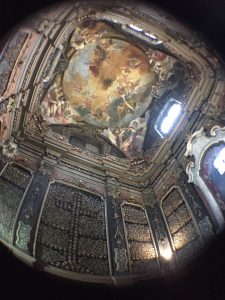
Aside from the big ideas of design and revolution, I’ve taken a few moments to find the city on my own. The ossuary in the middle of the city was a literal tower of bones and skulls of the poor who died in the local hospital. It’s only a few blocks away from the Duomo, off to the side of another cathedral.
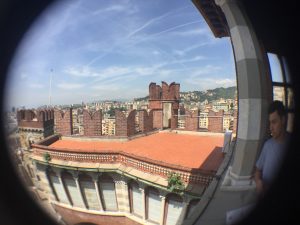
A quick train ride brought my housemate Robert and me to Genoa, home of Christopher Columbus and focaccia. We left the train station and ducked into a narrow alley which climbed up a hill. “There must be a castle at the top, right?” I asked Robert when I realized I was already drenched in sweat. There was in fact a castle at the top, and we visited the collection of an Italian colonizer who had collected artifacts from all over the world.
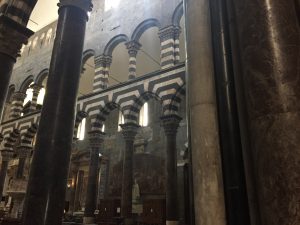
Descending back into the port city, we grabbed some food from the grocery and sat on the stairs leading up to the Cattedrale di San Lorenzo, a surprising building from the 12th century made of black and white checkered marble.
And that was my first week in Milan.