There were so many moments from this past month I wanted to highlight so I made a video about what a few of the places we visited taught me. The overall theme of “Don’t forget to look up” is inspired by Professor Kate’s message to us when we went to museums, studios, and other creative spaces because there would always be a beautiful detail above us that we could’ve missed if we didn’t look up. That phrase and concept stuck with me throughout the month and reminded me to really soak up everything we were seeing and experiencing.
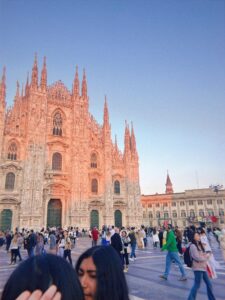
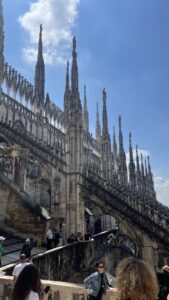
I never understood just how influential Italy has been in the design world until this trip. I will never forget walking up the metro stairs and seeing the Duomo for the first time. As a designer, you strive to make timeless designs, and the Duomo is a perfect example of that. Without even knowing any of the history behind it, anyone could look at the Duomo, during any time period, and they would always be met with the same feelings of awe and wonder. As I walked past this building time and time again, the awe of it all remained. This was the first of many instances in which I realized the difference between good and great design. Good design is eye-catching, but great design makes you keep turning your head and coming back for more.
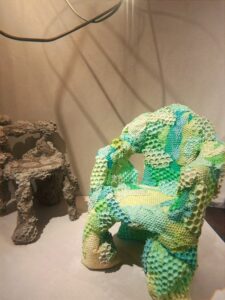
Spazio Rosanna Orlandi, along with other studios we visited, helped me learn about valuable design. What was an exhibition space for me was a shopping space for others. While the designs were so beautiful and skillfully crafted, I couldn’t wrap my head around the fact that they were being sold for thousands and tens of thousands of euros. Sometimes I’d say to myself, “With enough practice, I could make something like this for much less,” and I probably could. The difference is that I didn’t. I didn’t come up with the ideas of anything I saw. I didn’t take the time to master the craftsmanship of furniture making. Even if I did make a chair just like the ones I saw, it would automatically be less valuable because it would lack authentic creativity, no matter how beautiful it was. Here, I learned that creativity and authenticity are far more valuable than one might imagine, especially in an age where artificial intelligence can “be creative” for you. Moving forward as a designer, I must recognize the beauty and novelty in my own creations in order to communicate and stand by its value.
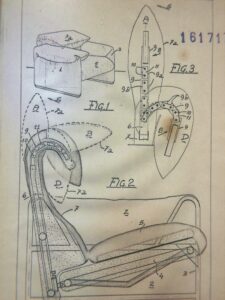
The ADI museum gave so much insight into the immense amount of detail that goes into design. There was a specific couch, which I eventually saw and sat in at Cassina, that almost folded in on itself. In the museum, there were sketches of the design with incredible details and measurements. When I later sat in the couch, it felt as though it was made just for me. The way I perfectly sank into it and could position myself just how I wanted almost felt like magic. Its perfection would cause the average person to overlook this extreme attention to detail. I was able to truly appreciate the couch as a work of art only because I saw the sketches and the work that was put into it. Good design makes you notice details, but great design is so detailed that it is almost overlooked.
One of my favorite visits was Studio FM. Upon first walking in, I was mesmerized by the graphic design. I wish I could’ve stayed in the studio for hours, learning about all of the projects they’ve done. I was inspired by the immense amount of research that was put into each and every project. When explained to us, it seemed so easy and obvious, but it takes a truly talented and design-minded person to be able to translate history into icons, logos, and graphics. Learning about the work behind the Mudec museum branding and then seeing it in person really took me along the design journey from ideation to production. This studio cemented one of my biggest takeaways of the whole trip: research, research, research!! Above all, I think your level of research is what makes you a great designer, not just a good designer.
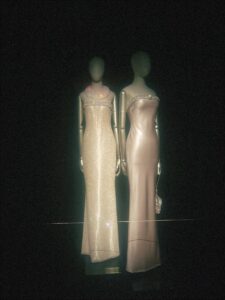
Finally, my favorite stop of all was the Armani Silos. I felt like I was in fashion heaven. I know some critique Armani for having the same silhouettes, but I think there’s beauty in that. I learned that sometimes it pays to have a specific style. When people want that particular aesthetic, they know exactly who to go to. When you see a Giorgio Armani dress on a red carpet, you know it’s a Giorgio Armani dress. That kind of recognition can be more powerful than any other advertising campaign. Great designers know who they are and do not aimlessly bend to the world around them; they just adapt and shift.
It’s hard to condense everything we’ve seen over three weeks into just one post, but I can say for certain that this experience has changed me forever, both as a designer and a person. While all the designs we’ve seen have been incredible on their own, design and art is so much better when you can share it with others. I will value and remember all the lessons I’ve learned, but the things that I will cherish most will be the laughter, meals, bus naps, and jokes that we shared with one another. I couldn’t have asked for more out of this journey and it’s all because of the people I embarked on it with.Milan will remain at the foundation of every design I make and will forever have a piece of my heart.
Industrial design has unfortunately been a discipline that I’ve put into a box before now, thinking of it as boring because it’s the design of random everyday objects. This trip completely transformed that idea for me- the design of everyday objects is such an integral part of shaping our society. The visits within this course taught me about so many facets of design, and I’ll cover 6 of these facets along with the main visit that showcased each one in this review: lighting, sound, shape, material, presentation, and cultural awareness.
Lighting: Pirelli Hangar
The experience of Pirelli Hangar on our very last day of class was transformative! The display about the bombing of Hiroshima relies entirely on light to tell its story- in particular, the walkthrough experience with mirrors relies on both artificial and natural light to guide users through the mirror maze. It showed me how light- or lack thereof- has an undeniable power to transform an audience emotionally and really captivate their attention.
Sound: The Brion Tomb
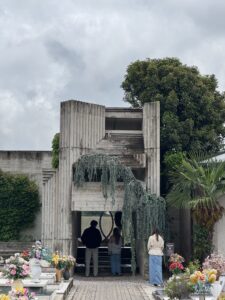
The tomb we visited in Treviso was one of the most peaceful places I’ve ever been, and not just because of the flowing abstract architecture of the space. As I stepped over certain tiles in the tomb, they shifted and created a deep, resonant tone that echoed throughout the space. These sounds mingled with environmental noises of running water and chirping birds, and created an auditory atmosphere that felt grounding and meditative. It was a prime example of architecture built with an end emotion in sight.
Shape: Vico Magistretti
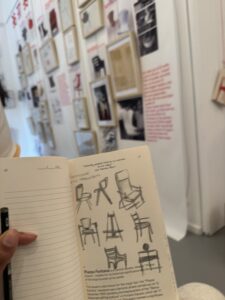
The chairs at the gallery of Vico Magistretti that we visit experimented copiously with shape- ranging from short and wide to lean and tall, and incorporating all sorts of straight edges and curves on their designs. I thought it was interesting to read about the different design intents for each one- some were comfort, others posture, and others aesthetics. The shapes of the chairs also influences how my classmates engaged with them- sinking in with a sigh, perching on the end, or simply studying the chair rather than sitting in it. It was a great experience to sketch the chairs as well and simplify them down to their core shapes.
Material: Artemide
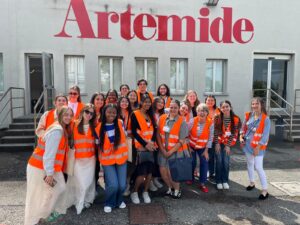
The Artemide lighting design visit was one of my favorite experiences of the trip. Not only did we get to see final design products in the showroom, but we had the amazing opportunity to tour the production factory and see how materials and lamps were tested before being added to the catalog. The extensive testing process behind Artemide’s lamps was a testament to their high quality as well as the company’s innovation in material selection, and it was a wonderful blend of art and science.
Presentation: Castiglioni
The visit to Castiglioni’s studio showed me the importance of personal presentation in addition to design- I don’t think we would have been as fascinated by all of the designs in the studio if they hadn’t been presented so enthusiastically by Giovanna, Castiglioni’s daughter. She constantly made us engage with learning about the functions of each product, as well as making us laugh along the way.
Cultural awareness: The Biennale
One of the things that surprised me in Europe was how often past inequalities are recognized and reflected upon. I think I had some preconceived notions about European countries having an ego about their histories, even when that history involves countless colonizations and unjust acquisition of resources.
At the Biennale in Venice however, especially at Britain’s pavilion, I noticed that most of the exhibits focused on revisiting unjust moments of Britain’s past and reflecting on them. It was a very culturally-aware display that was memorable to me.
Overall, this course gave me many insights into how designers and architects can create impactful products and spaces. I’m so grateful for all the hands on learning that I had the opportunity to do as a part of this class- I’m really going to miss it. I know I can take all of the soft skills and design insights I gained with me throughout the rest of my academic journey and into my professional career, and I hope to return to Milan again sometime in the future!
Getting to understand Milan from a non-tourist perspective was what made me fall in love with the city. Coming to this trip I was scared I wouldn’t make the most out of it, but after these past 4 weeks I truly believe this experience has forever changed my whole practice as a designer.
Usually when people visit a new city they go to touristic areas, they learn some of the history, and go to the most attractive places. Although we did begin our journey by exploring iconic places like the Duomo, we got to dig deeper into the history and roots of Milan to understand the role of design in the city. I experienced a place that’s embedded in the design culture, every aspect of Milan from the architecture to a chair outside a coffee shop feels so intentional and connected to the artistic side of the city.
It’s hard to choose which moments during this trip were my favorite, but below there’s some that have impacted me the most.
First, the Duomo on our second day in Milan. I think starting with this was perfect. It was our second day in Milan after a very exhausting flight and coming out of that train station and seeing it right in front of me impacted me so much. I had seen it before in pictures, but seeing it there in front of me left me in a state of awe. It finally hit me that I was in Milan about to start my so long waited study abroad. Every detail, every corner was so beautiful I could not stop staring at it every time I walked by the plaza even on my last day in this city.
Visiting studios and seeing the work that goes behind what is usually displayed to the public was also a very interesting thing to learn about. On May 20 and 21, we went to two of my favorite places in Milan: Fondanzione Achille Castiglioni and Artemide. I learned about the research and time that goes behind each product. Seeing how playful and fun design can be in Castiglioni and at the same time the amount of research and tests it takes to put a new product in the market in Artemide, we’re two perspectives I had never seen in person. They both taught me how essential is every step of the design process. I loved it so much I would love to work developing the first stages of a new product in a factory environment.
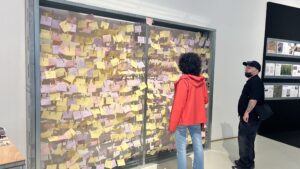
The Triennale di Milano was without a doubt the most impactful visit during this trip. Seeing the recent works of designers, the current conversation, and the research behind this big works was life changing. Seeing works like El Tendedero by Monica Mayer made me think of home back in Mexico. It is an exhibition/mural that has been replicated in almost every school by the students as a way to express their concerns, feelings, and calling out sexist behaviors from any person involved in the school, from students to professors. Seeing a part of home that is so common and part of the education culture in a big stage like the Triennale felt so surreal. Other works were equally as impactful but that one was the one that stayed with me the most.
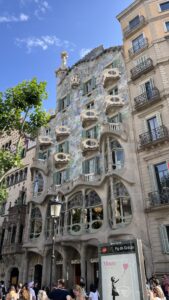
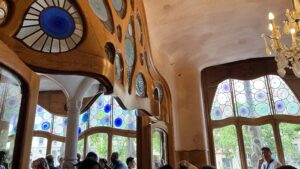
For my last impactful moment of this past month I chose my weekend trip to Barcelona. We visited lots of Gaudi’s work, truly amazing. The Sagrada Familia was a dream seeing it in real life, and although we couldn’t get tickets to go inside, we did get to go inside Casa Batlló. I remember learning about his works and this specific house my first semester of college during an architecture course, but being inside this house felt like being in a new world. Seeing the details, the finishes on the walls, the curved doors and windows, the use of tiles, everything working together towards this new concept of art and architecture was so beautiful. It felt like I was underwater for 2 hours. The tour taught us more about the history of the building, and it ended with an immersive experience that showcased all of Gaudi’s work. It was an amazing way to end my trip here in Europe.
I will forever be grateful for this experience. A year ago the idea of ever existing in another continent felt impossible and now it’s time to go back. I learned so much and I can’t wait to go home and tell my family all about it. This will definitely be the trip I won’t stop talking about for the next years. I’ll make sure everyone gets tired of hearing me talk about how studying abroad changed my whole perspective not just in the design field but in my life in general :)
These last two weeks were packed but exciting! Week 3 was probably my favorite so far, featuring a multitude of museum and gallery visits, including the Alfa Romeo museum, Artemide lighting, and the Castiglioni gallery. My favorite was probably La Scala on Monday though, I never thought I would enjoy a vocalist/opera so much before!
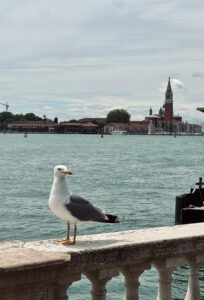
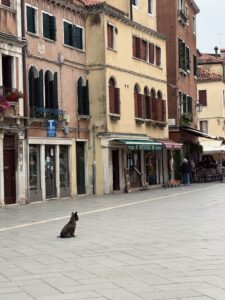
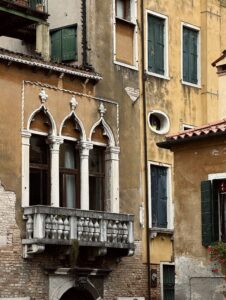
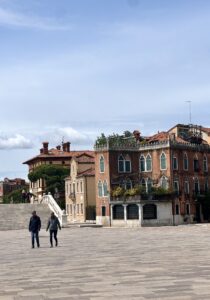
The latter part of week three was an overnight trip to Treviso and Venice. I had my favorite meal of the trip in Treviso at Le Corderie, where the appetizers were absolutely amazing. And then it was fascinating to finally see Venice, a city I’ve seen in movies and pictures for so long.
Over the weekend I visited Pisa and Monterosso, and went to an AC Milan game. Then we had our final week of the program, featuring the Armani Silos exhibit, the Triennale, and the trip to Alessi in Omegna.
I really feel like I’ve been settling in during these weeks, getting used to daily life in Milan, starting to use Italian more, and engaging with people outside of the program. It’s also been really nice to meet everyone from IES Abroad and learn about their lives in Milan.
From the moment that I landed in Milan, it became clear that it was a city of intention, where architecture and design were crafted with both functionality and beauty in mind. There was design in everything, every object or building that we looked at, but that principle became more clear at certain sites. In particular, I believe that some examples of design resonated more strongly because of their ability to define space. Thus, I have selected the moments below for their manipulation of space, how they are able to control where people can go or what they’re intended to do.
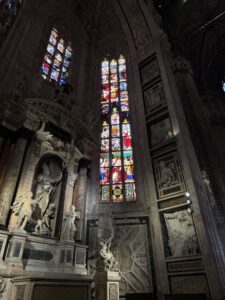
1) Interior of the Duomo, featuring a stained glass window.
The first site where the power of design became evident to me was the Duomo, which we saw on the first day of class. It is a giant building whose visual presence cannot be missed, from the moment that you walk into the plaza or exit the metro station. People are forced to walk around it if they are going to the Museo del Novecento or the Galleria. Even inside, the high, vaulted ceilings, floor to ceiling stained glass windows, and ambient lighting communicate the sacred nature of the Duomo. Based on the buildings manipulation of space, its effect and function become clear.
2) Arco della Pace, looking through the archway.
The second site at which I observed this power did not happen during a class excursion, but rather on our group walk for the Mapping the City assignment. The Arco della Pace features beautiful design on an impressive scale – my very first impression was of how ornate the arch appeared, even at a distance. The space of this building is especially interesting as well, as the design encourages people to walk under it instead of around it. However, its grand, neoclassical nature almost makes you feel intimidated to do so, like you may not be nearly as grand as the arch.
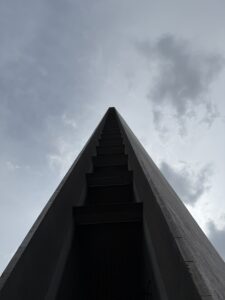
3) Lombardy Region Government Building, as seen looking upwards from the outside.
The third site I have included here is built on a manipulation of space. The Lombardy Region Building is a government building in Milan, but it is probably the most unique and unusual office building that I have ever seen. The building manipulates space for hundreds of meters up into the air, and the supports of the building are intended to support that. As we learned on our tour, the pillar supports of the building thin out as you go higher and higher. In my view, the in-person experience of being in the building is in line with that physical architecture. Looking up, the building seems to disappear into a point in the sky, looming far above you. I do believe that this effect is potentially beneficial for a government – a government wants to communicate its power over the city, its ability to control and see what is going on.
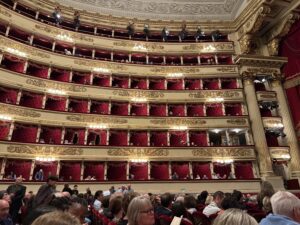
4) La Scala, as seen in the concert hall.
The fourth site, La Scala, is both a moment and a piece of design. My view of this building is strongly influenced by the suspense that led up to our visit as a class, which fueled lots of dress and shoe shopping. Preparing to go to La Scala was an event in and of itself, which suggests that the power of this building’s design extends far beyond the physical structure. When we arrived at the performance hall, those boundaries between interpersonal and spatial experience continued to blur. Most of the seats stretched out in two groups of rows, although I could see smaller seating rooms on the floors above. The high ceilings and stage immediately suggest that the room is a theater meant for performance. Furthermore, the interior design of the building seems to be chosen carefully to support the ornate and grand architecture. The red seats and the golden decoration communicate luxury, as if everything is plush and sparkly in this room.
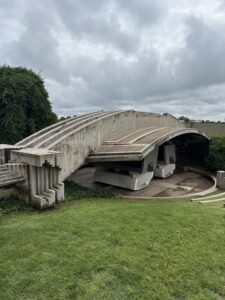
5) Memoriale Brion
The fifth site that I selected, the Memoriale Brion, is something that I already discussed in my Week 3 blog post. However, I loved this site and visit so much that I couldn’t leave it out of my overall in review. I first studied the tomb in class and was intrigued by its shape and design, but I was still completely unprepared for how it felt in person. The curve of upper section swoops over the two tombs, granting a protective feeling similar to that of a wing or a mound. As a visitor to the site, the spatial layout of the memorial welcomed me in, demonstrating that it was alright to walk around and explore. Everywhere that I looked, there were hidden details of design: gold accents, interlocking circles, beautiful tiling, and geometric edges.
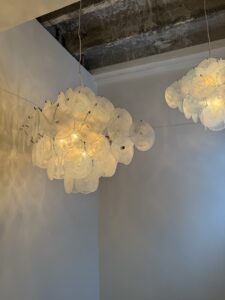
6) Pair of lights as seen at Fragile show-room.
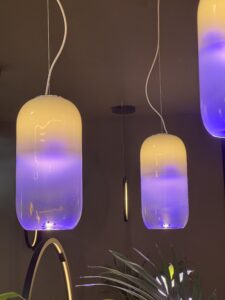
Finally, the last site that I have selected is truly more of a moment. During our visit to the Fragile showroom, this pair of lamps caught my eye, and I took dozens of photos trying to capture the way that they reflected the light. It seems that the lamp itself is a wire frame upon which many circular pieces of glass are hung, and there is a light fixture inside. This structure is what produced such variation in the reflection of the light, and thus the space around the lamp. Therefore, it seems that lamps, these small pieces of design, are just as capable of manipulating space and experience as large buildings. Even in such a small scale, I felt like I flowed with the changes in the light, and I appreciated its soft, calming glow.
Overall, this Maymester taught me that design is always present around me, waiting to be observed in architecture, objects, or moments. I hope that I will be just as vigilant about noticing it when I return to Austin, regardless of how many other things also demand attention. In addition, I want to continue noticing the intersection between interpersonal and spatial experience. Milan has showed me that a carefully designed building is capable of influencing us, our actions, and our feelings. How might the design of other cities do the same?
As I look back on this semester, I can now see how ignorant I was to the intricate details that make up the world, and this is done through the genius of design.
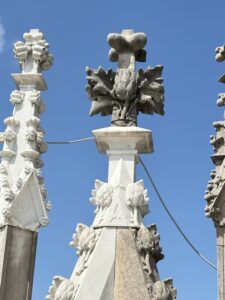
During our very first introduction to Milan, we were brought up to the Duomo where we took in the cascading views of the city. While spotting out the buildings we would later have to do our projects over, we were told to look at how every spire was accompanied by a different design funded by differing designers. At first glance, I would have never noticed this intricacy, but with direction I found the beauty in these creations lied in the story they told. Each spire held the same core elements of having a base leading up to the center display which is where variation occurred, and then melded back into a point at the top. While they all shared this similarity, each one was unique due to its designer and what they believed would represent Milan, Duomo, etc best to be displayed for generations on. These delicate details are what hold such deep meaning below the surface and this was my first exposure to the intricacies of design.
Like I mentioned earlier, we had a project called ‘Mapping the City’ and my group was assigned two drastically opposing architectural buildings. Bosco Verticale and the Federazione del Fasci Milanesi were two quite intimidating locations for differing reasons. Federazione del Fasci Milanesi was originally a household but later turned into Mussolini’s headquarters in Milano, which was evident by the very clean cut straight lines, minimalist design, and overall fascist period style. In opposition, Bosco Verticale was newly build in sustainability and climate change efforts to fix Milans pollution issues by planting thousands of trees in two shiny, high-rise, modern buildings that takes your breath away at first glance. These two contrasted each other in many ways, but through this project we were forced to look deeper and find the connections between the two places. Wealth, power, old to new life, and security were all noted and the design of each element of these buildings preserves its intent which backs those findings. Again, I was flabbergasted that one could pick out specific details about a building and know what period it was most likely built in, and further the history behind the building based on built in contact clues.
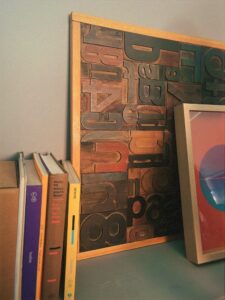
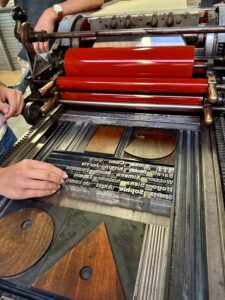
This idea of historical reference was further embellished in my memory and understanding when we visited Tipoteca in Treviso. This letter press and type studio was the perfect representation of design in life and at work. `As the wonderful guide explained, every type face has its own history, and its own design that makes it unique to a point where it can hold meaning of its own without even looking at the words its letters are spelling out. I found myself naturally gravitating to 1930’s fonts, however, this was a very trying time in the world, so I know there is an old soul behind those fonts with stories of wisdom, grit and times of resilience. There is something beautiful about knowing the history behind something so well known, yet so overlooked. As a stem major, this was an epiphany I had, and continued rounding back to over the semester. Tipoteca showed how letter pressing has evolved, the amount of time it takes to print one page of text, and how tedious print pressing can be. I found a new appreciation for literature in the foundational construction of a handmade book because each step has so much purpose and each letter quite literally must fit perfectly in the press making everything down to the size and font of one letter on a line of text deeply thought out and intentional.
Flashing back to the amazing visit we had with the genius Cristiano Bottino, I could see so vividly how intentional every detail of his work was and it was astonishing. From his talk I learned that some of the best designs come from and start with a simple and broad central idea and flower out from there. Specifically, Cristiano mentioned a project of his where he designed an airports signage and specific features with the lounge, carpet, etc. My jaw was on the floor by the use of the simple logo for an airplane, a simple and universal icon, implemented into all of his design work. Universal understanding of certain designs as well is something unique and so delicate as to not offend certain cultures and to surpass any sort of language barriers that could arise. Universal designs and graphics such as fire and stop have saved so many lives, but I never thought about the specificity in using authoritarian font for the stop sign and how that would be better than a cursive font. I never thought about how an airplane tilted up looks like its taking off but an airplane tilted down looks like its crashing unless you add a wheel. Little things like this are the details I’m describing that are like a kaleidoscope in designers minds. They can shift one concept into something completely new and beautiful in the right lighting and the tilt of the head. It’s a talent and skill I’m working on, but I cannot even begin to recognize these intricacies in the ways that I have seen on this study abroad (its so amazing).
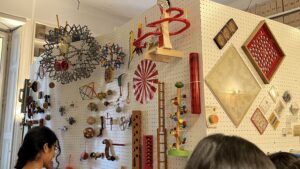
My childlike joy and imagination was brought back to life at the Achille Castiglioni visit. We saw how functionality and playfulness can be brought together in a compelling and usable way. Castiglioni was a realist but also enjoyed using the imagination to its fullest advantage to get practical and effective results while maintaining some aspect of joyful play. This is a delicate design type and one I love specifically for that. I remember the display of the never ending wire tool. It morphed into a basket, tray, cake stand, purse, and many other necessary items. This was probably the most multifunctional piece of equipment I have ever seen designed before for everyday house usage. In that moment I was reminded to never stop wondering but also to stay in reality and not wonder off too far.
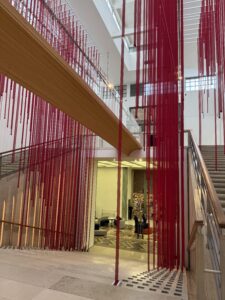
Finally, the most impactful experience I had this semester was one that hit me like a bus. The Triennale first exhibit rocked me to my core and forced me to sit out and just think for a second, but it was amazing. The data visualization was the most impactful and most insightful displays of facts I’ve ever seen in my life. I learned about how attention can be grabbed and how designing information in layers can allow the viewer to consume more information with less loss of attention. I learned so much about the world around me and was given so much world view. Walking up and down the stairs of the red ribbons displaying the casualties of war was heart wrenching and so eye opening. I learned that sometimes, a simple design can be more effective. I learned that history repeats itself and I also learned that design is so much more than meets the eye.
Design is the before, the insight into the why, the small details like pixel pushers that no one else notices, and the beauty in meaning and effort that transcends language barriers, space, time and relevance. Design is the way to remain and the way to send a message that needs hearing. I have met the most intelligent, kind and creative people during this time and I my eyes are open wide and will forever be changed by what I have learned in and out of the classroom of Milano. (Times New Roman is still my favorite font though)
I’ve said this time and time again, but I mean it when I say that this trip has been and will likely be one of the key moments to shape my design practice. Being exposed to and interacting with new design, architecture, and art ideas (especially in the company of non-designers) has enriched what I know, and has given me new threads with which to reference in my work. Below are some of the key moments of the trip which were sort of turning points for me.
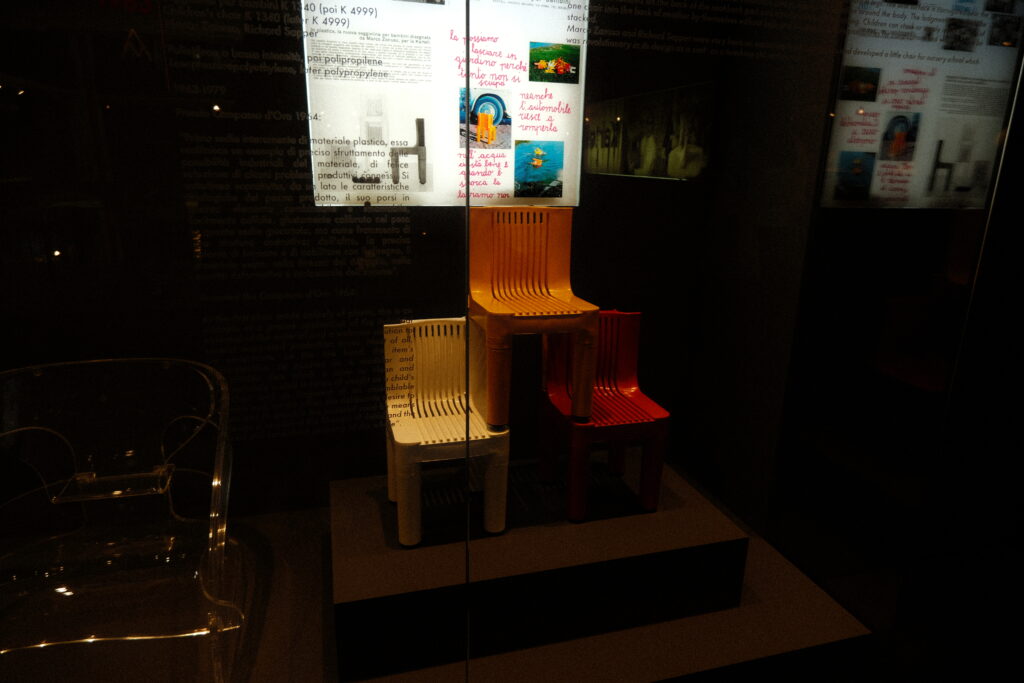
The value of materiality Though I wasn’t aware of it at the moment, visiting the Kartell museum planted a seed in my brain which did not sprout until later on, when we had our guest lecture with Naomi Fitzpatrick: the materials you use to make a thing speak to your intent and its impact as much as form would. It’s also something that was further perpetuated when we visited the Versace showroom. The use of plastics in Italian design and production made things playful, unserious, inviting, kitsch at times (?), whereas, if you consider the materials in Versace, for example, they all play in to tell a story about luxury, etc. I think, in design, I often think about what the thing looks like, rather than what it will be made out of. It’s time I start considering materiality as part of the user experience.
Nurturing one’s inner child As we saw in Achille Castiglioni’s studio museum tour, in surrounding oneself with play, designing with and through play, and inviting playfulness and experimentation with one’s product, we open ourselves to innovating and adding a new layer of depth to a product – not only is it functional at this point, it is joyful (at times, this will manifest itself in silent, private micro-delights, or in more public oohs and ahhs as we did).
Historical user experience Italian design is incredibly entangled with its history. I specifically remember feeling this the strongest when visiting Casa del Fascio in Lake Como, designed by Giuseppe Terragni. The fact that no corners are the same, as well as the design which draws you towards the light – the center – and the sensation of being watched were all observations that made me realize that these decisions, of course they are intentional, but also held real historical significance in the early to mid 20th century. These architectural features afforded the people who interacted inside them real can’s and can’t’s, which could have been life or death.
The idea of family legacy We saw this mentioned in the Castiglioni Studio, Alessi, etc: there is a real and strong interest of continuing family careers or passions here. And, rather than erasing it, people honor those roots (except maybe the Futurists) and build upon those missions and goals.
The importance of a multidisciplinary approach to design At Alessi, it was mentioned that one of their designers grew up in the mountains. Because he was accustomed to the style of buildings there (bottom-heavy fort structural integrity purposes), his works featured this similar pattern/motif.
My favorite quote is one by Donna Haraway in her book Staying with the Trouble: “It matters what stories make worlds, what worlds make stories.” The above example, to me, is a perfect example of this.
Exhibition design as a catalyst for change I will likely process numbers on a chart, but it may not be compelling until it is put into a format that is relevant personally. To me (and to all), that is a lived experience. Thinking about not only what your work is, but in what spaces people will encounter it or learn about it is also a worthwhile conversation. People will probably forget verbatim words on a page, but they will never forget how something made them feel. This was on full display at the Biennale.
To think that I almost withdrew from this program. I was genuinely terrified. The night before my flight to Milan, I cried myself to sleep for many reasons: fear of being alone in a new country, fear of not adjusting well to the customs, fear of being in poor company. I was seriously worried, scared, and wanting to withdraw (too late, of course). I am glad to share that none of my fears happened. I love Milan and everything in it, and leave with so many friends. I could not have asked for a better team to embark on this journey with. It’s changed my life for the better.
Our last week in Milano was incredibly special, and felt like me finally beginning to get into the rhythm of things. Analyzing, making connections, finding patterns… the most fun a girl could have in my opinion.
Triennale I was beyond excited for Triennale, especially after seeing Biennale! The exhibits and info were all put together so well. I especially loved the data visualizations. Data is beautiful – it can and should exist in forms other than dots and lines and bars! Don’t get me wrong, I loved it, but I think I liked Biennale more! I think it just had more info that was more closely tied to my work in microclimate, designing livable worlds, placemaking, and damage mitigation efforts.
MUDEC Having just spoken to Christiano Bottino, our visit to MUDEC was put into a lot more context, and it was incredibly impressive to see how much thought went into everything. I loved looking at all the iconography and branding, it was like a scavenger hunt to find everything.
Armani Silos
I’m not super into fashion, but the Armani Silos were stunning. I think the entire exhibition embodies luxury with its use of sound and scent and sight, but through this, it also kind of crafted this experience that makes it feel like you’re in on a well kept secret. They have a rich legacy which is incredibly important and you are important for being here watching it. you are part of it all.
Alessi + Omegna
ALESSI MY BELOVED-EST!!!! It was so fun to hear about their design process, evaluation framework, and “failed” projects! I got so many good quotes from Gloria:
A good designer must be able to go to the imaginary world, even though it doesn’t exist yet, see the potential and possibilities, and bring them down with an idea.
The advantage of flopping is you know where the borderline is.
Who is a good designer? A good poet. They should have this delicate attitude, this lightness in envisioning the future. Bringing in art and poetry in his work without forgetting the functionality.
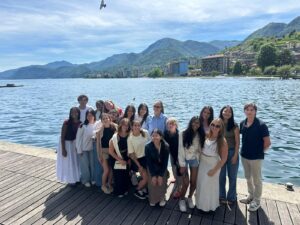
Omegna was so so beautiful. It made me cry. The world is beautiful, and because we are part of it, we are too <3
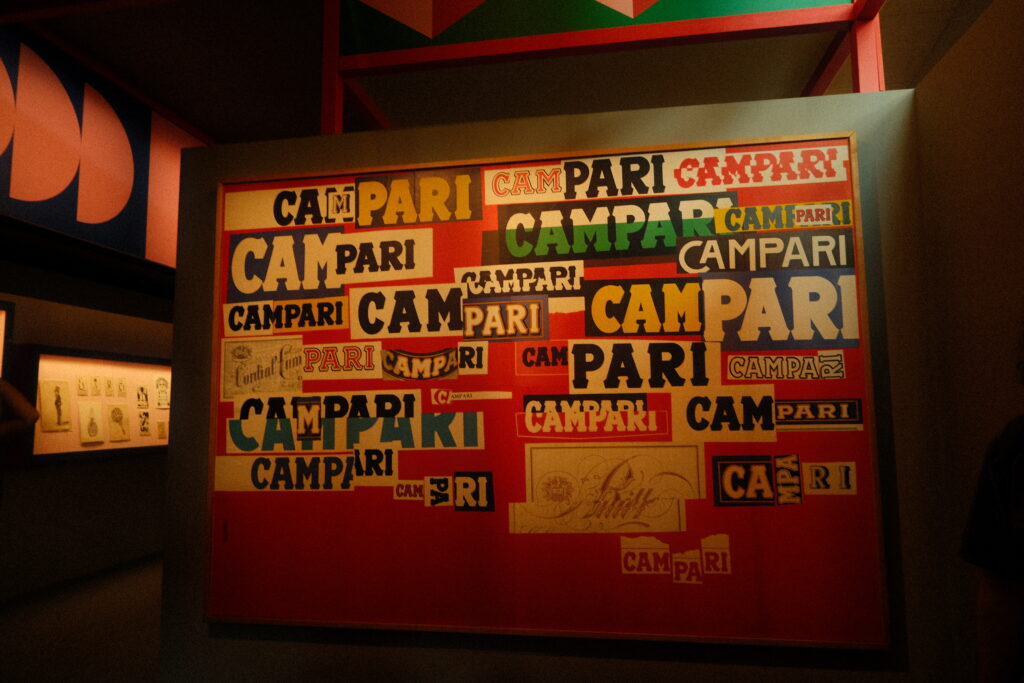
Campari
These folks do more than branding, they curated a lifestyle, a culture, a social phenomenon. They cared beyond what their audience drank, they cared about the media they consumed, the images they associated with, the identities they chose to align themselves with and share with the greater community. That was insanity in the best way possible.
This week was the busiest week yet! Some of my favorite activities were going to the Biennale and seeing both heart shattering and inspiring pieces. Something I particularly enjoyed was the exhibit on nuclear energy and how it can be used to create sustainable living solutions. The design work on the actual exhibit made it easy to understand for someone with no knowledge of nuclear energy, and the design of the actual project itself was something that I found very unique. That was an exhibit that inspired me despite many pieces highlighting the negative impacts of human life on our planet. I also really enjoyed the concept of the AI generated interview to display gender disparities in the workplace. Something else that we did that I loved was the Mudec museum, where we saw exhibits designed by Christino who we previously met! I really enjoyed a particular piece that represented the cycle of life and human relationship with the earth. Finally, one of my favorite things we did this trip, visiting the Armani Silas which presented pieces previously in season. This was something that hit it out of the park for me in all aspects. The design of the dresses were all unique in their own way, in color and in texture. The museum itself was engaging through the music, lighting and color. The way the exhibit was set up made the visitors feel as though each piece was a glowing trophy, demanding attention. The music relaxed my senses, allowing me to focus only on each piece.
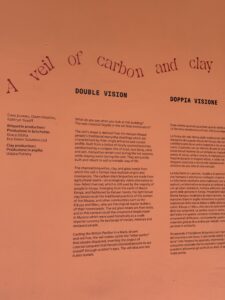





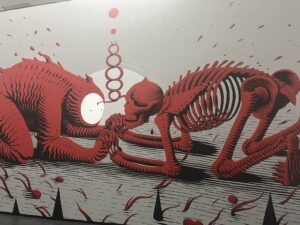
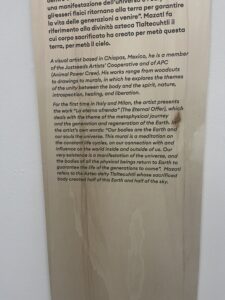 This week was the busiest week yet! Some of my favorite activities were going to the Biennale and seeing both heart shattering and inspiring pieces. Something I particularly enjoyed was the exhibit on nuclear energy and how it can be used to create sustainable living solutions. The design work on the actual exhibit made it easy to understand for someone with no knowledge of nuclear energy, and the design of the actual project itself was something that I found very unique. That was an exhibit that inspired me despite many pieces highlighting the negative impacts of human life on our planet. I also really enjoyed the concept of the AI generated interview to display gender disparities in the workplace. Something else that we did that I loved was the Mudec museum, where we saw exhibits designed by Christino who we previously met! I really enjoyed a particular piece that represented the cycle of life and human relationship with the earth. Finally, one of my favorite things we did this trip, visiting the Armani Silas which presented pieces previously in season. This was something that hit it out of the park for me in all aspects. The design of the dresses were all unique in their own way, in color and in texture. The museum itself was engaging through the music, lighting and color. The way the exhibit was set up made the visitors feel as though each piece was a glowing trophy, demanding attention. The music relaxed my senses, allowing me to focus only on each piece.