In a nutshell, fascism is the political form of government which is most closely tied to the infamous Italian dictator, Benito Mussolini whose reign stretched during WWII. It is believed that the word for this type of government is derived from the Latin word Fasces, which means “unit”. In ancient Rome, Fasces was most closely related to the idea of an axe surrounded by rods. The symbolism of the unity and power behind Fasces is an ideology that can be seen throughout a multitude of ancient and contemporary Italian media. In Gaetano Prevati’s Chariot of the Sun, these references can be identified within various motifs within his piece.
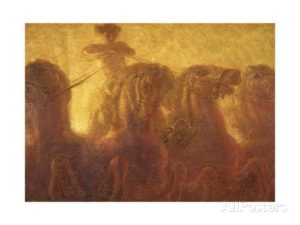
Of course, as all totalitarian rulers do, art is exclusively used in its various and specific forms of style and imagery as a tool to express ideas of absolute power. This piece by Prevati is a perfect example of this, demonstrating not only the literal imagery of power and control, but also using mythology in order to emphasize a divine characteristic and the “necessity” of absolute power. A direct reference to the myth of Helios can be found in this painting, specifically through the use of the image of the chariots and the use of golden color in order to highlight a sun like quality to the piece. Through this, the major theme that can be seen is the correlation between unity and power; while one wields the reign, the group is able to glide forward through the total control of one individual. Summing the very essence of the ideology that drives the purpose of fascism.
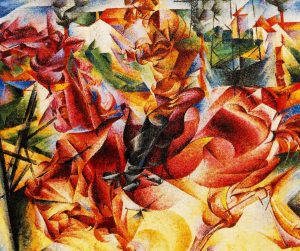
Similarly, Elasticity by Umberto Boccioni possesses similar elements to Chariot of the Sun. Through using cubist form, Boccioni creates a variety of shapes and patterns that also reference the sense of unity and power. Similarly, to a Rorschach test, every individual is able to conceptually pick out a unique feature from this painting. For me, I immediately recognized patterns that could be related to images of sails on ship as well as images of what appears to be laborers working on a field. Regardless of what image one picks out from the entire piece, there is one common theme laced throughout; that everything within the painting is strictly controlled. Everything within the piece is incredibly similar, only deviating between the use of lines and color throughout. In terms of unity, the coherence of color and shape are a direct reference to this regardless of individualistic forms. In turn, this directly creates the reference to power; everything within the image is strictly controlled through its boundaries of lines and curves.