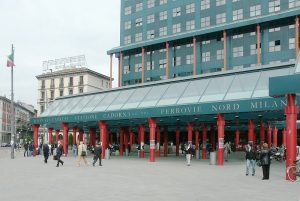
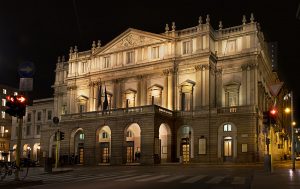
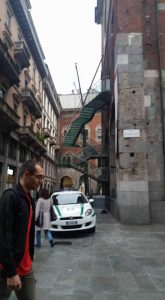
Point A: Cadorna Station <-> Point B: La Scala (E.T.A. 20 mins.)
We are in the process of creating a powerpoint showcasing the panoramic view of the intersections, then details focusing on the footwear of everyone we pass; also, we focused on the architectural structure and how it changes between each location.
For example, closer to La Scala, the buildings become older and more gothic-themed, and the people on the streets and on bikes are better dressed than those near Cadorna. Most likely, these are people who work in the older, more prestigious buildings near La Scala, and the ones near Cadorna are travelers or work in the shops in and around the city, so they have less reasons to “dress-up”.
Cadorna Station, Point A
The walk is roughly 15-20 minutes, and it’s quite lovely. The streets are nicely shaded, and the shops that line the walkway are intriguing. There are, however, less lovely areas on this walk. For example, there are quite a few areas of construction and a few instances of homelessness.
The focus is primarily on the social aspect such as how do the people we pass change between locations (shoes and attire, for instance), how does the sidewalk and building facades change, is it walker friendly, etc.?
Italian art is never so simple as to be solely for the aesthetic; Italian artists have set trends, sparked movements, undermined governmental control, and allowed the oppressed to seek redemption. The avant-garde movement of Futurism allowed Italian artists to celebrate and publish works that elaborated the notions of urban modernity and technology. Artists wanted to rid themselves of the old (old style, old works, old ideals and culture), and they wanted to embrace the beauty of modern light.
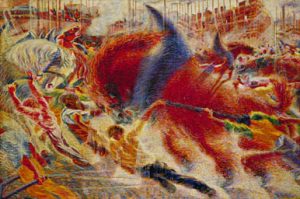
One of the greatest artists to have accomplished such advances in art is Umberto Boccioni. Not only were his paintings renowned but his sculptures paved the way for modern design and art. As a principle contributor to the revolutionary aesthetic of the Futurist movement, Boccioni created significant pieces that sparked the fire he needed to progress. This ideal behind the Futurist movement is evident especially in his “The City Rises” piece (depicted below).
The City Rises is considered to be one of the first Futurist paintings by Boccioni; as the city rises, the fires of the revolution consume it.
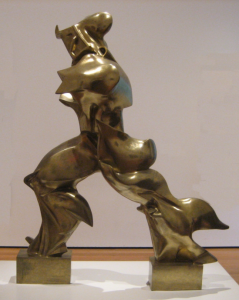
Another incredibly influential piece at the time was another work done by Boccioni; however, it is 3-dimensional rather than the 2-dimensional pieces of his canvas work. Boccioni was frustrated by the lack of movement in his canvas pieces, so he wanted to create a work in motion. Thus, he created a more effective way of expression in his famous work “Unique Forms of Continuity in Space (1913)” (depicted below).
This piece captures the essence of a figure in motion, rendered in a way that conveys an effortless grace and movement.
These two works of art were key components in the advancement of Futurism. Despite his short time working in Futurism, Boccioni made grand strides with his works, and they helped shape the “future of Futurism”. The ideas of embracing and romanticizing labor and movement are evident in modern pieces that were influenced by previous works such as these.
Trains: are they a necessity or a nicety? Would it be easier to catch a cheap flight or take the drive? Trains were one of the first modes of transportation, so it makes sense that one of the oldest countries holds fast to traditional ways of travel. Trains are especially important to those trying to travel within Italy. Not only is the view spectacular, but many trains travel rather quickly. For example, a train from Milan to Venice is only a two and a half hour ride and around 120 euros.
Great price, great time, and great view.
Metro
Much like every major city, public transportation in Milan is essential. The metro with its multicolored tracks and easily navigable stations remind one of the monotone and hectic station New York City.
After only living in Italy for a short week, the metro has actually become one of my favorite modes of transport. It is easy to use thanks to our metro cards, convenient due to the many stops and stations, and fast moving – transporting both civilians and businessmen alike on a daily basis. Not to mention, it too is a fairly inexpensive way to travel the city.
Tram
I have never ridden a tram before this trip; however after the initial jolt of unease while boarding, i realized it is essentially no different than the bus system. Just know your stop. And take a buddy. Or two.
Buses
Speaking of above ground transportation, the buses are possibly the most confusing of them all. The names of the stops are in small print or not visible at all to the rider. Also, the view of the beautiful city is so awe-inspiring that you can become very distracted and miss your stop completely. Unfortunately, that has happened more than once in the span of three days.
Unlike the buses in Austin, the bus schedule and numbers are fewer and farther in between. Despite having a full month to understand this foreign system, i will most likely stick to the metro.
Taxis/Cars
Finally, the streets of Italy are winding and highly confusing especially to a foreigner like myself. Taxis and other vehicles pull up and even park on the sidewalk; they also drive in insane circular turnabouts all across the city. Although driving in the city may give me a panic attack, Italian drivers and natives are surprisingly calm and cautious. From squeezing between trucks to parking on the sidewalk, cars in Italy have a unique sense of driving that is brand new to me.
Cars aren’t often the most popular mode of transport, but the few on the road are small and fast.
Americans wouldn’t be able to handle this.
With so many ways to get around the city, your best bet is to find what is most comfortable, whether it’s by bus, metro, or your own two feet. For now, I will stick to walking to the metro station.
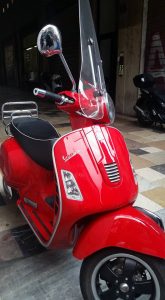
Mopeds are frequently used for single riders trying to get around the city faster.