Transportation Differences in Italy

Trains

Trains: are they a necessity or a nicety? Would it be easier to catch a cheap flight or take the drive? Trains were one of the first modes of transportation, so it makes sense that one of the oldest countries holds fast to traditional ways of travel. Trains are especially important to those trying to travel within Italy. Not only is the view spectacular, but many trains travel rather quickly. For example, a train from Milan to Venice is only a two and a half hour ride and around 120 euros.

Great price, great time, and great view.

Metro

Much like every major city, public transportation in Milan is essential. The metro with its multicolored tracks and easily navigable stations remind one of the monotone and hectic station New York City.

After only living in Italy for a short week, the metro has actually become one of my favorite modes of transport. It is easy to use thanks to our metro cards, convenient due to the many stops and stations, and fast moving – transporting both civilians and businessmen alike on a daily basis. Not to mention, it too is a fairly inexpensive way to travel the city.

Tram

I have never ridden a tram before this trip; however after the initial jolt of unease while boarding, i realized it is essentially no different than the bus system. Just know your stop. And take a buddy. Or two.

Buses

Speaking of above ground transportation, the buses are possibly the most confusing of them all. The names of the stops are in small print or not visible at all to the rider. Also, the view of the beautiful city is so awe-inspiring that you can become very distracted and miss your stop completely. Unfortunately, that has happened more than once in the span of three days.

Unlike the buses in Austin, the bus schedule and numbers are fewer and farther in between. Despite having a full month to understand this foreign system, i will most likely stick to the metro.

Taxis/Cars

Finally, the streets of Italy are winding and highly confusing especially to a foreigner like myself. Taxis and other vehicles pull up and even park on the sidewalk; they also drive in insane circular turnabouts all across the city. Although driving in the city may give me a panic attack, Italian drivers and natives are surprisingly calm and cautious. From squeezing between trucks to parking on the sidewalk, cars in Italy have a unique sense of driving that is brand new to me.
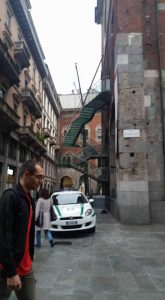
Cars aren't often the most popular mode of transport, but the few on the road are small and fast.
Cars aren’t often the most popular mode of transport, but the few on the road are small and fast.

Americans wouldn’t be able to handle this.

With so many ways to get around the city, your best bet is to find what is most comfortable, whether it’s by bus, metro, or your own two feet. For now, I will stick to walking to the metro station.
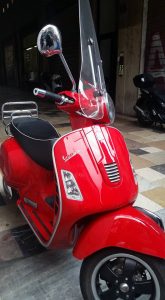
Mopeds are frequently used for single riders trying to get around the city faster.

First Impressions

IMG_7449

One of the first things one notices when arriving in a new destination is the stylization of the architecture within the city. Geographical similarities within Milan is abundant, and this is a fact that is can be seen as soon as one first steps foot into one of the many districts within Milan. For me, what seemed to stand out the most within the architecture within Milan was how many of the apartment complex’s share three dominant characteristics; quaint, close-knit, and colorful buildings can be found on nearly every street and corner. More specifically, what is most notable about these buildings is that fact that although they may appear to be synonymous in their makeup, they each possess unique traits that define their individuality. This is something I noticed as soon as I entered my apartment within the city.
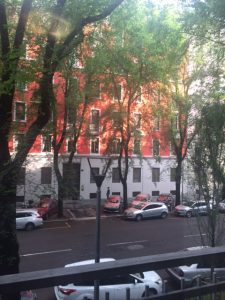
From my building, I have an incredible view of a bright red toned apartment that can be seen across from my room. I spent a few minutes analyzing its features in comparison to other buildings I saw upon my arrival. Although one may carry the notion that these apartments may look incredible pre-planned and fixed, further analysis shows definite evidence that each building carries unique features that solidify their individuality. For instance, the building across my apartment is notably plain in contrast to a few others on my street. This building is designed with plain windows (consisting of a modest white frame), simple lines, as well as quaint details such as lighting fixtures. However, what makes this building stand out is its rich, red toned surface that catches the eye. While a building may appear the be deceivingly rich in its appearance, this is merely a mirage that occurs due to specific color choice. Incredibly simple buildings can be transformed through the use of paint.
This is a theme that can be seen in a variety of other structures within Milan as well. On a tangent, something that is also notable is the use of iconic or more notable buildings in order to draw attention to less prevailing structures. I was most aware of this in the district around Duomo, where a variety of shops and quaint stalls can be seen throughout the area. All of these stores were greatly enhanced in structure and presentation due to the fact that they were all adjacent to the most iconic structure within Milan. Ironically enough, in comparison to the similar buildings that can be seen throughout Milan, the Duomo is the most unique in its style and construction. The Duomo’s own institution of individuality against the identical features within the city testifies the capability of uniqueness to prevail in popularity regardless of the style that may appear to be commonplace.

Living With Relics-Milan

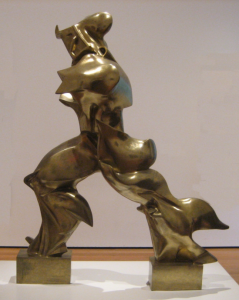
During our first day of orientation in Milan walking tour of the city’s fashion district, IES Abroad Director, Roberto Andreoni, mentioned the strange juxtaposition of the city’s residential and urban architecture: old and awe-inspiring buildings stand squeezed next to mundane and “ugly” new constructions. His statement reminded me of the Futurist Manifesto and their goal to diverge from antiquity and tradition, embrace the change that came along with industrialization.

Roberto Andreoni also mentioned that most of these newer buildings were constructed to replace the old structures that were destroyed during the bombing of Milan in World War II. Instead of imitating older styles of architecture the municipal government used its limited resources and loan money to reconstruct the city from rubble.  They used what was left over to construct a newer city instead of leaving all traces of it behind, quite the opposite of what the Futurists would have liked.

This trope of old blending with new, and not in a clean and uniform way, is a rather pervasive theme in the parts of Italy I have visited thus far. Bellagio, Verona, and Milan are full to bursting with old architecture, landmarks, and monuments that stand in close proximity or even crammed together, sharing walls, so that no single structure can be taken in without comparing and contrasting it with buildings in the vicinity. Buildings like the Duomo or the arena in Verona, I would have expected to view then in their untainted glory, standing tall and magnificent, calling upon the memory and artistry of architects and artists who lived eons ago.

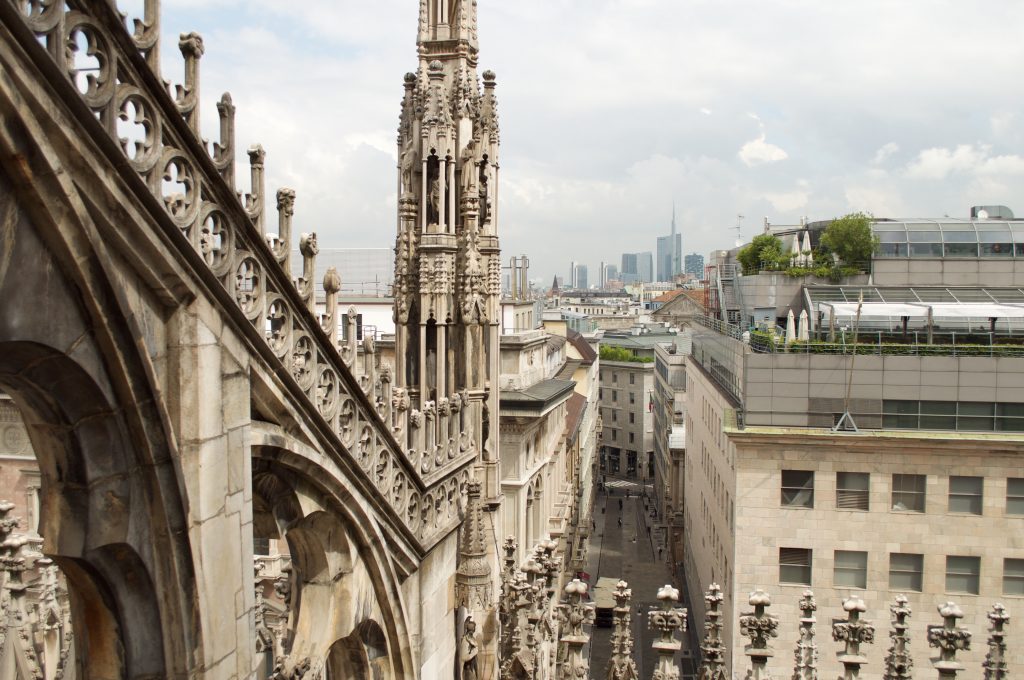
Instead the Duomo exists alongside an upscale mall, above an efficient subway system and in a piazza teeming with tourists.  Even the view from the top doesn’t remain uninterrupted. The spires topped with detailed sculptures stand out against a background of blue or cloudy sky (depending on the rather flaky weather) and the industrial grey of urban construction. This doesn’t really devalue or corrupt the glory of the Duomo as much as its existence is recontextualized.

The Duomo

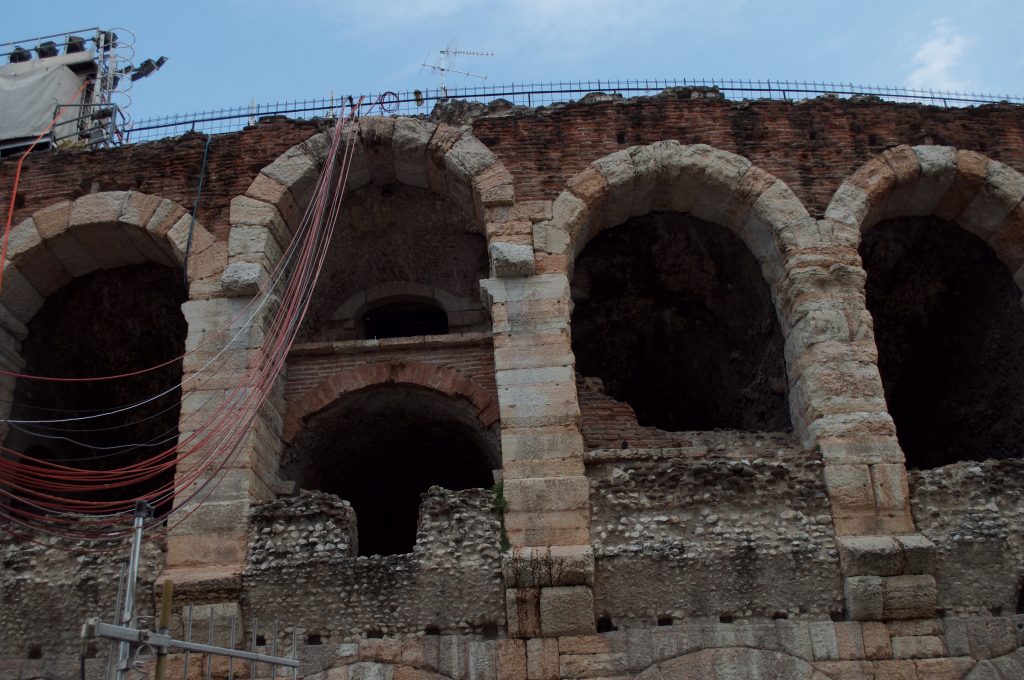
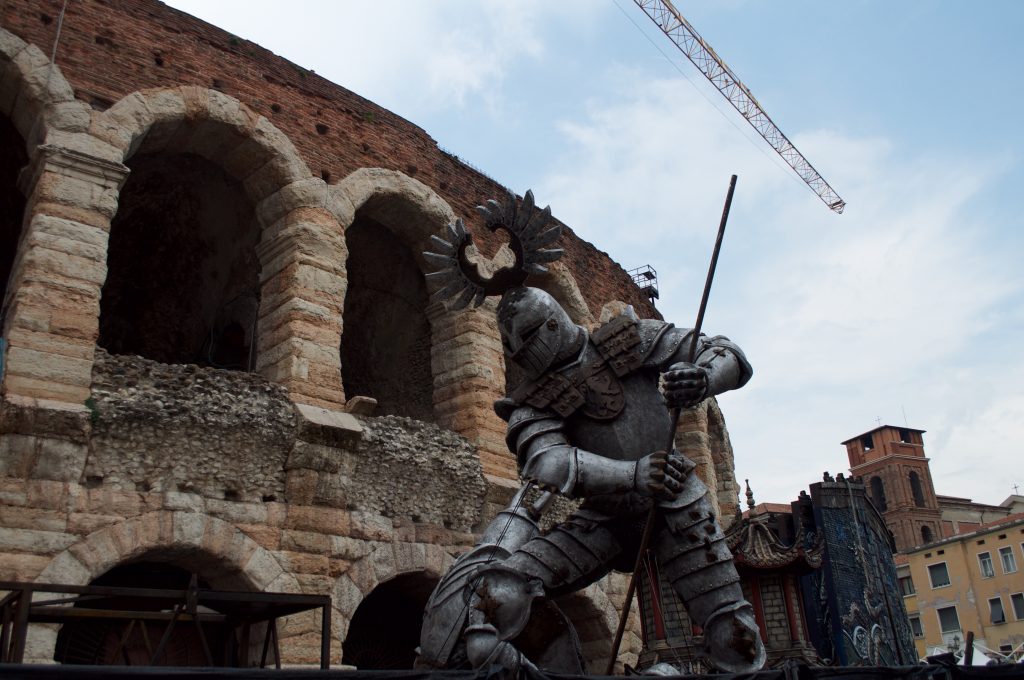
Similarly with the Arena in Verona, it was quite a task to find a view of any one side of the exterior without including at least a sliver of modern technology. The Arena was dwarfed, in my opinion, by the fleet of Vespas, performance stage metalwork, barrier gates, construction cranes, and oddly a float of a medieval knight. Admittedly there was no time to sit and ponder about the fact that it actually exists today even though it was constructed during the Roman Empire OH MY GOD because of the time crunch on our day trip.

 The Arena in Verona

Medieval Knight in Verona

There is such a huge difference in the way important monument structures are treated in Italy versus the States. Italy has made history part of life, carrying it forward with progress. America sets it aside in a museum, to be observed, used as inspiration, never to be mixed with modern life.

~Saniya

Culture Shock is Real

ItalianRecycling

Culture shock is a real thing and was definitely experienced within days of arriving in Milano. Not knowing Italian was challenge number one, however, the lifestyle itself has been an adjustment. Coming from Austin, Texas, the city life of Milano did not, at first, seem as if it would much more complicated to adjust to. Boy, was I wrong. Recycling is taken to a whole new level in Milan versus the often notoriously ‘tree hugger’ environment of Austin. As if the three separate trash bins in the apartment were not already intimidating enough, there is also another bin found under the sink or on the balcony for compost! I love that recycling is much more strictly enforced here. Although intimidating at first, I believe that it can truly make a difference as long as it is being enforced. Ironically enough, the use of plastic bottles is out of control though. Water filtering is obviously not as big of a deal here since every restaurant will serve bottled water over tap water and there are not really any refill stations. Whereas Americans see water as something to be provided, Italians see it as another commodity to be purchased.


Another change from Austin to Milano has been the transportation. Although Austin is decent to be able to travel by foot or bike, the automotive transportation is completely different. It may be that we are limited to not being able to drive while we are here, but I believe that even if we were provided that means of personal transportation, it would be meaningless. Milan is much more easily navigated by bus or metro and is more conveniently designed. Austin is thankfully equipped with a public transportation system that most American cities are lacking, however, the convenience and ease of use are far from that I have experienced in Milano. Austin is much more driven by the personal vehicle, much like the majority of America, but Milano is in favor of the pedestrian, biker, and user of public transport.


The change is lifestyles has definitely been culture shock, however, it has been a refreshing change from the typical American lifestyle. Adapting to the ways of strict recycling has become easier and seems more rewarding and motivational to enforce back home. Navigating transportation has been exciting, although occasionally stressful, and rewarding. Finding new places and learning to get around this new place that we will call home for the month is incredible. And while the amount of walking may be absurd when looking at the number of steps or the total distance traveled, it is never noticed at the moment due to the wonderful experience that is surrounding our every move. This is only the beginning, but I am already sad about having to leave so soon. Tomorrow begins the second week of adventures- here we go!

transport with style

Prior to my arrival to Milan, I was unsure what to expect in terms of design. Our pre-departure reading- “Made in Italy: Rethinking a Century of Italian Design”- discusses in the introduction the idea that Italian design has become a “victim of its own celebrity”. The star power of Italian design gave me a preconception of what that really meant- flashy images of Fiats and daring furniture coming to mind without any real context.

Through this course, “Design in Context” my goal was to find that meaning.

Of the topics the book states Italy is known for- cars, coffee, and fashion- I immediately became fascinated by the first. Cars.

I chose the theme of “transportation” for my sketch book after a day of exploration across the city and a full camera reel of nothing but scooters, cars, and trains. The variety of means that the Milanese turn to for transportation is something I am excited to document.

The number of scooters and small cars parked in the streets was certainly a pleasant surprise to me. Already I am seeing the incorporation of these mass-produced, stylish products that revolutionized urban transportation by means of accessibility. As the book noted, this was driven by the “increasing desire and need for individual, private transport” post-World War II. The varied pace of the city echoes this, with the public transport system thriving alongside the more independent mode of transportation found in the Fiat and Vespa. I think that it showcases the presence of both a very controlled and more open society within Italy’s past.

I look forward to sharing some of my sketches on this topic in future blog posts. Until then!

ciao

-autumn