The Floating Piers

The highlight of last week were the Floating Piers by Christo in Iseo. It was also incidentally the most taxing day thus far. Our day began early, and right off the bat we were thrown into absurdly long lines…more like amorphous blobs consisting of people shoving and crowding to get to the front. Lines don’t exist here apparently, especially if the event is free and for a limited time period. Not too different from life in India. There were innumerable times where I wanted to turn back: the second I saw the line after getting off the first train, while waiting for the second train, while waiting in line to get to the pier. I think this is the one day I complained the most about nearly everything.
Needless to say that day was a dream trapped in a nightmare. The lines were a horror but the experience of walking on water, on these golden bridges reflecting light from the sun while the cool breeze blew past, was an ethereal experience. Hot, sweaty, exhausting, but definitely transposing.
The lines made it seem like the piers would be packed to the brim. There were moments where I wondered if it would start to sink due to the weight. But I really can’t question Christo’s judgement since he’s had multiple large scale installations that were just as popular.

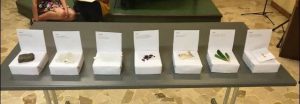
Photo taken from the top of a little food and rest stop.

Mapping the city: post-presentation

When beginning our journey from the Federazione del Fasci Milanesi to Triennale di Milano, a feeling of suppression to being more open was felt along our way. To better describe our journey, an exhibit was created as our presentation. This idea was inspired by one of the exhibitions at the Triennale. Our journey was divided into seven key stops as described in my last blog about this project. These key stops were described by a single word during our exhibit presentation. Our presentation focused on the emotional feeling that our journey took us from past to present time. Even though the headquarters was build after the Triennale, the environment we were in at the beginning felt so heavy. With a history of Mussolini giving address to his people at this central location of Milan, an individual is likely to exhibit a feeling of suppression with its fascist theme building. Continuing our journey from a feeling of suppression, deplete, stimulate, rouse, mobilize, uplift, and feeling of expand in the end are used to describe the key stops. Though during our first walk, we did not know how to present the feelings we felt during the journey, an exhibition from Triennale inspired us that there is no better way to progress through time then to have an exhibition.

IMG_6942

Sketchbook: Studio Tours and Chairs

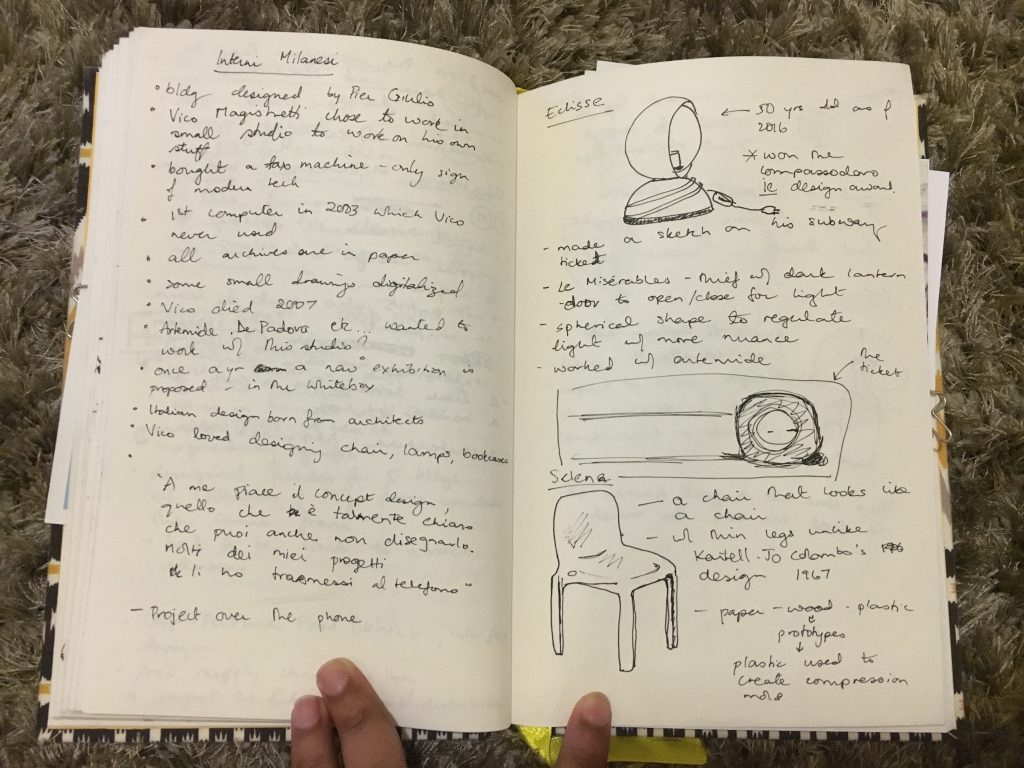
Over the period of this study abroad, my favourite trips were the ones where we visited designers’ workshops like Castiglioni, Magistretti, Studio MF, and a couple more. It’s a more intimate and in depth than a factory tour (although Alessi was just the very best), and it’s quite fascinating to see how the studio is maintained. In cases like Magistretti and Castiglioni who have passed, the maintenance of the studio is a little different. Castiglioni’s studio, by the looks of it, hasn’t changed much since the last time he used it. The organized clutter, reams of used paper, photographs, books, all looked mostly intact, except for those left out for visitors to look through. Magistretti’s studio on the other hand, was also made into a studio. Our guide, who also pleasantly turned out to be his granddaughter, mentioned that she and a few other helpers sorted through all of Vico Magistretti’s sketches and writings and catalogued them so that they could be put on display in the studio turned mini museum. The change in purpose of the space didn’t really ruin the vibe though. I think the energy and genuine love that our guide had in talking about Vico Magistretti allowed for the mini museum to have a more warm atmosphere than a more formal museum would. Also Magistretti’s little office in the back was pretty much left the same.

On another note, one thing I realized with all these studio visits is that chairs are honestly the pinnacle of new design. It seems like every designer in his or her early days managed to find a new way of letting people sit, and each designer had a real, genuine idea on how to make the simple chair a better sitting experience. Magistrate added an s-curve to the legs so that they were sturdy but not bulky, Kartell created chairs that were easy to play with and durable in harsh weather, Castiglioni created an uncomfortable bicycle seat chair that kept phone conversations short, so on so forth.

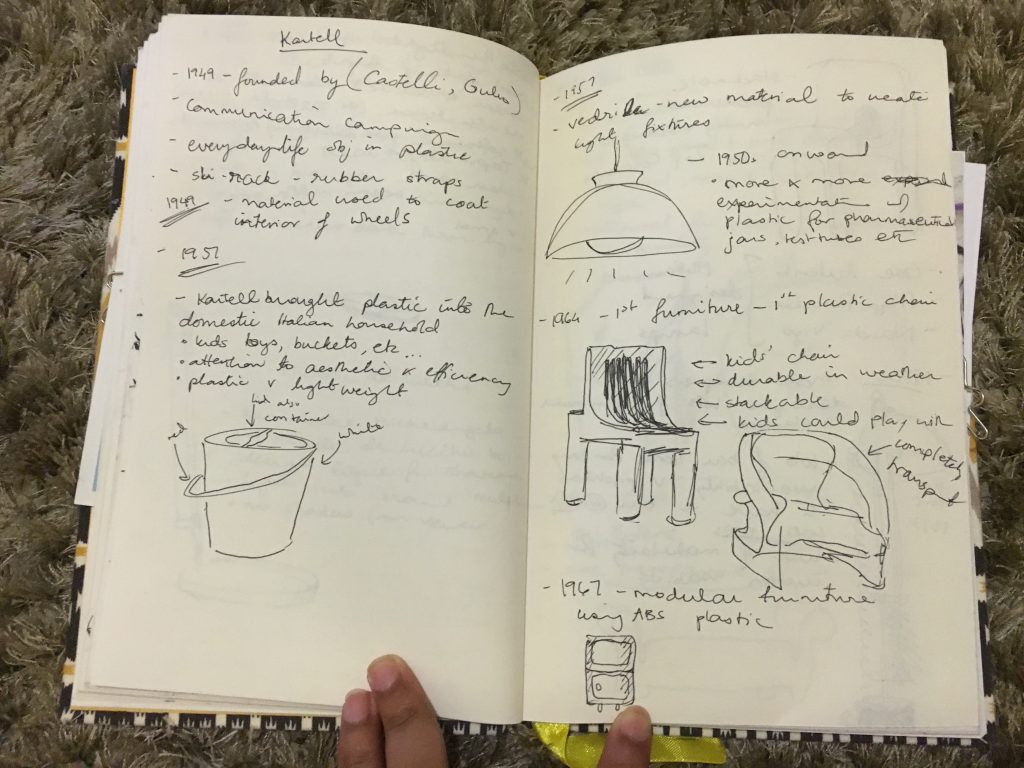
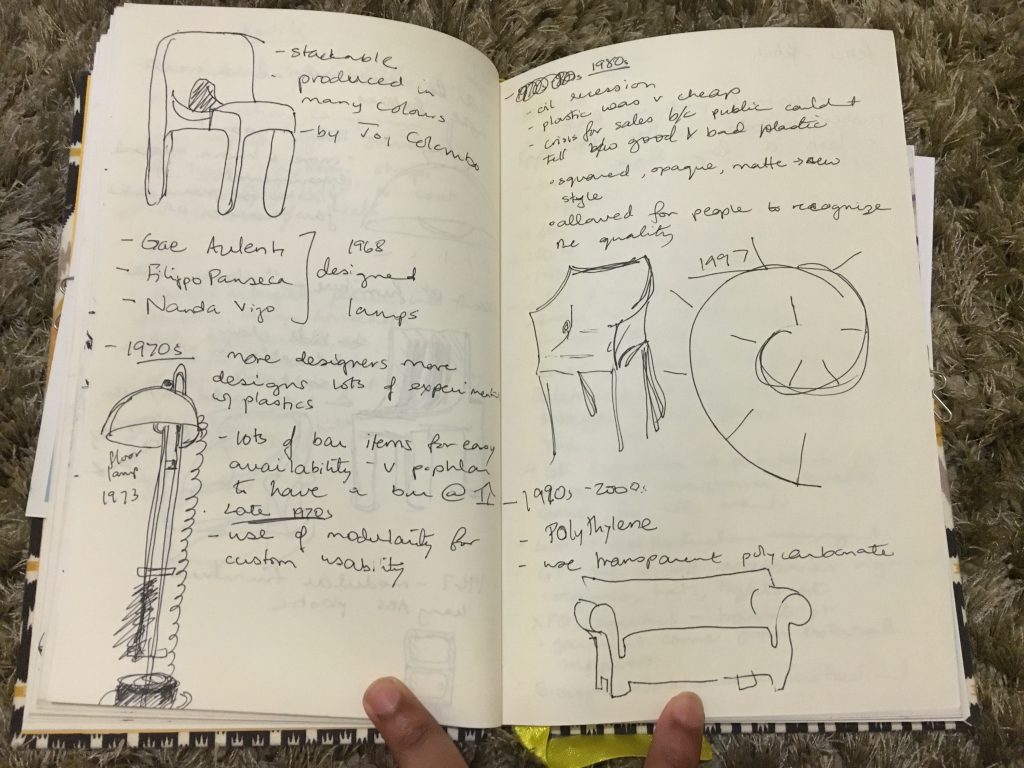
Kartell notes and sketches
Notes and sketches from Magistretti
Notes and sketches from Kartell

Worth the Agony

Last week was crammed packed with a day trip to visit the ‘Floating Piers’ exhibit on Lake Iseo. All week we had mentally prepared for this adventure and the long 4.5km walk along the piers. However, when the day finally came not one of us were ready for what was to come. It ‘only’ took not fitting into a packed train,running to a new train with no A/C, standing for two hours in a mob of sweaty travelers, and about eight hours of travel to finally arrive at Lake Iseo.

Along the way, the heat and exhaustion mixed with the aching and swollen feet convinced many of us that the journey just was not worth it. I cannot lie, I definitely considered bailing out of the madness on several occasions. Let me tell you- I am so glad that I did not! Once we arrived at Lake Iseo it was not quite a remarkable experience, but shortly after it truly was.

Maybe it is just me, but being barefoot is one of the absolute best things in the world. Once we got through the madhouse of lines and arrived at the pier entrance people began to remove their shoes and walk along the golden pathways- HEAVEN. At first, the sight of this act did not make much sense, but who was I to complain? However, once we got on the pier and removed our shoes there was a sudden relaxation, relief, and overall tranquility that overcame me.

Although that may sound lame or cheesy, it was absolutely true. Perhaps it had just been the breathing point at the end of a journey filled with agony, but the piers somehow made it all worth it. The views were remarkable, unquestionably, but the experience through motion and sensation were what made this ‘exhibit’ the most incredible in my opinion. At the end of the day I was left questioning the exhibit though. Had it been the intention for it to be a relieving experience at the end of chaos? Or if it hadn’t, would the experience have been the same – or as rewarding – had I not just spent eight hours on my aching feet to get there? Maybe the agony is what made the piers so worth it. Maybe, if I had not endured the draining journey then I would not have appreciated the total experience. But it was a once in a lifetime experience so I suppose I may never know.

*PICTURES NOT UPLOADING*

Visit to Kartell

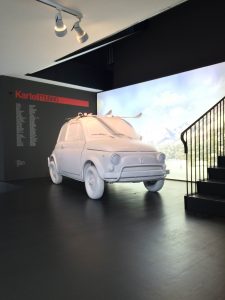
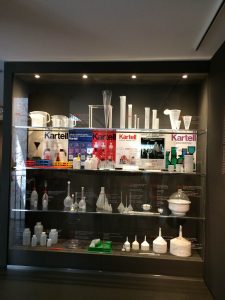
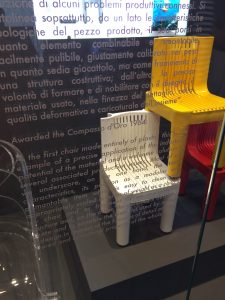
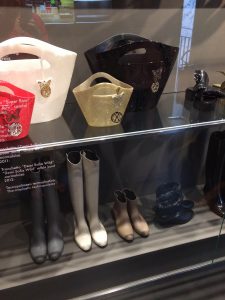
During this week’s visits, we got a chance to visit Kartell museum. When first entering the museum, I remember seeing a model of a small car that looked like just a real car except painted. When the tour began, we were told that Kartell has produced more than 8000 items since 1949. The company was created to make everyday items using plastics. People began to get rid of traditional items created using metal or wood and started using plastics, as it was long lasting, easy to clean, light and sturdy. Starting off our tour, we were first shown plastic buckets that women used to wash kitchen utensils, first plastic lamp that was created in 1958, plastic lab equipment that was also produced in 1958, the very first plastic chair in the world that was really important for the company. The first plastic chair was made for children in 1964 and then for adults, plastic chairs came in 1967. This first chair to be made entirely out of plastic marked Kartell’s furniture manufacturing. Furthermore, in 1967 Anna Castelli designed modular furniture that was very important for history of plastic due to its mechanical characteristics. Kartell began to produce everyday items that met home and personal needs. Modular trolleys, drawers, vases, ashtray, table lamps marked a historic time when plastic became the material of future. One of the modular items that I greatly admired was a bookshelf made without any screws in the 1970s. Kartell also produces a bookshelf that is not square or rectangle shaped, rather in circular shape during the 1990s. Additionally, along with producing furniture, Kartell takes a big step in making plastic fashion objects. Items such as plastic shoes and purses mark a big step for Kartell to enter the fashion industry. It is hard to indulge a fact that one company can produce this many items in plastic. What started as a single dream for Kartell turned into easy accessible everyday item for consumers to utilize. A company that started more than 60 years ago still continues to beautify objects using a material that was not imaginable to be utilized in so many ways. Kartell continues to experiment with expansion in technology and it is hard to imagine what this company will continue to do in the next 60 years. Seeing so many objects made out of plastic in one building made me realize the importance a single material can have in the industrial society and in consumer goods.

IMG_6178 IMG_6189 IMG_6192 IMG_6203


Sketch Notebook Adventure

13563699_10155042845564126_1098277589_n

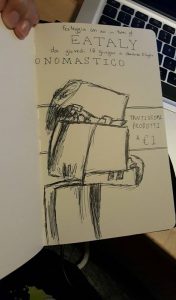
Thus far my sketch notebook has not only been an adventure into getting to know my drawing style and how I can progress as an artist even though I didn’t even consider that a possibility. It’s also a way to take notes and look back on my previous adventures throughout Milan and how this study abroad experience has impacted me. It’s also a way to find the interesting ads of Milan and show them to colleagues and learn the differences in culture that are present here. One of my favorite sketches currently is the one above. The reason I greatly enjoy it is because to me it feels like a pun and even to the people of Italy I believe it is taken that way. I think this is the case because in the headline it says “eately,” which to Italians is how you pronounce the word Italy, and it also contains the word “eat.” This amazing pun made me laugh for a good ten minutes as I realized the play on words and really wanted to congratulate the agency that thought of this one. Even though I have no idea what the ad is actually saying, I can tell that it’s related to food with not only the picture of the woman holding bags of food but also the word “eately” telling me. It also seems to be strictly for Italy and would not even come close to working in the United States, which I feel gives it that uniqueness and sincerity that can only be achieved here.

Fun in Florence

Florence was a city I REALLY wanted to visit during my stay in Italy but it didn’t like it was in the cards for me. I knew a large group of girls were planning to go on Saturday, but I was unable to because my sister was flying in from New York. I had given up on the idea of going, when my roomates planned a last minute day trip there. We were able to book an express train to get us there in a short amount of time and I was able to persuade my hesitant sister to join us. Our trip was incredible! We were able to visit the Duomo and climbed over 400 steps to reach the top of the Campinile. My legs were burning by the time we reached the top but the view was worth it. My roomate Hailey really wanted to visit the Basilica of Santa Croce to see where Galileo and Michaeli Angelo were buried. On our way there we found ourselves in the midst of a jousting tournament. That was a fun surprise! We wrapped up the day by visiting the Gucci Museo, which was nothing short of incredible. I’m so thrilled that I was able to visit Florence for the first time and share that experience with my roomates and sister.

Me and my sister at the Gucci Museo

Mapping the city: pre-presentation

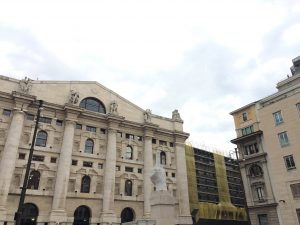
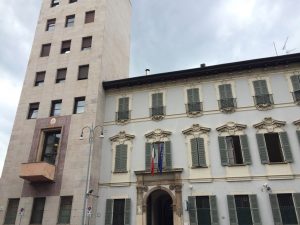
For mapping the city project, a route between Headquarters of the Federazione del Fasci Milanesi and Triennale di Milano had to be administered. My group and I began our journey on Piazza S. Sepolcro where the headquarters is and ended at Emilio Alemagna where the Triennale is. Even though Triennale was build before the headquarters, this pathway of journey enabled us to better interpret these two important buildings. When doing our first walk, we didn’t have any idea of how to best interpret our journey. Starting at the piazza, we were reminded by how suppressing the feeling of just being there felt like. Standing tall as the 9th century church in front of it, the headquarters was the political center of Mussolini when fascism ruled Italy. Going further, we passed the stock exchange area where the financial district of Milan is. After that, we came across bunch of shops and cafes where the daily interactions takes place. Then we saw a community with parking garage with some cafes as well and people jogging around. Next, Cordona station was sighted with a park sighted right before our last stop, Triennale. When stopping at Triennale, we felt we were more in an open environment without feeling suppressed.

IMG_6315IMG_6281

Sketch notebook: week 3

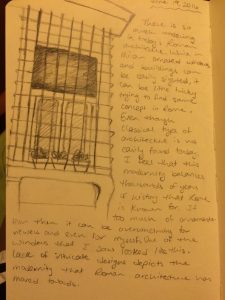
In between traveling around a single country, a change can be noticed in any single subject. Whether that is architecture, food, transportation, environment, or clothing, a difference can be easily recognized. While I have been in Milan for about three weeks now, a variation in architecture was observed when I traveled outside of Milan. With the focus of my sketchbook being windows, I spotted differences in windows and overall architecture of buildings between Milan and when visiting Rome last weekend. While here in Milan there is a mixture of elaborate and decorative buildings, as in Art Nouveau, with that of Fascist architecture, in Rome however, there was only Fascist style to be discovered. Even with the lack of ornamentation, by embracing the simplicity of modern architecture in Rome I did not become overwhelm. With already an existence of prehistoric architecture and monuments, by seeing buildings, especially windows not also take the form of extreme decoration, I was able to smoothly grasp my surroundings. Moreover, since fascist style was brought through Mussolini’s idea of unifying Italy through fascism, seeing this effect take place with the simplest art in Rome and everywhere in Italy, shows the influence that politics can have on art.


IMG_6941


Presentations: Getting a Glimpse of Milan

13417650_10155008234544126_2118225574462884162_n

This week had a very anxious start with the final presentation of our glimpses into Milan and the amazing amount of information presented about our buildings. Through this amazing adventure, we were able to meet the community of Milan firsthand and interact with the city instead of just staring at its wonders. We memorized street names and coffee shops. Smelled the fresh fruits and live atmosphere that kept Milan the amazing destination for those to live and work here. It was a great experience and being able to tell the experience was even more rewarding. I was even asked at the end for more information regarding my story that I told while we walked. The story included actually being able to see a building in the style of a village. It was remarkable to learn how others in Milan live and be astounded by how incredibly similar their living situations were to those in, for instance, New Orleans with the expanded courtyards and the beautiful layout that allowed a person to see those around them when staring up in the courtyard. It was a great experience and retelling it was even better. Being able to hear each of us present this experience to our classmates and retell stories we had constantly practiced was really hard and nerve wracking, but fulfilling.