Quality is Key

This past week, we had a large variety in the exhibitions, studios, and factories that we visited. However, I believe that the combination of visits were a true testament to quality control and longevity of design on the market. The Artemide factory truly emphasized quality of not only design, but materials and finished products as well. The tour demonstrated the extensive processes that are taken in order to control quality and consistency of Artemide products. While the market trusts high-name brands for quality and reliability, knowing the actual processes behind the trusted quality is incredibly important to understanding the steps behind making a good design into a great product.
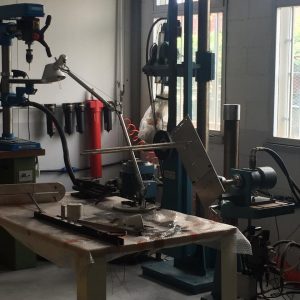
Artemide Quality Control Test of Lamp Joints

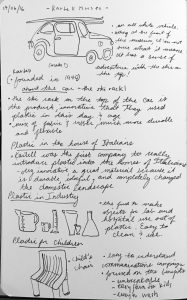
The merging of good design and product quality sounds obvious, but so often today quality is sacrificed for expense, which only contaminates the market with deceptive products. Kartell’s showroom inly emphasized this point further. Everyone, including Kartell’s staff, knows that plastic is often deemed as a ‘cheap’ material and it can easily be used to make similar style products with significantly less quality. Unfortunately, it is undeniable that certain pieces of Kartell’s collection looks as if they could be found at either an Ikea or Target; however, they have not altered the material processes to compete with the prices of these look-alike competitors. Not only are they remaining loyal to their processes, but they are making a statement about the importance of quality in products. Yes, their products do have a higher price tag than look-alike products on the market, but their quality and attention to detail is unmatched by these ‘competitors’ and will be able to have a longer product lifetime.
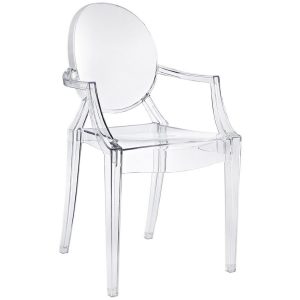
Kartell Ghost Chair
Kartell Ghost Chair

Not only is this conversation prevalent to product design, but fashion design as well, which Kering reiterated throughout the visit to their product factory. Although the designs themselves are remarkable across the lines of Artemide, Kartell, and Kering brands, the attention to quality and consistency are what I believe have helped launch and maintained each of these companies success and prevalence on the consumer market.
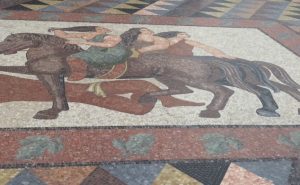
Consistency in Italian Flooring

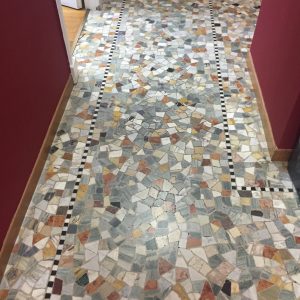
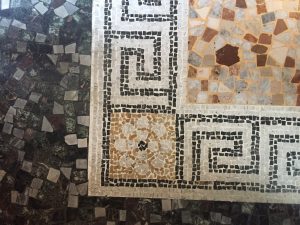
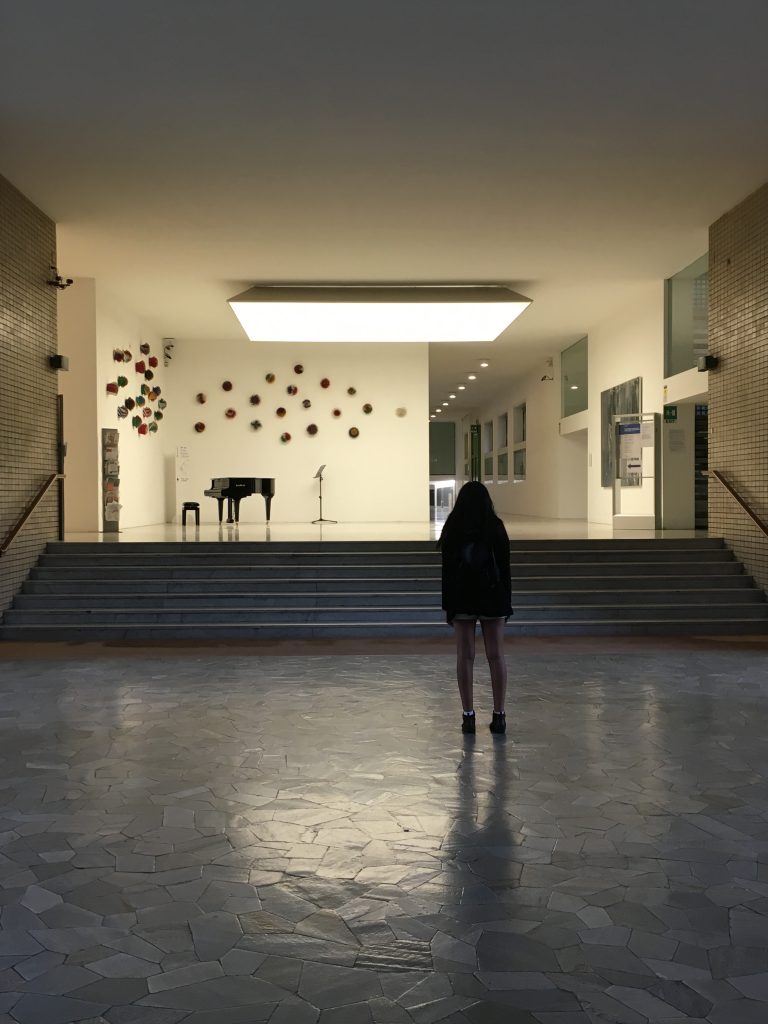
My focus over the weeks in Milan has remained consistent with my sketches still being focused on the representation of various ground coverages and patterns found around the city. Almost all of the floors, thus far, have consistently utilized geometrical shapes and patterns as well as a mosaic method. However, coloring has varied significantly from bright and playful tones to neutrals and serious colors. I have yet to find a justifiable correlation betweens place and color use – except for the fact that the most colorful examples have most often been found in sections of halls, walkways, or more public space as well as more often being found within interior spaces rather than outside.

The ground floor mosaic at the bottom of the main stair.
The ground floor mosaic at the bottom of the main stair of the Triennale.

Since returning from my previous weekend trip to Lille, France and Bruxelles, Belgium, I have become more aware of the extensive floor patterns found in all areas of Milan due to the fact that there seemed to be far less example within either Lille or Bruxelles. Granted that more patterned floorings seemed to be found in Bruxelles than in Lille, they were duller in comparison with the floorings I have seen so far in Milan.

IMG_4595
IES Flooring. Pattern and coloring consistent across various areas in Milan.

Curious as to whether or not these examples of floorings were descriptive or representative of Milan more so than Italy as a whole, I thought back to the places outside of the city of Milan that we have visited and kept my eyes on the lookout in Rome this weekend. I feel as if it is reasonable to take these intricate floor coverings as a representation of Italian design since they have been found relatively consistently throughout various Italian regions- Milan, Como, Lago Maggiore, Borromean Islands, Venice, Rome, etc. The floors on the Islands and in Rome both reflect the geometrical patterns and use of mosaics, as well as a variation in use of color that is not completely explanatory. Therefore, rather than my sketchbook being primarily reflective of Milanese floorings in specific, there will be a representation of different floorings in the regions of Italy that I am able to explore to show certain consistencies in Italian design.

IMG_4640
Flooring found at site on Italian Island.

Unusual Architectural Findings

This past weekend I braved a solo adventured to Lille, France to meet up with old friends, who had previously studied abroad in Texas. My ‘mini-adventure’ consisted of three countries in three days (Italy, Belgium, and France) and it was incredible! Once I had finally arrived in Lille, I walked the city center to learn more about this surprisingly not so small place in France. While I have become more acquainted to the less than grid-like layout of Milan, Lille introduced an entirely new level of maze-like qualities within the landscape of its city center.

The center of Lille was a maze of radial grids without any of the typical straight axes out from the center. However, the pedestrian-friendly streets / walkways and old cobblestone streets were quaint and refreshing in comparison to the narrow and traffic heavy areas I have been experiencing in Milan. In the center of the maze was another intriguing discovery, the Norte Dame de la Treille.

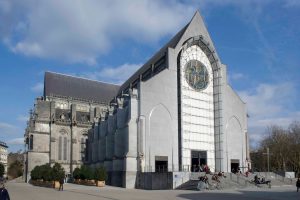
Differing drastically from the scale and architectural style of the Duomo in Milan, the Norte Dame de la Treille is a cathedral with an odd juxtaposition of styles. The drastic mash-up of architectural styles is what made this structure stand out to me as something different from most other structures I have seen, or studied, previously. Similar to the Duomo, the Norte Dame de la Treille was in the beginning stages of construction around the 13th century and utilized gothic style architecture. However, in comparison to the Duomo, which also took several centuries to complete, the Notre Dame de la Treille was not complete in the same style as when it began. Construction began in the 13th century and continued on into the 20th century on Lille’s cathedral. And while many remarkable structures of this time took centuries to complete, there was often a consistency in the overall design of the original plans. However, the Notre Dame de la Treille is striking simply because it did not follow this typical consistency.

While the back portion of the Notre Dame de la Treille is an example of classic gothic architecture, the front facade appears as a modern aesthetic from the 20th century. This visual juxtaposition of architectural styles, which also expresses the timeline of construction for this particular structure, was definitely one of my favorite findings of my weekend getaway.

Notre Dame de la Trielle, Lille, France
Notre Dame de la Treille, Lille, France


Week 3 Sketches – Kartell Museum & Triennale

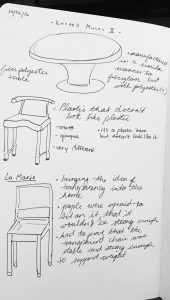
Kartell Museum – simplicity is key

IMG_2449

On Tuesday we visited the Kartell Museum and learned about the company’s history as we traveled through time with various famous designs from the company. It was quite fascinating to see the inception and transformation of the designs, and how something as simple as plastic could be transformed in wonderful ways. The designs of Kartell are all very familiar to us, even if we have never heard of the company. I believe many of their designs are timeless.

I’ll admit, while the history was fascinating and the items quite lovely, I won’t be forgetting the sticker shock I experienced in the gift shop anytime soon.€200 for a plastic chair? I will let it remain as a beautiful memory instead of purchasing it.

IMG_2450

Triennale – focus sketches

IMG_2448

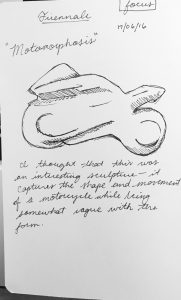
While we were visiting the Triennale on Friday, I stumbled upon two perfect subjects for my focus, which is transportation. The first is an interesting form- a sculpture which resembles a motorcycle. It is part of a project called MOTOMORPHOSIS. From the text about the project:

“MOTOMORPHOSIS is a project of social awareness on the issue of education, safety and mobility of all aimed to improve living together and sharing the road.”

I liked the shape and sense of movement from the sculpture. The project is a relevant one. Different modes of transportation- cars, scooters, motorcycles- give us a great deal of freedom, but we must be mindful of one another on the roads in order to live peacefully.

IMG_2447

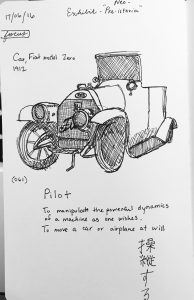
The second sketch was of a Fiat model Zero (1912) as part of the exhibition “Neo-Preistoria”. It was number 61 in the exhibit, which was a progression of items throughout our human history, accompanied by a poem/definition that describes our relationship with each one.

061 – Pilot

To manipulate the powerful dynamics

of a machine as one wishes.

To move a car or airplane at will.

I like this definition of “pilot”, as it conveys the relationship people had with vehicles well- especially Fiat. “Manipulating… as one wishes” gives a sense of freedom- of power. As I’ve been walking, busing, and using the metro across Milan, I’ve sometimes wished that I had a car or scooter to get to a destination quicker. The independence that a vehicle allows us is one I often take for granted.

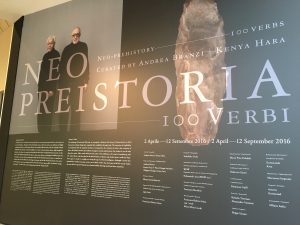
Neo-preistoria

IMG_2206

This exhibit gave me a lot of mixed feelings.

IMG_2187IMG_2188

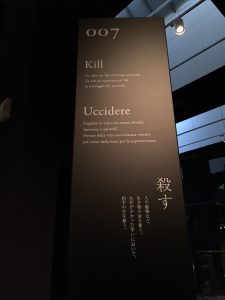
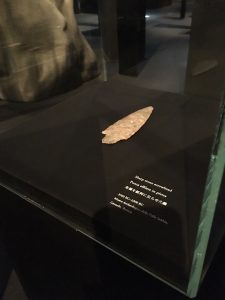
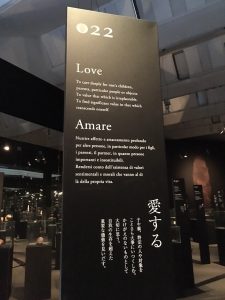
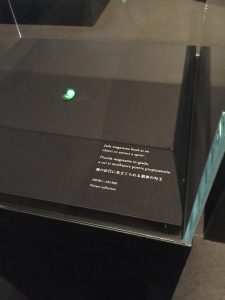
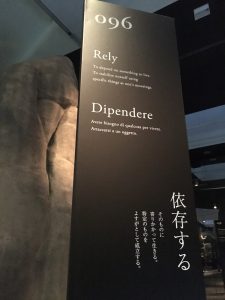
It showed a progression through time— objects created by humans and our relationships with these objects. Words and their definitions associated with the object- an emotion or purpose for it. Our intentions, our desires, sometimes consequences we had not foreseen.

IMG_2191IMG_2190

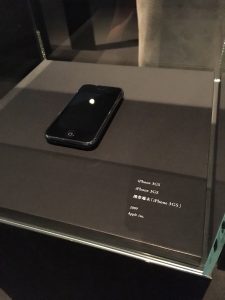
I stood in front of the atomic bomb we (America) dropped on Hiroshima and almost came to tears. I specified “America” in parenthesis but upon writing it, I realized I could have left that out and simply said “us”—humanity. Surely it was a collective fault of humankind that we allowed such a monstrosity to occur. I couldn’t help but notice that toward the most recent chapter of humankind that the objects and associations seemed negative… World War II, addiction to smartphones…

IMG_2202IMG_2203

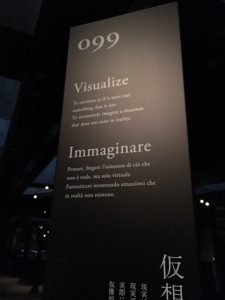
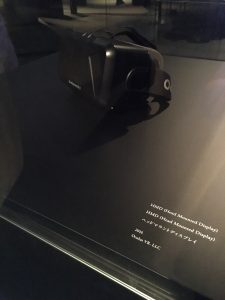
And then, there were the absolute newest innovations. 3D printing, virtual reality, the manufacture of artificial organs. These things carried no sentiment in their definition. As someone involved in virtual reality, I read every day how the technology could be used for good, used for bad…

IMG_2204IMG_2205

Just as any other object in the exhibit could have carried a different definition if we had used it in another way- it is up to us to define how these new technologies will impact our species.

I suppose- it is our destiny to determine how they will define us.

The Mapping Project

The path between Torre Velasca and University Luigi Bocconi, which my group (Kendall, Angelica, and Anissa) and I have been assigned for the mapping project, is a rather interesting experience. There is a very tangible change in mood as one walks the streets from one spot to the other. Now this could very well be due to the fact that we were hyper aware of everything we passed, but I would like to believe in the contribution of the subconscious registering a change in atmosphere.

We started out walking in a rather bright and dandy looking spot, lots of hip looking college kids, green green park space across the street, a smattering of food spots, the likes. We also ventured into the university building, and although the security guard said they were closing, he allowed us five minutes to take in the front lobby at least. I’d say they were quite inviting.

Inside of the Università Luigi Bocconi

The mood changed as we walked towards the tower. The college aged crowd started to morph into suited older men and women, shops became more formal. The quaint old buildings became a little more daunting. The last point of comfort was a little church like building on the street just perpendicular to the tower.  The mood of the place took a drastic turn to the gloomy side.

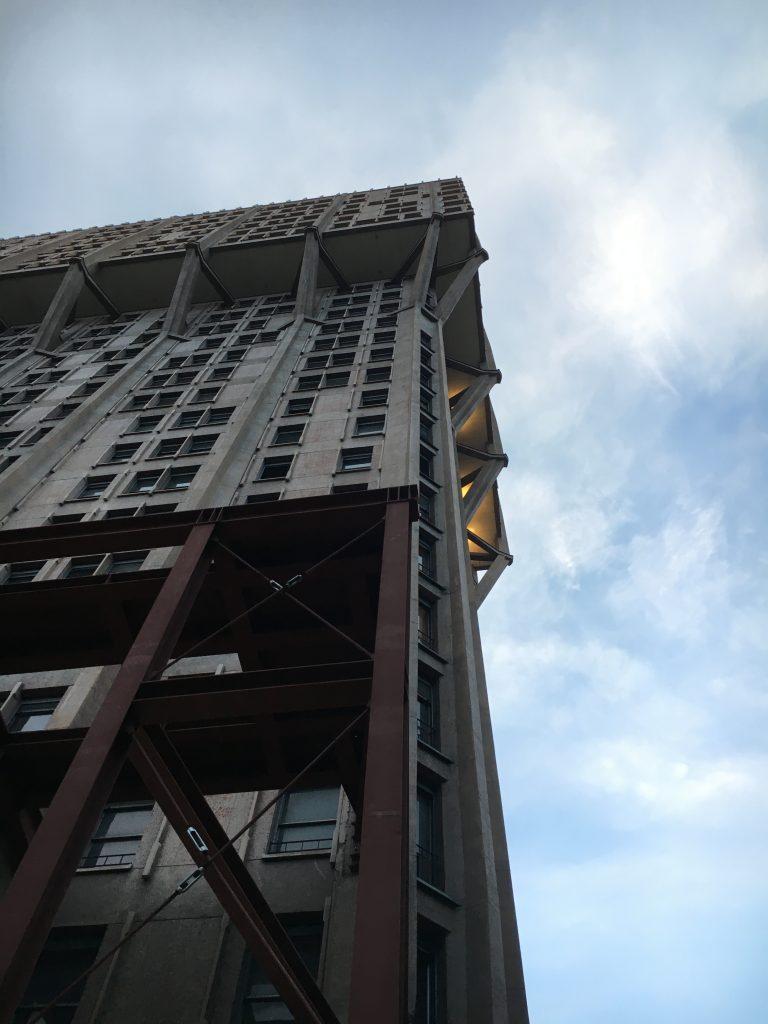
Torre Velasca was built in the form of a medieval watch tower and it really does accomplish that goal. The street was quieter, the buildings surrounding were more somber. I also felt uncomfortable goofing for the camera which is really not something I have a hard time with.

Worm's eye view of the tower
Worm’s eye view of the tower

This helped us settle on our theme for the mapping project. This was a personal brief on the experience of walking the path. Specifics will be talked about in our presentation on Tuesday!

W.Women in Italian Design @ the Triennale

Entrance to W.Women in Italian Design

This was by far my favorite exhibition that we have been to thus far. This exhibition was especially important and memorable to me because it gives me validation and representation as a woman in design as well. Although I may not be 100% Italian, I was excited and proud to see this exhibition so prominent at the Triennale. Since design has been, and in some cases, still is dominated by men and the male perspective, it gave me great joy to see women represented at such a level. To have a whole exhibition solely focused on women in design is a powerful movement for the design world.  Many times in the past, women’s work was subsumed under a male peer’s name, withholding the recognition women deserved.

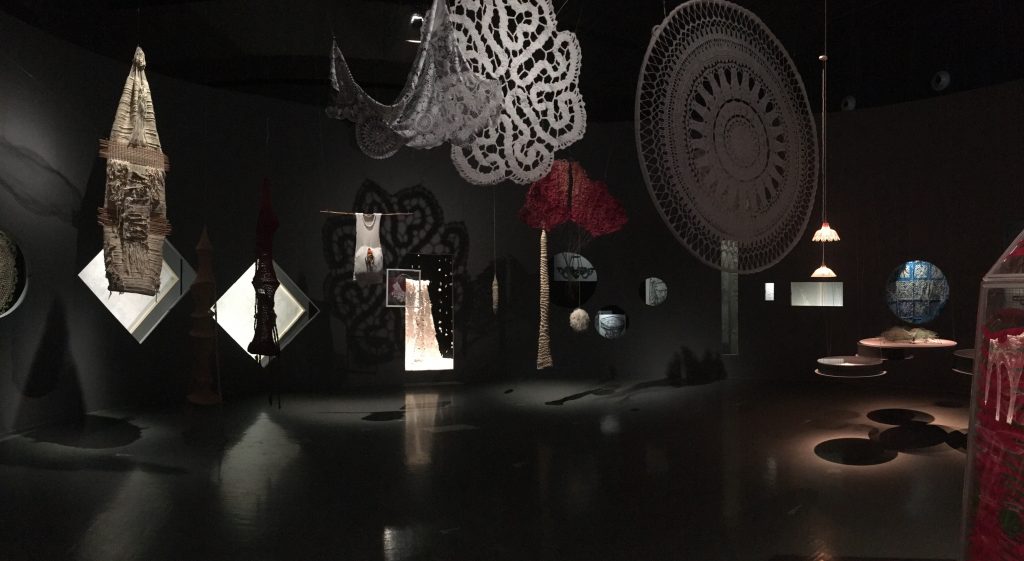
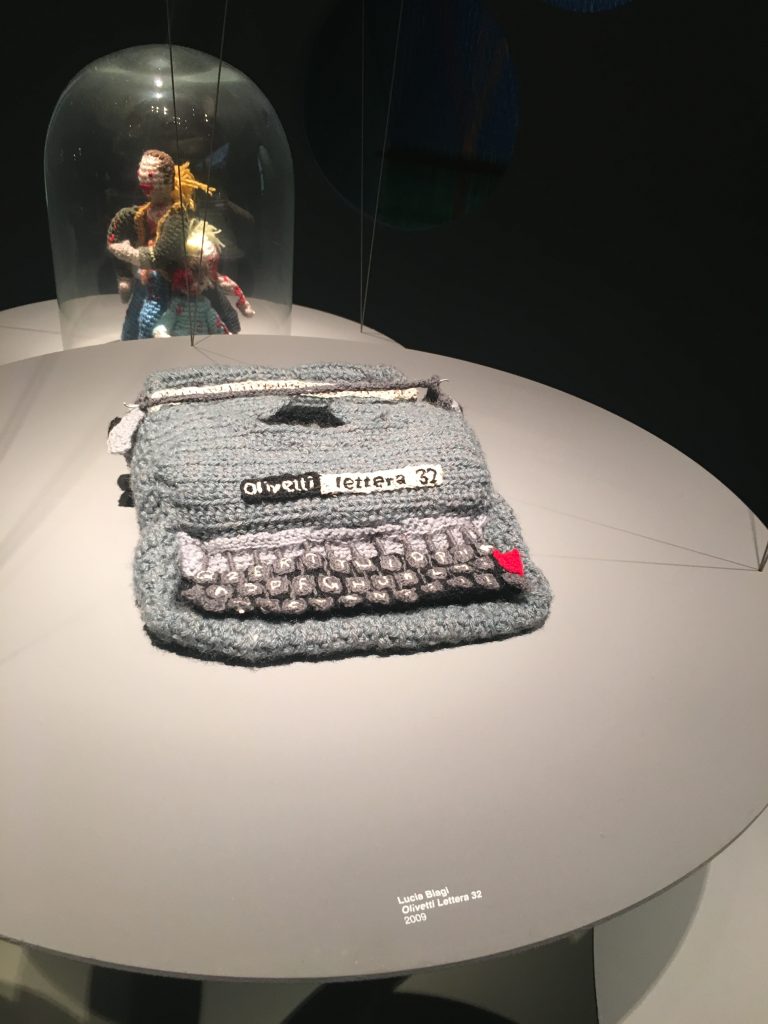
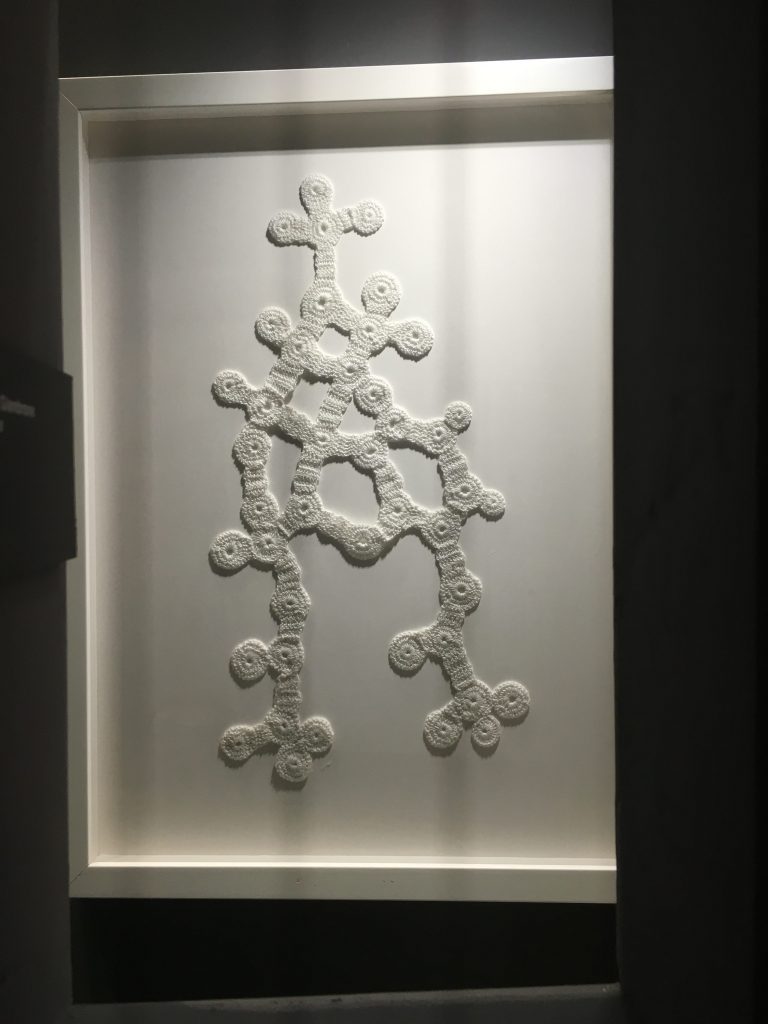
The beginning of the exhibition immediately caught my attention. I was so pleased to see so much craft work, so much design with fibers!! I, myself am an avid crocheter (that’s with a hook, not two needles), and was overjoyed by giant doilies hanging from the ceiling, and various crochet sculptural objects on display.

First view when entering exhibit; giant doilies hanging from ceiling
The first view when entering exhibit; giant doilies hanging from ceiling

My mind was going a hundred miles an hour after walking through the first part of the exhibit. I was thinking of all the ways that I could incorporate crocheting, yarn, and fibers into my senior design project. The validation that came from seeing something that I only thought as my hobby, in a museum, was inspiring.

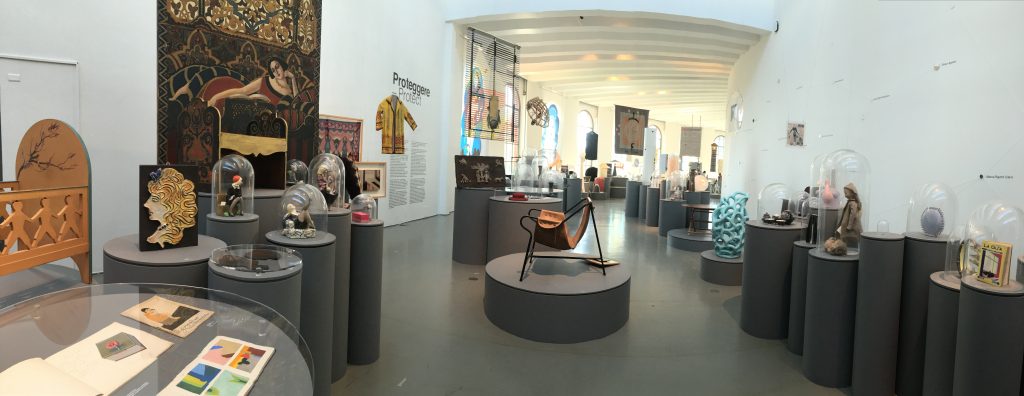
After that experience walking through the dark room with my favorite things in it, I came into a large and airy hallway type room that showcased hundreds of designs from women. I never knew that so much design came out of Italian women! My mind now was thinking about so many things! If these women did it, and it’s in a museum, then I can do it for my senior project, surely.

View of second part of exhibit

Overall, this made my inner feminist leap with joy that these women achieved such recognition for their talents and innovations. I believe that the society we live in now is getting better about giving credit where it is due, but it could still use some improved. Way to take a step in the right direction, Triennale! Brava!


Tra Arte e Moda – Ferragamo


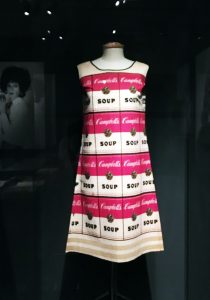
sam4While In Florence I visited the Museo Salvatore Ferragamo, and the exhibit in English is called Across Art and Fashion. When you first walk into the museum there is an installation that has multiple kinds of shoes, and a piece of string that connects the shoe to the a mini animation of shoemakers from the past. The show illustrates Salvatore Ferragamo’s inspirations, and collaborations of the 1950s and 1960s. Osam1nce you pass the shoes that are with the animation there is a wall that is covered in custom shoes of famous celebrities like Audrey Hepburn. There is a constant back and forth between fashion and art. As you continue walking there is a series of huge self-portraits of Andy Warhol. A few of them are out of focus, and there is one that he has completely transformed his appearance as a girl with 60s hairspray hair. The museum also features multiple pieces of fashion like dresses, and mirrors, that go beyond just Ferragamo’s shoes. Not only was Ferragamo inspired by pop culture but also the Futurists. He shared their views and interests of bright colors, and geometric shapes, and he also enjoyed experimenting with unusual materials. This exhibit is a must if you are in Florence! It is also nice to be in a museum that you do not have to wait in a very long line as well!
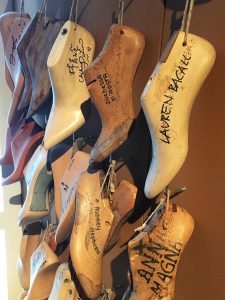
sam2

John Thackara

After my airport experience, I recalled John Thackara’s article regarding design. The quote that arose for me was “After building objects as projections of our bodies, we can now begin to consider them as projections of our minds.” This is a beautiful inspiring note. Not only does it inspire me to continue with my research, but also encourages me to ask questions … How do we begin to design objects after design? How do we design them to remind us of who we truly are? How do we begin to design artifacts that inspire our minds to grow? How do we reconnect with one another? How do we negotiate and navigate these questions with the global markets? I don’t have any answers to these questions, but it sure is exciting that there are conversations happening. There are small actions taking place in the design world. Let’s hope that the transformations occurring take us (the designers) back to aspirations of the futurists, to the radical movements that inspired and helped shift the ideals of everyday life. As John Thackara commented that small actions can transform bigger experiences and systems. Let’s hope that we begin to reconnect to the ground, to nature, to our true selves.

London Airport Retail

A weekend in Scotland via London… stuck in an airport in a 4-hour layover was stranger than strange. As I walked out of the immigration checkpoint and into the “gates” area, I found myself surrounded not only by advertisements, I was bombarded by these massive airport retail stores. My first thought was, wow… who’s designing these and who’s making money? The second thought, after I took a minute to digest all this information—and it is the most important … How is this affecting our lives and the way we communicate with each other? Am I the only one noticing something wrong with this picture? Everyone was shopping without realizing that they had become numb to their surroundings. Most people were either shopping or looking down on to their phones. Never had I experienced such an unsual event. The beauty at airports for me was seeing people communicate with one another—either saying goodbye to someone with a long affectionate embrace, happy smiles because their on vacation or simply, a caring glance to the person sitting next to you. The luxury of traveling (at least for me) was to converse with others across the globe, meet new people and experience new places. I don’t recall traveling as a shopping experience. Have we lost the art of traveling or has it simply shifted as our needs have changed? Has our environment simply adjusted to the populations needs? Are consumers asking for this or are they being fed this? Has traveling simply shifted to shopping? How is this impacting the way we travel and live? Lots of questions … maybe, a topic for another discussion.