Rough Week

culture_shock_curve_new


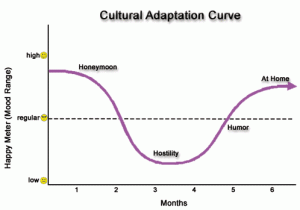
When I first began this journey abroad, one important graph our coordinator showed us was the downward slope that’s created near the end of the journey and how it affects those around you. In this case, it was quite a few factors that created my downward slope. The first of which was my loss of internet. I am currently taking this course as well as a physics course, so not having an internet connection was, honestly, a death sentence. I couldn’t finish my blogs in time and I wasn’t able to reach out to my friends or family because I didn’t have data. This also led to the realization that unlike the U.S., where there are random cafes that give wifi and allow you to sit and work, these cafes don’t exist here. It seems that Italians don’t have this type of lifestyle, which didn’t work in my favor. Once I finally did get an internet connection, I decided to celebrate! Hooray, internet! I may as well go out with friends to enjoy Milan a bit. However, in the process of my celebration, I actually lost my wallet. It was honestly a stab to the chest in an already rough week.

However, even though these events did happen to me and I do feel poorly about it, I do have some bright sides. Thanks to the outstanding staff at IES, I did manage to communicate with the police and file a report, then get a new metro pass at the Centrale station. Also, thanks to the outstanding teacher I have, I was only met with understanding when I couldn’t post my blogs in a timely fashion. So, though these awful events did happen, it didn’t bring me all the way down. I did manage to look on the positive side which was that at least my wallet wasn’t filled with a lot of money or with important documents such as my passport. This situation could have been a lot worse, and we could have even been without an internet connection for longer, but was only without it for most of the week, not for the next week and the weekend. It was quite a turn of events to receive the text saying the internet was back.

I also feel that, just like the graph shown to us, the downward curve does have an incline and I honestly have a greater appreciation for the time I do have and the exhibits that are to come in the future. It seems that these small realizations have shaped and accustomed me to a standard of living in Italy that I was not used to before. It humbles me to my past and my future and makes me grateful for this opportunity at becoming more cultured and being able to laugh about these events. And also hopefully, my family doesn’t get too worried about me being on my own and can trust me a bit more on how I handle a crisis type situation.
Umberto Boccioni

bcee5ed2ed5c876c533e00250160a88e

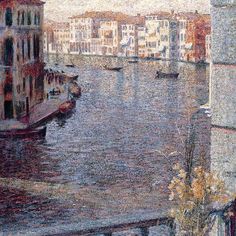
Grand Canal of Venice by Umberto Boccioni

9b993bbe81a40e1809385abfe32b6f5c

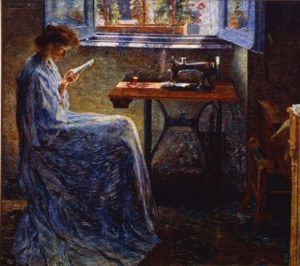
Novel of a Seamstress by Umberto Boccioni

While visiting exhibits we were able to see some amazing works of art that really inspired and brought together the ideas of futurism with many colors and talents from many artists. Two that really stood out to me was Novel of a Seamstress and Grand Canal of Venice by Umberto Boccioni. Both of these amazing works done with oil on canvas and done beautifully. I had never seen such detail done with oil paints before and to allow for such depth and shadow to appear in this work. Umberto Boccioni himself focused his energy on working during the futurism movement and creating pieces from this time. However, I felt the strongest connection with these portraits that were created earlier in his life in Italy where he pushed for portraits, mainly of his mother and landscapes of the beautiful scenery. I felt a deep connection with these portraits even though they aren’t too closely related to his more intense work done during the futurism movement which focused more on abstract shapes and designs. I felt that this was remarkable in its own right and deserved to be recognized as an astounding piece.

Alessi: One of the Greats

13460805_10155018842709126_247680548_o

During this week, we actually had a chance to visit the Alessi museum. It wasn’t quite a museum as told by the host, but it was something to behold. Even the extravagant way in which our guide moved the shelves was amazing. With this turnstile type wheel, the shelves were moved across the floor and pushed each other into one direction in order to get to the shelf beside the one being pushed. It was amazing and a remarkable use of engineering and creative genius. The entire presentation of the items in this museum was amazing. There was constantly something interesting to look at and another interesting story to back it up. One of my absolute favorites was how the son of the original owners, made his own by bringing in amazing artists such as Salvador Dali to come in and create an interesting piece of their own. It was so great to see someone born from such a creative family to admire the art of those around them and understand the importance of these artists when it comes to the inspiration of great design. It was even interesting seeing how architects were the main assets for design genius during this time and weren’t used for strictly designing buildings, but also modeling their tea set to the shape of cities.

Week 3: Mapping

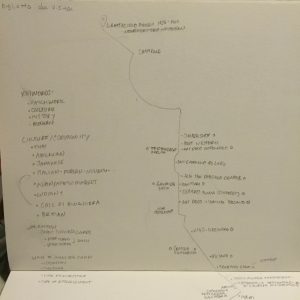
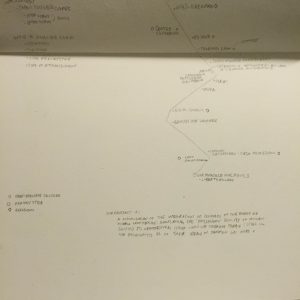
The mapping is ready to be presented! We did our walk twice, from the Pirelli building to Via Marcello Malpighi. The first time we played the role of the casual observer. We were good little flâneurs. We took note of signs in different styles (Art Deco, Rationalist, etc). We took note of smells, colors, culture, and food.

Then our second walk took on the spirit of the Situationists International. The situationists believed that it was important to construct situations, deliberately, to reawaken the soul. We did not want to simply take our walk as observers, but create a situation in which we had to directly interact with our walk. Our solution was to acquire as many business cards as possible from establishments that held meaning to us.

By collecting cards and talking to people from cafes, sushi bars, massage parlors, and commercial shopping, we experienced an array of (often awkward) encounters. Yet, I can assure the reader that each place is remembered and now dear to me. Our map presentation showcases the cards we received and guides the viewer through some of their subtle (or not subtle) historical references in Milan’s patchwork of the past. Top of map + Musings

Bottom of map + Musings
Shopping + American + Contemporary
Italian + Art Nouveau

Mapping: Fascism to Modernism

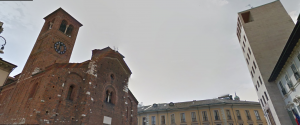
Hillary, Zalak,and myself were teamed together to map the experience between the Headquarters of the Federazione del Fasci Milanesi and the Triennale di Milano. Although we had previously visited the Triennale, we were completely unfamiliar with the Federazione del Fasci Milanesi – a Piero Portaluppi design. Not too far off from the Duomo, the Piazza S. Sepolcro (Federazione del Fasci Milanesi) is much more dense and heavy in the mood of the atmosphere. Taken away by the church across from our starting building, we noticed the odd juxtaposition of styles between the Romanesque church and the fascist tower that suppressed the surrounding structures. 

Piazza S. Sepolcro
Piazza S. Sepolcro

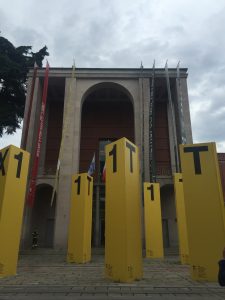
In absolute contrast to the dense and heavy atmosphere of our beginning building, the Triennale is located in an open area surround by light and greenery overflowing from the adjacent parkland. Although the building is also large and of similar coloring on the front-most facade, the architectural style is much lighter and of a different time. Both buildings were built in the early 1930s, but their stark differences in architectural styles make them seem decades apart in age. While the fascist tower is a prime example of fascist design, the Triennale is modern in aesthetic and belongs to the Novecento movement.

Triennale di Milano
Triennale di Milano

The walk between these two differing endpoints was interesting and ended up reflecting a path of heaviness to lightness in environment along the route from the Headquarters of the Federazione del Fasci Milanesi and the Triennale di Milano. As a part of our mapping project, we are drawing inspiration from an event hosted at the Triennale, however, the main focus will be on moods and environments as we shifted from point A to point B. Our inspiration was realized in the form of exhibiting objects from key areas along our route and using verb definition to iterate the mood/impression of each area along our route. 


Week 3: Sketchbook

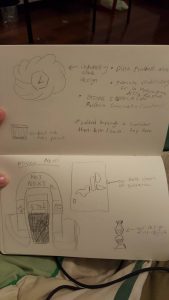
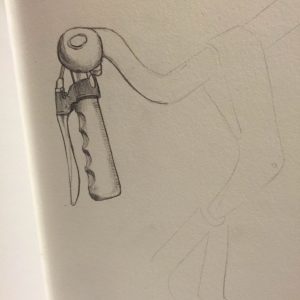
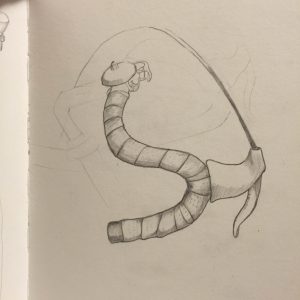
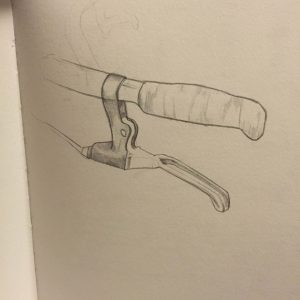
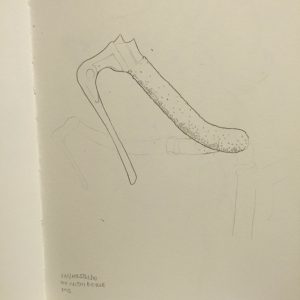
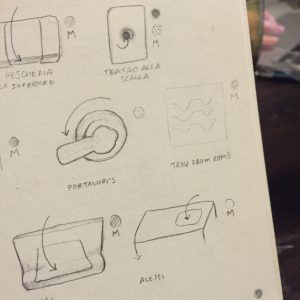
This entire trip my sketchbook has been torn between my love of bicycles, and interest in the variety of appliances (aka toilet handles). The toilet handles have hit a little bit of a plateau and are starting to look the same, which does of course mean I can now start researching the brands and functions. Yet this week, while adding a few new sketches to the flushers (including one very obnoxious one found on the way home from Rome that flushed without warning) I was entirely enamored with a bike exhibit within one of the Triennales we visited.

I figured I’d go ahead and post about my secret obsession (bike handles) because it has been consuming a lot of pages within my book. These bike-handle sketches have also made me realized how unique the craftsmanship and variety is in Milan. I will look more carefully when I return home to Texas, but I swear I haven’t noticed such extravagant bikes in such common areas as I do here. The Triennale show also introduced me to Paolo Manfredi and his talk about about craft-built bicycles in Italy, another venue to look down.

Bike outside apartment-very common
Street bike with wrapped handles w/ holes
Marble + plastic handle
The Urushi Bicycle, 2015
Awful + mean trenitalia flusher

Kering Factory

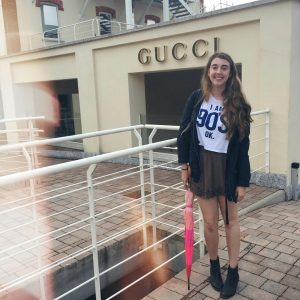
Outside the Kering Factory [/caption]As a textiles and apparel major, I’ve lost count of the number of times I’ve studied the product development process for a garment. In fact, I even took a course entirely dedicated to the product development process. While I’ve been able to enjoy all the beautiful museums and and workshops we’ve visited thus far,the Kering Factory was one of the main attractions I most anticipated. I was aware that Kering developed runway samples for luxury lines such as Gucci and Stella McCartney, but never in my wildest dreams did I think I would get that up close andintimate with the garments.
As soon as I walked in the door of Kering Factory and saw giant “Gucci” signage, I immediately felt at home. Our group first sat down in a conference room where a representative gave us a presentation about Kering and its background.
Kering specifically makes runway samples for Gucci, Saint Laurent, Bottega Veneta, Altuzarra, and Stella McCartney, but they also create PR sample garments as well as red carpet gowns. After receiving an overview of the factory the tour began. I made sure to be in the front of the line closest to the representative. I was so excited that I started to feel the tingle in your nose that you feel when you’re about to cry. Thankfully, I was able to collect my emotions and maintain a calm composure.
The first stop on our tour was the CAD center. CAD stands for computer aided design, where you design the technical flats of the garments. UT offers a CAD class which I have yet to take, but I hope to enroll in it in the future. After visiting the CAD center, we made our way to the position of the factory that cut patterns and fabric. The majority of fabric is cut by intricate machines, however some fabrics must be hand cut due to their delicacy.
My favorite part of the tour had to be the next part of the tour, where we saw seamstresses attaching zippers, buttons, and any other adornments to the garments. I have never seen so many beautiful items in my life. I’ve always been sure that I’ve wanted to have a career in the fashion industry, but my visit to the Kering Factory just reaffirmed everything. It would be my dream to work as a representative for Kering. In fact, I told our guide that I would see her in a few years!

Outside the Kering Factory

Update: Lights in Milan

IMG_8707 IMG_8708 IMG_8709

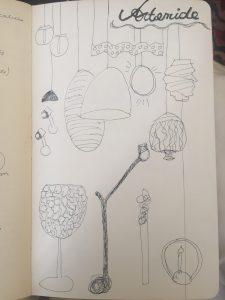
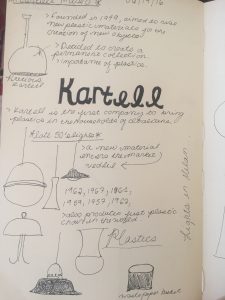
Definitely a highlight within the past week has been visiting both the Kartel and Artemide museums. Coincidently, both these fabulous visits included a multitude of lights for me to sketch and detail. One of my favorite pieces was the plastic lamp that we saw at Kartell, I was fascinated by its design that incorporated a vintage structure but was modernized through the plastic material. As I mentioned in my sketchbook, what I loved about the use of plastic was that the way the plastic was formed makes the pieces appear like glass. At Artemide, I found the technology put behind the variety of lamps really intriguing to learn about. In specific, there was a specific technology shown to us during the presentation which detailed how it could be possible to send wifi through a lamp. Overall, the theme at Artemide was creating lighting that could be something more than a simple lamp in their use. Having the opportunity to see the step by step creation of these pieces in the factory was simply amazing. (As a fan of How its made, I felt like I was stepping through the tv screen in an episode of How its Made: Lamps)

Weekend in Rome

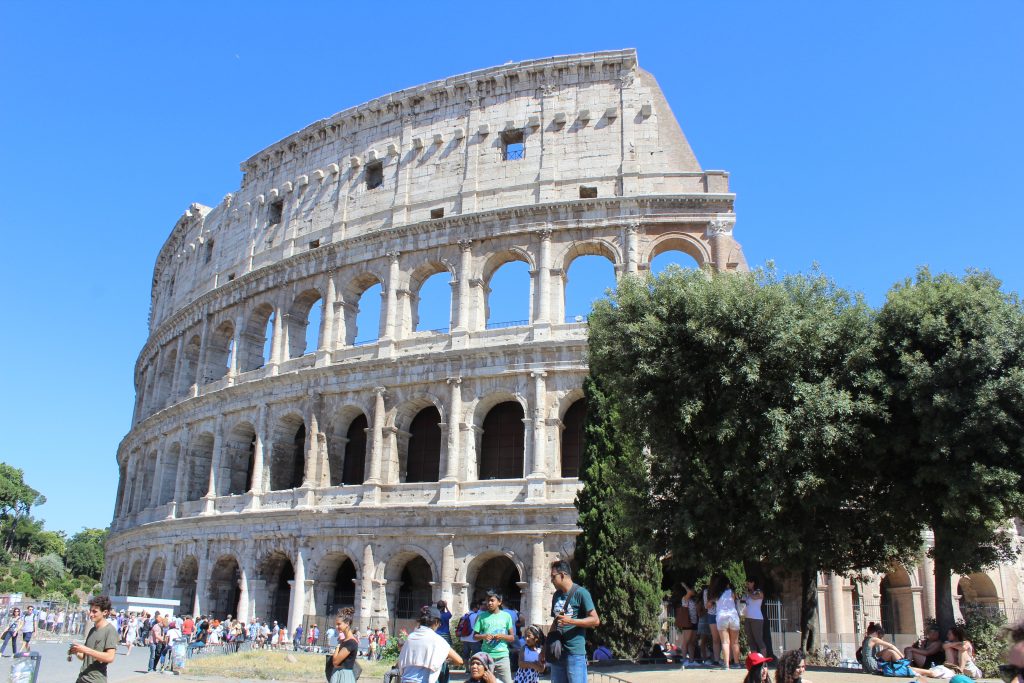
This past weekend a group of us spent the weekend in Rome! It’s very different from Milan, I must say. The public transportation is not nearly as well designed as Milan’s. The city has a different feeling that Milan. Tourists are wandering around everywhere, and there are ancient ruins on every corner. I guess it might be difficult to build a modern city around an ancient city. The metro was confusing.

The metro was confusing. They used the same “M” as Milan to indicate an underground stop, and similar signage, but the layout was not intrinsic. We couldn’t figure out which line we were going into when we entered, and just hoped we would see the stop we needed on the map. And this was not attributed to human error! Underground was not as well lit, or open as Milan’s Metro. The metro cars were jammed packed. I see why they say to watch your bags in Rome.

Rome was a beautiful city, though. I wasn’t sure what to imagine since I’ve only ever seen Rome through a screen in films. The history was rich and I loved imagining what life might have been like in Caesar’s time. Although I must say, Milan has a special space in my heart!

Colosseum
Colosseum

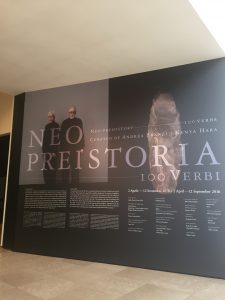
Reactions: “Neo Preistoria”

IMG_8609

“By combining 100 tools and 100 verbs, we attempted to delineate the history of human desires as fixed form of poetry… This exhibition is the result of considering, with Mr. Andrea Brandi, what lies ahead in this kind of human evolution, and whether there is really any hope.”

One of the most striking aspects of the Neo-preistoria exhibit at Treinnale was at the sheer rawness of the entire experience. The exhibited consisted of a series of boards (numbered from 1-100, as mentioned in the quote above) which each explicitly stated a verb that in some form was reflective of human behavior. This entire experience was organized to make the individual feel as if they are experiencing the greatest and most troubling aspects of the human condition,which are infinite faults and ambitions of achieving progress.

IMG_8593

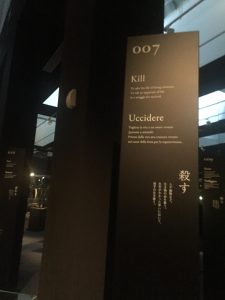
Something that truly made an effect on my own experience while walking through this exhibit was how brutally honest Brandi and Hara were in their description of human progress. For example, number 7 within the exhibited reflected on “Kill[ing]”. They described this as, “To take the life from living creatures. To rob an opponent of life. In a struggle for survival.” To me, the key words within this poem is the idea that killing is automatically linked to “surviving”, and that in order to survive, one must kill. Other words such as “Obey” included a similar connotation, Brandi and Hara write that obey is to, “To accept the power of the strong without resistance.” In essence, each board seemed to innately posses a theme of hopelessness, which is an interesting concept due to the fact that Brandi and Hara created this entire space in order to analyze if there is any hope for the human condition. Of course, one should remember that experiencing the exhibit from a crystalized point of view is simply impossible, seeing that Brandi and Hara have attached their own definitions to the experiences.

IMG_8604

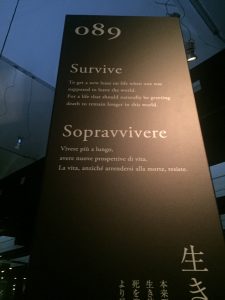
This highly structured way of analyzing human progress was especially prominent in number 89, which was labeled “Survive”. Brandi and Hara define Survive as, “To get a new lease on life when one was supposed to leave the world. For a life that should naturally be greeting death to remain longer in this world.” Accompanied by a range of faux drugs on display, Brandi and Hara form a complex identity of survival through their simple words. This is achieved by bringing to surface that to survive is to also cheat death. And through doing so, humans are creating an imbalance within the world. Although survival is often linked with awe and positivity, Brandi and Hara highlight an often overlooked aspect of surviving, that through the act of survival, humans are disalining the natural order of the world.