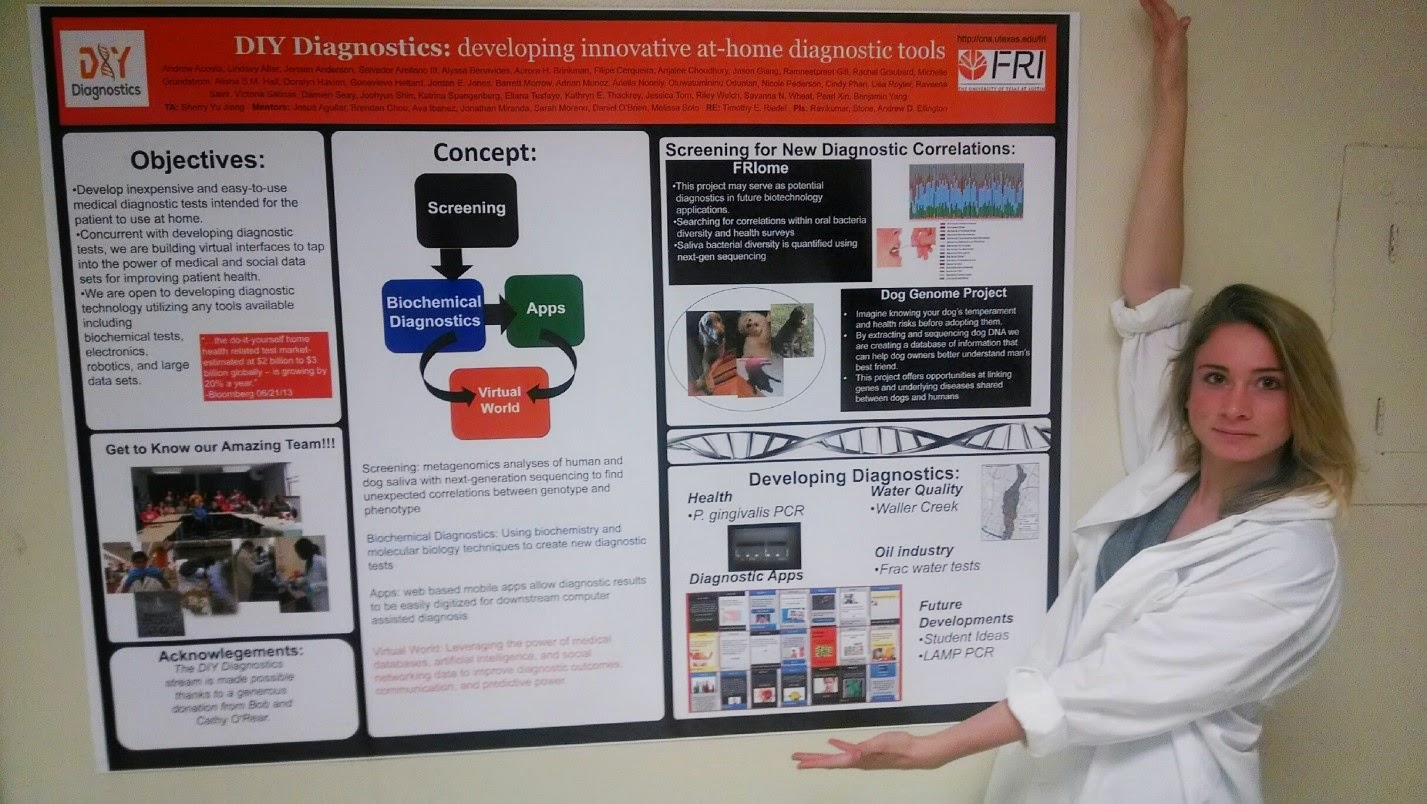
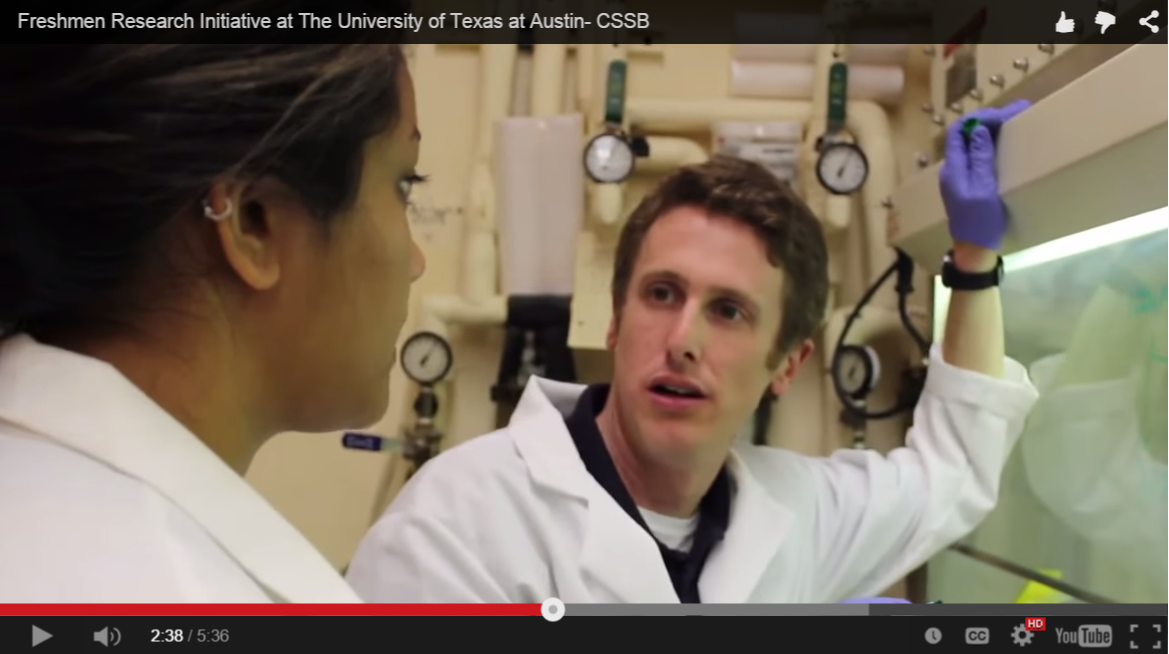
Do It Yourself (DIY) Diagnostics was a no brainer for a medical school wannabe like me. During the FRI picnic, which showcased all the streams and their educators, the DIY Diagnostics poster and the wonderful Research Educator Tim Riedel was the only stream that caught and held my attention, making it the only stream that I wanted to be a part of. This research stream offers so many opportunities for individuality and support for the development of whatever it is that you want to pursue in this field of diagnostic research and discovery. I love how technologically forward this stream has been, especially with the diagnostic phone apps that many of us researchers have been working on. Learning how to code for these apps has been a really difficult and tedious, yet useful and a pretty cool skill that this non-computer science major has been learning how to do. I also love the support that I have from my R.E. and fellow researchers. We have each other to bounce ideas off of and help stumble through the long process that is research, and long hours in the lab have been made fun because of the people that are a part of this stream. If you want to join FRI and you have some great ideas and you want to be able to do your own independent projects and learn all about the process that is research and discovery then this is definitely the stream for you!
Author: Timothy E Riedel
-

Barrett Morrow
My name is Barrett and I’m a sophmore Biochemistry major. My freshman year, like for many others, was quite a rollercoaster. From classes of four hundred plus to piling amounts of homework, college life didn’t seem like all it had been hyped up to be. Thankfully, I made the decision at the very last second (literally 15 minutes before the application deadline) to join the FRI, which has served as my saving grace in my time at UT. Now the FRI may be great, but once you’ve completed your first introductory semester you reach a point where you have a great many stream options in front of you, but I can assure you DIY Diagnostics is the best. It quite literally means “Do It Yourself” diagnostics & the goal of the stream is to create at home diagnostic tests ranging from industrial applications to healthcare oriented tests.
The DIY Diagnostic stream is a relatively new stream. What does this mean for you? You have the opportunity to help mold a lab that will remain at UT far after your graduation. I know from my first semester in the DIY diagnostics lab that students have far more independence in the topics they pursue as compared to other labs. For example, I have always been interested in chemistry. With the recent legalization of marijuana I noticed that there lacked an efficient, easy & cheap test to test for marijuana strength and contaminants. I did plenty of research on the subject and proposed an idea to Tim Riedel, the stream leader, who was more than excited to jump on board. It was this enthusiasm, this primal scientific curiosity and drive that exudes from every corner of the lab that has made my time in the DIY Diagnostic stream so enjoyable.
I didn’t actually end up working with Marijuana, due to complex legal issues, but I did extend my idea to other mixtures to which I could legally test. We eventually decided upon measuring the levels of cholesterol in earwax. The reason behind this is because there is a hypothesis that earwax cholesterol levels are a better representation of overall cholesterol health than readily fluctuating blood levels. I even got a summer internship at UT out of all this where I was able to work on my own project all summer! I’am still currently working on this very project and hope to finish it up this fall! I hope you decide to join the DIY Diagnostic stream, and even if not, that you really enjoy your time in the FRI. There is nothing more exciting and rewarding then running a succesful experiment after hundreds of failed ones. Doing research has made me become invested in my schoolwork. I now look forward to organic chemistry in hopes that maybe I will learn something that will help me with my project!
Once you get involved academically in a subject you are very interested in, school becomes less of a job and more of a hobby, something that you can enjoy. The DIY Diagnostics stream is very exciting, and much progress has been made in the sole year of its existence, and it needs your help to continue! Pursue the ideas that interest you in an environment conducive to learning, innovation & discovery. Personally, there has been no experience of mine thus far that has came close to rivaling that of which I’ve had with Tim & the DIY Diagnostics team. I hope to see you at our open house in the fall!
-

Nicole Pederson
Why did I choose DIY Diagnostics? Easy. I wanted a chance to help revolutionize the way people view medical care. When first introduced to the stream, I was told they were aiming to create at-home tests (like pregnancy tests) for all sorts of conditions and diseases. This immediately piqued my interest. As a pre-pharmacy/biology major, I immediately saw a way that I could make my own impact in the science field. I was even more excited to find out that we would be able to come up with our own diagnostic ideas and conduct research on our own time. One of the first ideas I had for a diagnostic test was inspired by my mother, who currently lives with a heart arrhythmia. She has always wished that she could have an at-home device that would test her heartbeat and notify her if it was racing at the dangerous speed that would signify an attack. The medics use a similar device when they arrive in an ambulance, though an at-home option is not widely available, if available at all. Though the accuracy of such a machine would be questionable and the mechanics outside this streams’ reach, I do hope it can one day become a readily available diagnostic. I hope that my time in DIY Diagnostics will lead me to be involved in this research sometime in my future.
Through DIY Diagnostics, I have been involved in many interesting projects this last semester. These projects range from creating apps designed to test for a disease to the FRIome project, which is essentially trying to make connections between bacteria in your mouth and certain medical/personal characteristics. Working on these projects has taught me a great deal about coding and useful lab techniques. Being involved in this lab has also helped me in other labs that my major requires because I have already been introduced to proper lab etiquette and common skills. In addition, working independently has shown me how often I rely on other people’s guidance in my life. This stream has opened my eyes to true independent work and the importance of establishing relationships with those around me. Though the work is independent, there is an amazing team of mentors to help you when you truly need it. I am tremendously thankful to be involved in such a terrific stream.
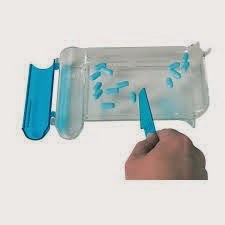
Over this summer, I have had the privilege to continue my DIY Diagnostic experience through a mini fellowship. I was involved in trying to create an app that will identify a pill based on taking a picture of it. Over the summer I also worked in a pharmacy and got to experience hands on how this app could affect a Pharmacist’s everyday life. There were several times when I would be counting pills only to realize that there were two different kinds of pills in the same bottle. Though it was usually just a smaller size of the same medication, the Pharmacist would have to look it up and identify the two types of pills before it could be used to fill a prescription. With my app, however, it would only require a picture to be taken. However, my app is still a work in progress, though I am excited to see how it will end up.
-

Cindy Phan
As a freshman, I stumbled upon this stream while looking at every potential stream that I might be chosen for. I thought to myself what a great stream this was to have your very own independent project. I was so excited to research about cancer or ringworms and all sorts of strange diseases. I expected this stream to be a “no-team-by-myself kind of stream”, but I was wrong. I learn that teamwork is what this stream strives for and that communication is key. I learned that even the strangest project, Waller Creek was the one I hold dearest to my heart. I tell people all the time that I am in a research stream where everyone had potential to change the world.
I tell myself all the time that I am a pre-med student, but do I really love it? It’s really easy to tell that I have no passion for med-school, but I still strive for my parent’s expectations, not my heart. When I hear that I get to be in a lab and going through the stages of failures and success, it gives me the chills down my spine. I learned so many great things and a thing that I am not too fond of as well (the apps), but this stream was really a test to see if I really knew myself.
The best thing that I had encountered during this lab was being able to work along with my mentors during the summer and being actually useful to them. It was so funny when Sarah accidently transferred the mEI plate instead of the mTEC plate into the 44.5 degree water bath and I was basically hyperventilating trying to search for the missing mEI plate. I think my experience was a lot more fun and enjoyable than other undergrads. This research stream really helps me figure out who I am and what did I really enjoy. I can see this stream running for over 20 years because this stream has something that others do not, a chance to figure who you really are through the frustration and success this stream had to offer. I can see myself going to grad school and be like how Sherry is now. It is actually very exciting to see what my future holds with this experience.
-

Lisa Royter
What first drew me to the DIY Diagnostics stream was that it was brand new. When I first went up to the presentation poster at the FRI stream fair in the fall of 2013, Dr. Riedel’s excitement for the endeavor drew me in. He told us about at-home tests for HIV, pregnancy, and even at home genome kits. As a pre-med student, this connection to the health industry intrigued me. When I attended an info session for the stream, Dr. Riedel promised an interesting lab, an effort based grade, and research relevant to our community. As a returning student to Dr. Riedel’s lab, I can confirm that the stream has fulfilled all of his promises.
Before attending the University of Texas and being a part of the DIY Diagnostics stream, I never considered myself a scientist. The occasional dissection or s’mores lab in my high school sciences classes didn’t quite qualify me. With my experience in the FRI, I have learned so much. One of the biggest lessons I have learned is that you have to rely on your knowledge. You cannot expect your Research Educator or a lab mentor to hold your hand through the assignments. It will be scary at first but when you learn to be confident in yourself, research is so much easier and more enjoyable. This lesson has also applied to my other classes. FRI is a great organization because it is designed for freshmen. One of the greatest things I have found about it is the class size. Streams are normally about 30-40 students, a group that is small enough to allow everyone to get to know each other. The size also really allows you to get to know your Research Educator. Dr. Riedel, a UT alum, was an excellent resource to have as a second semester freshman. He checked in with us periodically and was always patient with us as we were thrown into brand new lab experiences.
As part of the DIY Diagnostics stream, my classmates and I learned to program mobile apps. This at first seemed like a daunting task as many of us had zero experience with coding, but after a few simple assignments, coding became sort of fun. I even applied and accepted a research microfellowship over the summer to develop my own app.
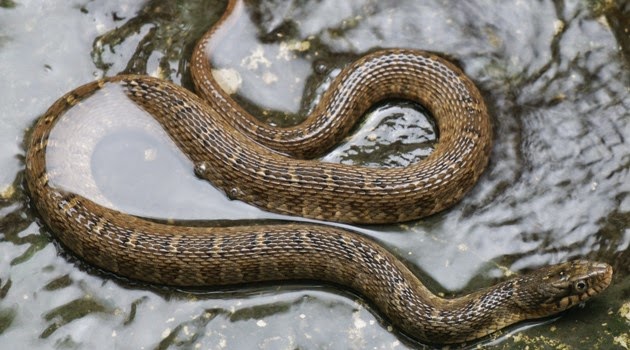
One of my most interesting experiences as a member of DIY, happened during the Waller Creek project we worked on last spring. Our assignment was to collect creek water at one of three spots and test for the presence of E. Coli and enterococci. Dr. Riedel had warned us about wildlife near the creek but I never expected to see a huge brown snake slithering in the water. Thankfully my partner, Sal, kept a look out for it while I finished collecting my sample. For the record, we did not capture that picture ourselves. We stayed far, far away from the reptile.
The diagnostic idea I am most excited about is also the project I have chosen to work on this semester, the FRIome. This project uses human saliva samples to collect and record bacterial DNA. The purpose of this project is to correlate the presence of bacteria with lifestyle choices, such as diet, exercise, and dental hygiene, among others. I enjoyed this project the most because we first began with samples from our own classmates. As the FRIome continues, we plan to extend our sample set to other FRI students as well as students and faculty outside of FRI.
Overall I am very grateful for the opportunity I have had as a member of the DIY Diagnostics stream. As I continue in the program, I have realized that it has been a very valuable asset as both a class and an organization. The close working environment allows you to bond and learn alongside your peers while you both advance your experience and confidence in the research field.
-

Raveena Saini
When I was a freshman entering the University of Texas at Austin, all of the different opportunities seem endless and it was overwhelming. Desiring to find a group where I can grow academically while also being able to develop problem-solving and creative thinking skills, I joined the Freshman Research Initiative. Through this program, I was able to learn more about what research was and basic methods of conducting it. Initially, I thought research was geared only towards people who had an extensive knowledge about science and feared the embarrassment of failure. Slowly, I began to realize that research isn’t about making grand discoveries on your first attempt for an experiment. The beauty in research is that growth comes from failure when you can reevaluate what went wrong and what can be done to fix the problem to result in better future outcomes. This new perspective not only helped my scientific findings, but also my outlook on all of the scariness that the first year at college brings. Through the FRI program, I was able to find the Do It Yourself Diagnostic stream that aligned with my career goals of working in the healthcare field as well as the goals of the new generation to work towards more involvement in ones own health. In this stream, not only have my peers inspirited me by the ideas that they have brought, but also I have discovered a new fire within myself to work to a new diagnostic discovery.
-

Vatsal Shah
As an undergraduate, I have had a hard time figuring out which major I want to pursue and what type of job I will love to do until I retire. From middle school, I always wanted to do something with computers, but I never knew what. Later in high school my view point changed a little and I wanted to explore Pharmacy. I took a class which prepared student for Pharmacy Tech Certificate Exam, hence I knew the ins and outs of a Pharmacist life through that class. As the class progressed, I did not enjoy what I was doing. But I loved the field of medical science by understanding how it is helping the entire world today. Hence after quitting Pharmacy I decided to do Computer Science after my first year in college. When I started taking computer classes I realized that with the little knowledge I have for medical science, sometimes in future I want to integrate medical science and computer science together.
I laid out my goals for future and decided to move to University of Texas for my Bachelor’s degree. In April 2014, I came to know I was accepted to UT. Additionally, by the end of April, I had received an invitation to join the DIY Diagnostics Stream. I looked at their website, and I knew this is what I would love to do. The Diagnostics Stream had all kind of app ideas/research that they were performing on their site. I thought I could make a difference in the stream by adding my computer knowledge. Moreover, it was a perfect do it yourself stream where I could learn more about medical science and apply that with computers. Moreover, the most important thing I noticed was the DIY stream was focused on helping the community, and making their life simple. I always want to give back to my community, and hence I picked DIY stream.
I am excited about two projects right now:
- Pillbox app – it is an app which will help the community to take a picture of the pill from their smartphone and through image analysis it will scan it through my database and find which pill that might be. This is used for people who have to take a lot of medicines in a day, and if they mix a few medicines and forget which one is which, this app will be a great use to them.
- Saliva Extraction – I am doing the statistical analysis side – and I am looking forward to making algorithms to do so.
So far in my experience with the lab, I think FRI was a great way for me to start doing research. It introduced me to how I can start thinking how a researcher does, and it also taught me on how to work with a team of researchers.
The biggest moment I had in this stream till today is getting us a database and a server from the UT IT department.
Being a transfer student, and as a first semester at UT this Fall semester, working with the DIY stream taught me time management skills in general which I am able to apply to my day to day life today.
-

Joo Hyun (Jenny) Shin
- Why did you pick the DIY Diagnostics stream?
I chose DIY Diagnostics because I was interested in the medicine-related aspect of it. I also liked that we, students, could have the potential to actually develop a new over-the-counter diagnostic test that could be used someday.
What diagnostic ideas are you most excited about?
I’m most excited about mobile apps that people can use to self-diagnose or find answers to any medical questions without going to a medical professional. I think these medical apps will become more popular in the future.
- How do you explain what you are doing to your parents or someone who’s never heard of the FRI.
I just tell them I’m doing research over something that I’m interested in. I tell them that FRI is a program that provides opportunities for undergraduate students to immerse and actually progress in research work, which is often challenging to do as undergrads.
4. Why do you love science? Do you consider yourself a scientist/researcher?
I love science because it explains how things live and work in the world. I think it’s also fascinating how that there is still a myriad of things unknown in science that people have not yet discovered. I don’t consider myself a scientist/researcher because I don’t think I have yet committed enough time and effort in research. However, through DIY Diagnostics and future endeavors in research, I do think that I will one day consider myself a true scientist/researcher.
- How has being a part of the research community helped you succeed at UT in general?
Being a part of the research community has introduced me to a lot of the resources that UT offers to students. I have also gained unique experiences and a community that I think will continue to benefit me even after I graduate.
- How was your experience learning to program mobile apps?
Even though I struggled a lot with coding since I have no experience in computer science, I thought that the results that we got out of them were really cool. I am very proud of the apps that we developed.
- Can you share a big “aha” moment you have had in the stream?
I had a lot of “aha” moments last year we were working on our mobile apps last year. It was always exciting whenever I was able to finally figure out to get my coding to work after spending several hours trying to fix my app.
- Has anything particularly fun or funny happened to you in the stream?
My most fun experience I had during the stream was when I went to Waller Creek to collect water samples. I went with three other FRI students, and even though this task lasted longer than it should have, it was a fun and refreshing experience doing fieldwork outside together with a group of other FRI students.
- How does your research experience compare to someone else you know who has done undergrad research?
I think my research experience differs from that of other undergrads who are involved in research because I have more freedom in what kind of project I want to do. Even when this freedom to do anything sometimes have felt overwhelming to me, I’ve had supportive faculty members and peers who helped guide me in the right directions.
10. Where do you see diagnostics in 20 years and how do you fit in the picture?
I think that do-it-yourself diagnostics will become more prevalent and more advanced in 20 years. Because of the longer life expectancies and the growing senior population, the demand for diagnostics will continue to rise. At that time, I hope that I’ll be continuing research and contributing in the advancements of diagnostics
-

Katrina Spangenberg
The DIY Diagnostic stream stood out to me because of all the possibilities it holds. There are so many directions you can go in research trying to develop diagnostic tools from disease and health, to environmental preservation. The streams’ goal of creating diagnostic tools would be applicable to everyday life and hopefully helpful to many people. All of these factors added up to my decision in picking the DIY Diagnostic research stream.
The DIY stream is a research lab within the Freshmen Research Initiative. It is an opportunity for undergraduate freshmen and sophomores to be a part of research that most students would not dream of doing until they are seniors or even graduate students. A community forms within the research lab that really propels us to go further into research and academics at UT in general because of the competitive, yet nurturing atmosphere. Being in an FRI lab, we gain skill and knowledge that most students at our level have not yet attained, putting us another step ahead.
One of the diagnostic ideas that we are currently working on developing is relevant to water and environmental safety. By researching the stream that runs through UT’s campus, Waller Creek, we hope to gain knowledge on bacteria levels in the creek and possibly develop new ways to test bodies of water for contamination levels. Once we reach the point of knowing what to test for and what levels are acceptable, there is the possibility of developing an at home diagnostic tool for people to use in their everyday life or travels. This tool could be helpful in developing areas to gain insight on whether water sources are actually clean or not. There is nothing quite as exciting as knowing that a potential diagnostic tool could have a global impact!
One of the things I love about science is how much it can uncover about the world we live in. To the common eye, many things go unnoticed, seem of little importance, or appear to be at the point of hopelessness. To a researcher, we get to look at details that are often neglected, ask more questions, and work towards resolving issues that seem far gone. Because of my time in the DIY Diagnostic stream, I now consider myself a scientist and researcher. We are asking more questions about water safety and bacteria levels, studying the water from a stream most students at UT never notice, and potentially developing a tool for the every day person to test water safety levels.
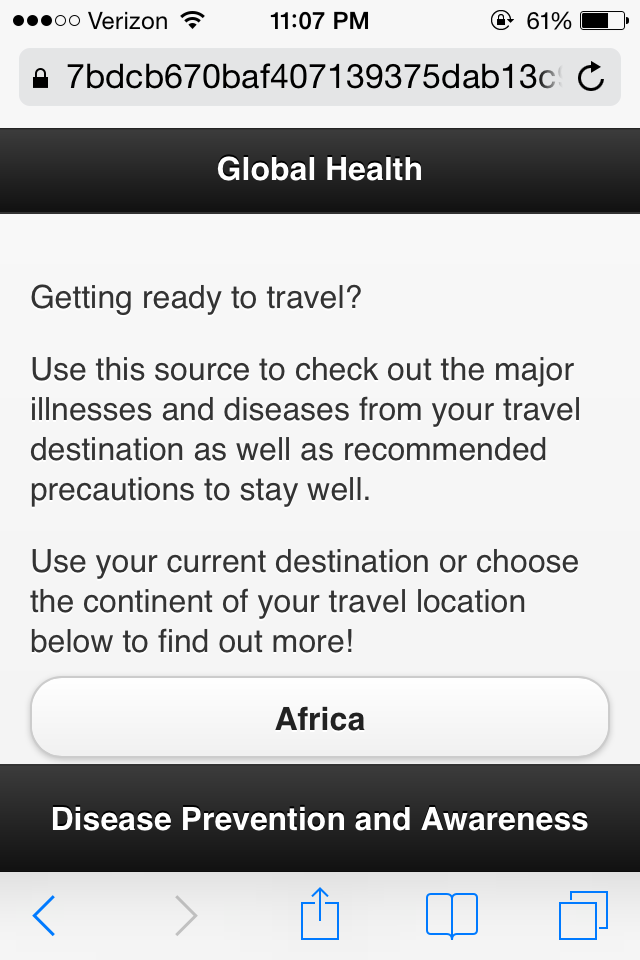
In the DIY Diagnostic stream, we have also learned how to program mobile apps. At first, it seemed frustrating because of how tedious coding an app can be. Thankfully, with every new app we make, the more advanced and useful the apps become. This summer, many of us got to work on developing an app for a “micro-fellowship.” I worked in a team with Michelle Gungstrom, and we developed a Global Disease app. This app can be used as a tool for travelers to gain knowledge of the diseases and precautions to take at a destinations. It works on mobile phones and computers alike.
Any friends that I know doing undergraduate research have not gotten to start until their junior or senior year of college. Thankfully, FRI breaks those barriers. The DIY Diagnostic stream stands out even more compared to other undergraduate research experiences that I have heard of because there are many routes to take within diagnostic research. Most of the time, undergrads are in a lab where their opinions and ideas are not usually heard out as much as they are here in DIY Diagnostics.
Twenty years from now, diagnostics will most likely be at a point beyond anything we can imagine. Diagnostic tools have the potential to completely transform healthcare by having more personalized tools or general health trackers. By that point, we could have tools that would enable us to have greater knowledge and awareness in our everyday environment. Maybe I will be using a diagnostic tool in Kenya to test the local drinking water. Perhaps I will be in a hospital using a diagnostic tool to identify whether a patients tumor is cancerous or not. The possibilities are endless.