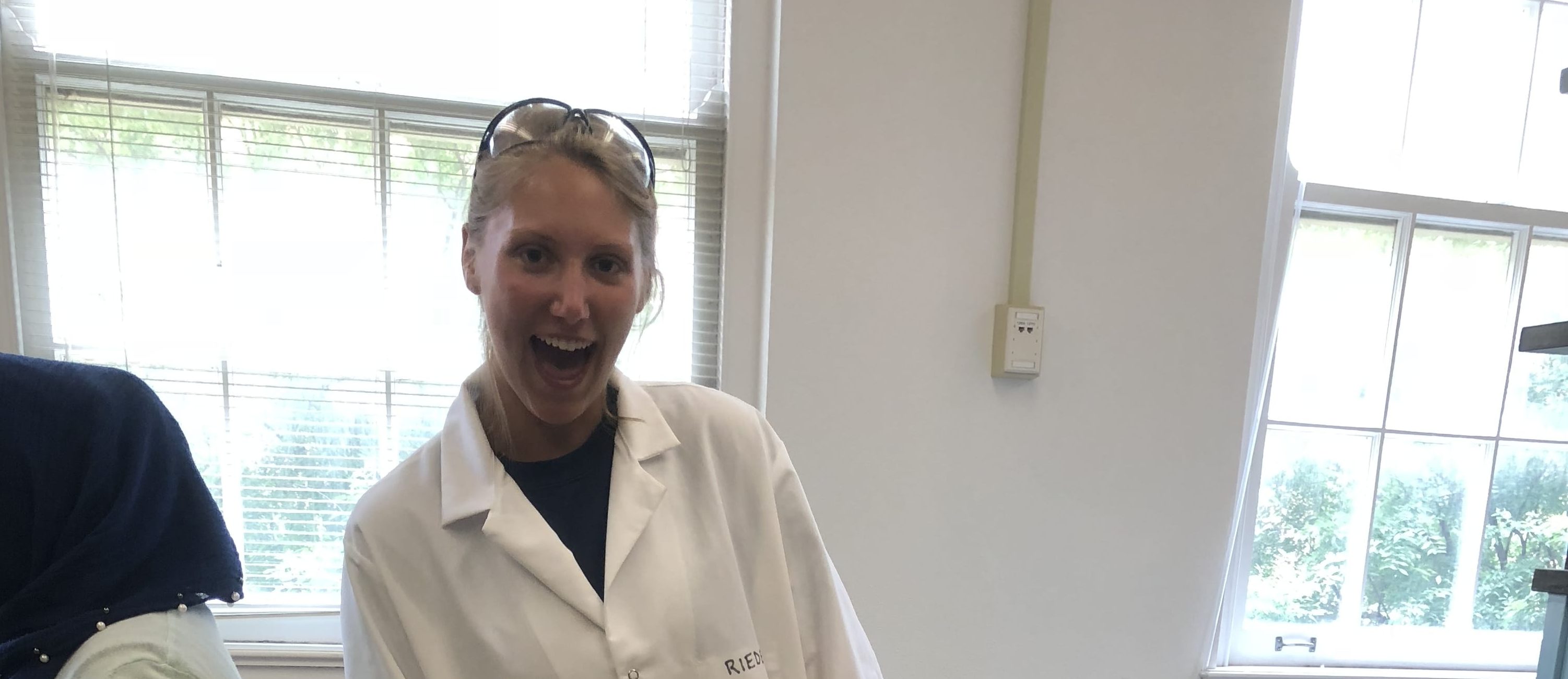
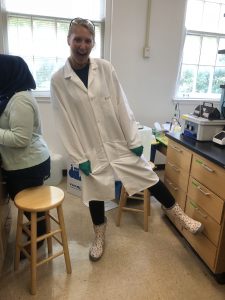
Hey guys! My name is Sydney and I am a sophomore studying neuroscience. I picked DIY Diagnostics because my FIG professor recommended Dr. Riedel for being very open to letting students pursue their own interests, I knew that the lab is related to healthcare in some aspects, and it is interdisciplinary with biology, chemistry, and computer science. These points couldn’t describe the stream more perfectly. To give some context to my experience I want to explain the general lifecycle of being in FRI; In the spring you are placed in a lab and your research is driven by assignments designed to teach you various lab processes. In our lab, we learned qPCR, 3D printing, and even a bit of coding. We cultured samples of Waller Creek to detect a pollution source coming out of a pipe, and from that data alerted UHS and the city about a real public health problem. After your first semester you have the option to apply for a paid summer fellowship, which gives you a head start on the more independent project that you wouldn’t start working on until the fall of your sophomore year otherwise. For my project I chose to use wax-printing and a method of agglutination with CRP antibodies on paper-based diagnostics to detect a sample’s quantity of target protein by measuring the sample’s lateral flow distance, specifically looking at an inflammatory biomarker highly associated with heart failure called C-reactive protein. I had no idea what any of this meant when I first started, but that uncertainty is the most important part of FRI.
During my fellowship with the lab this summer I learned all about the past relevant research, potential importance, and mechanisms of what I was working with, and as time went on became more confident with what I could do. It gets frustrating at times because working on a project without knowing what the outcome will be is intimidating, and on top of that you aren’t always sure what you’re looking for. This, though, is what pushed me to become a real researcher, and it will be what pushes you. Sometimes the most important thing you can do is to keep chugging along. It’s also the most rewarding thing ever when you realize you’ve become an expert at something! You may not have a Ph.D. yet, but you get to know your project inside and out, and that’s a truly valuable thing. Having the training to do something at a wet bench on your own or being able to control your computer instead of letting it control you are skills not found in many people our age, and if you market those skills right they can get you somewhere. Because of what I learned in DIY, I was able to pitch myself and my skills to a biotech company in Boston that is taking me on as their first intern this summer. People appreciate experience, so my best advice is to not take for granted what you have done.
What you do at UT matters. You have experiences that set you apart that make your story interesting and unique to you. FRI is an opportunity unique to UT, and you’re already forming the right habits by taking advantage of it. This lab is one of my experiences that has taken me very far, made me a better problem solver, and a better scientist overall. I highly recommend coming by during the open house sessions to see what we’re all about- you won’t regret it!
As a Public Health and Human Biology major, I am interested in studying infections diseases specially those transmitted by vectors. During the application process to UT, I read about how undergraduate students were developing do-it-yourself diagnostics for mosquitoes in the Freshman Research Initiative. After reading the article, I decided to apply to the FRI-DIY Diagnostics stream and was fortunately admitted. This fall 2018 semester I ambition to continue exploring the field of vector diagnostics with success by working on a device that can automatically count mosquitoes by listening for wing characteristics such as frequency. It is important to mention that I didn’t always have this ambition or confidence, like many of my fellow classmates I felt that I lacked the knowledge necessary to be a competent researcher. Being part of this research community gave me a sense of success because unlike other students, I was able to take a hands-on approach to what we learned in course lectures, and the stream itself provides the students with a variety of new skills that a regular student can only wish to have. To be honest, I didn’t find research interesting at first especially because it seemed too complicated, but Dr. Riedel and the mentors help any student make a smooth transition into the world of science. Dr. Riedel is truly an enthusiastic research educator, you can see it in his expression when you meet to discuss research projects, and as students, nothing makes us more motivated than having those who we look up to encourage us. This stream has definitely impacted the opinion I had about research, it has made me consider and search for medical school programs that place emphasis on research. The stream will help you create a strong research foundation that can be used for other undergraduate research opportunities, and in my opinion compared to other streams, DIY diagnostics offers more diversity in their skill developments such as learning to program mobile apps.
Something particularly fun that happened during the semester was when I plunged off into E Coli. Infested Waller Creek, I had to walk home soaking wet (Just kidding!). The whole experience itself is very enjoyable, you meet many new people who are just as eager to learn and who want to make the best out of this opportunity. Now for my favorite quote with a twist: remember not everyone can become a great scientist, but a great scientist can come from anywhere.
I always knew that I wanted to join a research lab as early as possible, however, I felt that with no experience, I would not be accepted for many positions that require knowledge of basic techniques. However, through the ARI program, I was able to join an unexpected stream that I had little knowledge about right after my freshman year. I felt that a wet-lab-focused research stream would suit me best as I would gain experience in elementary lab techniques and analysis needed to join larger neuro-related labs. The free-inquiry nature of DIY Diagnostics somewhat concerned me because I felt I would not figure out how to move forward or ask the right questions. I couldn’t be more wrong.
This past summer I was introduced to a project that started and ended with previous members of the laboratory. The premise of the project was to create a health diagnostic using keyboarding as an assessment of the progression of Parkinson’s disease in patients. Ultimately, it would be an inexpensive, universal replacement to the handwriting test that physicians have been using for years. There were no protocols to follow, and no set procedures I could read and repeat. Nonetheless, I loved how I had the power to pursue any question I felt was worth asking! Using a developed keylogging program called InputLog, we asked our labmates to copy a randomized paragraph multiple times to record and analyze their “typing behavior.” In other words, we wanted to distinguish an individual’s speed and accuracy from another individual’s just through their typing. We created daily and weekly surveys, which covered basic questions such as sleep and hunger and more complex questions such as positive outlook and well-being. So far, we have measured and analyzed to widely-studied variables, labelled “action time” and “pause time,” which represent the time it to press one key down and up and the time it takes to press one key down to the next key down, respectively. By logging our labmates multiple times, we have been find that individuals cluster in their own unique space when plotting pause vs. action times. Our goal would be to find different variables such as loud music or gloves to see how that affects each and every individual’s typing behavior.
However, the real goal in our minds to find a sample population of Parkinson’s patients and allow those individuals to log using the program so we can analyze their typing behavior. By comparing these results to a control group of patients who don’t have Parkinson’s, we will assess whether keyboarding becomes a telling health diagnostic. We found a sample populations of Parkinson’s patients who are enrolled in a local Austin non-profit’s exercise classes called “Power for Parkinson’s.” We feel that this project will grow into asking two different yet equally important questions: “Can we use keyboarding as a useful health diagnostic of Parkinson’s disease?” and “Can we assess the effects of exercise on Parkinson’s patients motor abilities using keyboarding and keyboarding data?”
Through the DIY stream, I’ve learned how to become an independent researcher, asking the questions myself and not being afraid of finding dead-ends. I gained coding experience in a powerful statistical language used for analysis of data, and I’ve learned about various studies in the field of “keystroke dynamics.” While I understand that this project will last for months and contain countless logging sessions with various individuals across Austin, I’m excited to see where this project leads us. Thank you to Dr. Riedel, the DIY Diagnostics stream, and ARI for allowing me to grow as a new researcher, and to allow me to research in a field I am very passionate about.
As a transfer student and a senior, the prospect of a research assistantship was something I was still seeking out, but my opportunities were increasingly few. However, after taking a biochemistry course focused largely on understanding and researching scientific literature, I was determined to join a research team and begin my own independent study in molecular biosciences here at UT. The opportunity I found was the DIY Diagnostics stream in the Freshman Research Initiative. Even though I am not a freshman, I was encouraged by my former professor to contact Dr. Riedel and inquire about joining his team. After following the news about the Zika virus and the developments in the scientific community, both academic and industry, I was already aware of the work the DIY stream was doing with a viral detection device. I was anxious to meet with Dr. Riedel and find out more about what his stream was working on and where I could fit in to his current team.
The project that appealed to me the most happened to not be the Zika research, but the FRIome project. This project is focused on finding correlations between general health and the oral microbiome. Following after the goals and continuing work of the Human Microbiome Project, started in 2008, the FRIome researchers have taken samples of the oral microbiome specifically, through saliva donations, and asked the same participants to answer a general health survey. As a part of this team, I have spent this summer sifting through the metagenomics sequencing results of these oral samples and the accompanying survey responses to glean what possible correlation of diversity there may be with respect to type of bacteria and a certain response. As we learn more about just how much influence our microbiota has on so many aspects of our health and everyday lives, I believe this kind of research is marking a new pathway into the future of healthcare. As a part of the DIY stream, one intriguing goal is to be able to isolate a particular bacteria for its significance, create a biomolecular detection test, and use an app to run and display the test and results on a cell phone. This will enable real-time access to health information, once we can make these correlations.
Working in the lab to extract the DNA from the saliva samples, test them for concentration, and prepare them to be sequenced, I have been able to use the skills I learned both in my Biochemistry lab course and my previous work experience as a lab assistant. The real challenge for me this summer has been analyzing the data using statistical methods and programming, some of which I’ve found have been specifically written to accompany metagenomics studies. As I continue into my last year here at UT, I look forward to pursuing this project to delineate a significant link between the oral microbiota and either a general health aspect or even a self-identifying personality trait. I hope that the work I have started this summer will continue to drive my development both as a student and as a future contributor to the scientific community in my career in Biochemistry.
Firstly, I hope you are adjusting well to the Forty Acres, after all, the campus is freaking HUGE and there are always SO many people. Not only that, but congrats on being admitted to the FRI program here at UT as well! FRI provides undergraduates with incredible opportunities and resources, which are now available to you, so definitely be sure to take advantage of them.
Secondly, I would like to tell you why I decided to join the best stream (DIY Diagnostics) in the FRI program and what I love about it. Personally, I was a bit nervous and terrified to be doing research as a freshman because I felt inadequate and not nearly as knowledgeable as I needed to be in order to be considered a “researcher.” However, when I was visiting all of the various FRI streams that appealed to me, DIY Diagnostics stood out the most to me and made the idea of research more tangible for me. Maybe it was the thought of being able to help people in third world countries with various diagnostics or Dr. Riedel’s outgoing and relaxed persona that led me to put DIY as my first choice. Whatever it was, I’m glad I made that decision.
During my time in DIY, I have learned many valuable research and scientific skills, but my favorite was probably learning to code. Prior to my first semester in DIY, I had never been exposed to coding or creating apps and I absolutely loved it! It was incredibly frustrating and challenging, but I loved it because it was like a puzzle that I just wanted to finish. Not only that, but I felt so accomplished and smart (even though I was learning basic coding material) because I could see what I had done. I remember for our first app assignment, all we had to do was add our name to the code and it would appear on the page and I was so stinkin’ excited that I sent the link to my parents and they were just like, “That’s it? You put your name on a page? Cool…” It wasn’t until I got to create my own questionnaire app that they were slightly more impressed with my work.
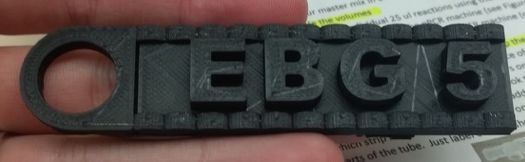
Originally, I was also super excited on learning how to pipette in the lab, until I did, and then it was not nearly as appealing as I thought it was. Lab assignments aren’t always the easiest, but the mentors and Dr. Riedel are super great and very helpful. Being in DIY has taught me that my primary interests are not actually working at a lab bench, which I found unusual. In fact, one of my favorite lab assignments was when we got to use the 3D printer! I made a keychain with my initials and favorite number on it. It was also something that my parents thought was pretty neat right off the bat, so that was nice too!
For almost two years now the DIY Diagnostics Research Stream has been monitoring Waller Creek along campus in the lookout for bacterial hotspots and attempting to identify the sources of these. I had the opportunity of joining the DIY Diagnostics Stream in 2014 and have been one of the Waller Creek investigators since then. I had honestly never really thought about Waller Creek before, even though it is right there in our main campus. Nevertheless, my time working on Waller Creek has made it clear to me that it deserves more attention than it currently gets. I’m honored to have received a Waller Creek Conservancy / Winkler Family Foundation fellowship through the Freshman Research Initiative to continue my research on Waller Creek.
The sites that we mainly focused on were located in the northern part of campus, where testing had proven high levels of fecal bacteria. Our tests consist of two stages; first we determine whether there is bacteria at any given site by using culture dependent techniques, which is basically giving bacteria nutrients and food and generally an awesome environment for them to grow. If the first stage proves that bacteria are present then we move on to the second stage. The second stage consists of determining where the bacteria came from, as of now we have the ability of telling whether the source of the bacteria is human fecal matter or dog fecal matter. It might sound kind of unpleasant and maybe almost kind of creepy, but think about it. These techniques allow us to identify contaminated water and point to the problem, which can then be fixed and prevented in the future. When talking about urban watersheds, such as Waller Creek, identifying sources of pollution is crucial. Waller Creek is surrounded by the city of Austin and the chances of people coming into contact with the water are pretty high, not to mention that Waller Creek eventually discharges its water into Lady Bird Lake where we like to paddle board and kayak, some of us also like to fall off of the kayak or paddle board into what we assume is water mostly free of human/dog “you know what.”
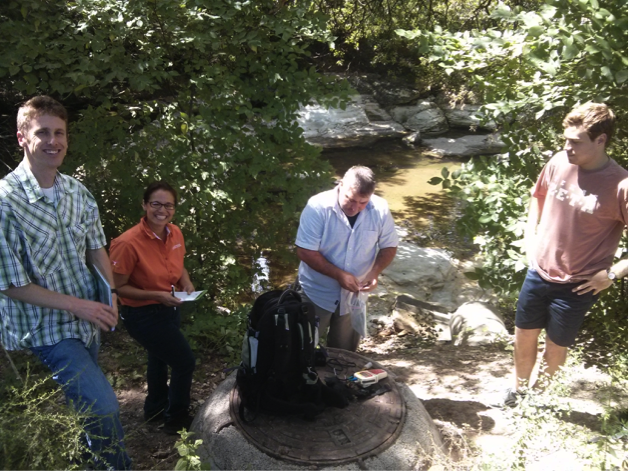
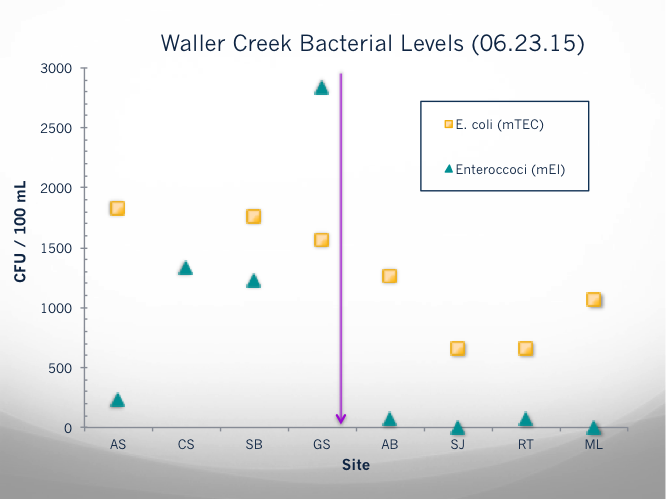
This summer we made some pretty amazing findings with the help of a group of high school students. The DIY research crew came together to lead high school students from the UT High School Research Academy to sample simultaneously at different sites along Waller Creek. We expected the results to show the usual happy bacteria, thriving in the very polluted water of Waller Creek. To our surprise, however, our usual joyful fecal bacteria were gone at the southern sampling sites. Where did they go? I’m talking about a huge drop, one that could mean two things: we messed up the experiment or something was making the bacterial levels drop fast.
These are the values of bacteria (E.coli and enterococci) at each of the sites sampled by the high school students. The purple line represents the point at which the bacterial levels dropped.
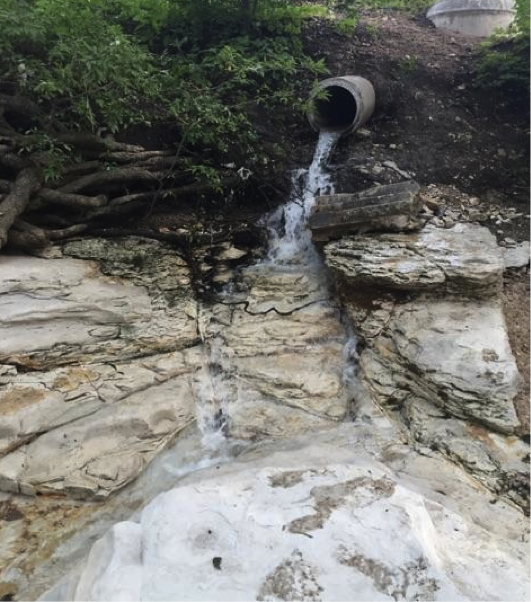
In attempts to find an answer we searched the creek for anything that could potentially explain the drop in bacterial levels. The search was a success! Right in the area of bacterial drop there was water flowing into the creek. We went ahead and collected water from the mysterious outfall to determine if bacteria were present. And the results said: NO. The culture dependent tests indicated that the bacterial levels were zero at this suspicious outfall. We returned to sample a second time and the amount of water coming out of the outfall was still high considering it hadn’t rained in more than a week. In addition, the temperature of the water from the outfall was almost 5C higher than the creek. Finally, we mixed some of the outfall water with water from a site further north that we know had high levels of bacteria. The bacterial levels of the contaminated water were cut in half!
Mysterious outfall.
We were now convinced that the mysterious outfall was somehow lowering the bacterial levels. We contacted Environmental Health and Safety and let them know about our findings. They were extremely responsive and within two days we met with them to show them the outfall. They conducted follow up tests and contacted utilities and facilities who were able to stop the outflow of water!
DIY Diagnostics Stream and EHS collaborating to protect Waller Creek.
Overall, this is a bittersweet story: Sweet because through scientific research we found a hazard to Waller Creek and with the help of EHS were able to stop the problem. Bitter because bacterial pollution is still a major issue in Waller Creek and needs to be addressed, especially since Austin’s population is growing. The next step for us is to determine the source of pollution, which I described before as stage two, and use this information to aid in the restoration of Waller Creek and ultimately prevent future contamination.
Blog Post by Ava Ibanez:
Ava Ibanez is a student from Mexico City completing her Bachelors in Science degree in Marine and Freshwater Biology at the University of Texas at Austin. Currently, she is on her third year and expects to graduate in the Spring of 2016. She has experience with experimental design, conducting independent research, and research presentation. During 2014 Ava worked as a mentor and researcher in the DIY Diagnostics Research Stream at the University of Texas at Austin. Her research focused on assessing bacterial levels in Waller Creek and determining the source of the bacteria through culture independent techniques. Ava was then accepted into the Semester by the Sea undergraduate research program at the University of Texas Marine Science Institute in Port Aransas, where she worked on another independent research project focused on fisheries ecology in the Northern Gulf of Mexico. Most recently she took a field research class through UT at the Yucatan Peninsula in Mexico, where she led a group research project and studied the effects of tourism on the feeding behavior of herbivorous fish. In the future, Ava wishes to continue her education in graduate school as a field biologist with a focus on natural systems, such as Waller Creek, that are increasingly affected by anthropogenic and environmental factors.
As a freshman, I stumbled upon this stream while looking at every potential stream that I might be chosen for. I thought to myself what a great stream this was to have your very own independent project. I was so excited to research about cancer or ringworms and all sorts of strange diseases. I expected this stream to be a “no-team-by-myself kind of stream”, but I was wrong. I learn that teamwork is what this stream strives for and that communication is key. I learned that even the strangest project, Waller Creek was the one I hold dearest to my heart. I tell people all the time that I am in a research stream where everyone had potential to change the world.
I tell myself all the time that I am a pre-med student, but do I really love it? It’s really easy to tell that I have no passion for med-school, but I still strive for my parent’s expectations, not my heart. When I hear that I get to be in a lab and going through the stages of failures and success, it gives me the chills down my spine. I learned so many great things and a thing that I am not too fond of as well (the apps), but this stream was really a test to see if I really knew myself.
The best thing that I had encountered during this lab was being able to work along with my mentors during the summer and being actually useful to them. It was so funny when Sarah accidently transferred the mEI plate instead of the mTEC plate into the 44.5 degree water bath and I was basically hyperventilating trying to search for the missing mEI plate. I think my experience was a lot more fun and enjoyable than other undergrads. This research stream really helps me figure out who I am and what did I really enjoy. I can see this stream running for over 20 years because this stream has something that others do not, a chance to figure who you really are through the frustration and success this stream had to offer. I can see myself going to grad school and be like how Sherry is now. It is actually very exciting to see what my future holds with this experience.
 Hey guys! My name is Sydney and I am a sophomore studying neuroscience. I picked DIY Diagnostics because my FIG professor recommended Dr. Riedel for being very open to letting students pursue their own interests, I knew that the lab is related to healthcare in some aspects, and it is interdisciplinary with biology, chemistry, and computer science. These points couldn’t describe the stream more perfectly. To give some context to my experience I want to explain the general lifecycle of being in FRI; In the spring you are placed in a lab and your research is driven by assignments designed to teach you various lab processes. In our lab, we learned qPCR, 3D printing, and even a bit of coding. We cultured samples of Waller Creek to detect a pollution source coming out of a pipe, and from that data alerted UHS and the city about a real public health problem. After your first semester you have the option to apply for a paid summer fellowship, which gives you a head start on the more independent project that you wouldn’t start working on until the fall of your sophomore year otherwise. For my project I chose to use wax-printing and a method of agglutination with CRP antibodies on paper-based diagnostics to detect a sample’s quantity of target protein by measuring the sample’s lateral flow distance, specifically looking at an inflammatory biomarker highly associated with heart failure called C-reactive protein. I had no idea what any of this meant when I first started, but that uncertainty is the most important part of FRI.

 Ava Ibanez is a student from Mexico City completing her Bachelors in Science degree in Marine and Freshwater Biology at the University of Texas at Austin. Currently, she is on her third year and expects to graduate in the Spring of 2016. She has experience with experimental design, conducting independent research, and research presentation. During 2014 Ava worked as a mentor and researcher in the DIY Diagnostics Research Stream at the University of Texas at Austin. Her research focused on assessing bacterial levels in Waller Creek and determining the source of the bacteria through culture independent techniques. Ava was then accepted into the Semester by the Sea undergraduate research program at the University of Texas Marine Science Institute in Port Aransas, where she worked on another independent research project focused on fisheries ecology in the Northern Gulf of Mexico. Most recently she took a field research class through UT at the Yucatan Peninsula in Mexico, where she led a group research project and studied the effects of tourism on the feeding behavior of herbivorous fish. In the future, Ava wishes to continue her education in graduate school as a field biologist with a focus on natural systems, such as Waller Creek, that are increasingly affected by anthropogenic and environmental factors.