
• Skip to primary navigation
  • Skip to main content
  • Skip to primary sidebar
  • Skip to footer
UT Shield
The University of Texas at Austin Texas Center for Disability Studies Steve Hicks School of Social Work
  • Home
  • Visit our website
  • Community Map

February 6, 2024, Filed Under: Uncategorized

Disability History for Black History Month

Senior Outreach Program Coordinator

Kathleen Hernandez

Join E4Texas as we recognize February as Black History Month. We’re hoping you’ll take some time to reflect on intersectionality to recognize and honor the rich tapestry of experiences within the Black community, including those with disabilities. Intersectionality is a concept that acknowledges the interconnected nature of various social identities (such as race, gender, and disability), and how they cross over to shape individuals’ experiences and opportunities. Throughout history, Black individuals with disabilities have made significant contributions to society, often in the face of at least two different levels of systemic barriers and discrimination. Their stories deserve to be celebrated and remembered, not just during Black History Month, but year-round.

A commonly talked about historical figure during Black history month is Harriet Tubman– a courageous abolitionist known for her role in the Underground Railroad. What is often less recognized is that Tubman also lived with a disability. As a result of a severe head trauma sustained during her enslavement, Tubman experienced seizures and other neurological symptoms throughout her life. Despite these challenges, she fearlessly led countless enslaved individuals to freedom, embodying resilience and determination in the face of adversity.

Another notable figure is the activist and scholar Audre Lorde, whose work explored the intersections of race, gender, sexuality, and disability. Lorde, who self-identified as a Black lesbian feminist poet, was also legally blind and living with chronic illness. Her writings, such as “The Cancer Journals” and “The Master’s Tools Will Not Dismantle the Master’s House,” offered profound insights into living with illness while navigating intersecting oppressions.

Claudia Gordon was advisor on disability matters to President Obama within the White House Office of Public Engagement. She holds the title of the first deaf student to graduate from American University’s law school, becoming the first Black Deaf attorney in the United States. Throughout her career, she has been (and remains) a vocal advocate for disability rights, serving in various prestigious roles such as at the National Council on Disability, Homeland Security, and the National Coalition for Disability Rights.

In addition to these individual stories, it’s crucial to recognize the broader historical context of disability within the Black community. Historically, Black individuals with disabilities have faced compounded discrimination and marginalization due to intersecting forms of oppression. From the eugenics movement to institutionalized racism within healthcare and education systems, systemic barriers have often limited opportunities for Black people with disabilities.

Despite these challenges, Black disabled activists and advocates have been at the forefront of movements for social justice and disability rights. Their activism has led to important strides in areas such as accessibility, inclusive education, and representation in media and public life.

As we reflect on Black History Month, let us honor the resilience, strength, and contributions of Black individuals with disabilities.


January 1, 2024, Filed Under: Uncategorized

New Website Empowers Youth with Disabilities in Health Care Transition

Young woman with intellectual / developmental disabilities on laptop.

We’re thrilled to share a fantastic resource that aligns perfectly with our E4Texas program goals! The Center for Transition to Adult Health Care for Youth with Disabilities has just launched a website designed by and for young people with intellectual and developmental disabilities (I/DD). This user-friendly site, backed by ACL’s Administration on Disabilities, aims to support our students in their journey towards independent adulthood.

What makes this website special is its emphasis on empowering youth with I/DD to take control of their own healthcare needs. It provides practical tools and resources to help students, their families, and healthcare professionals navigate the crucial transition to adult health care. From understanding legal rights and responsibilities in healthcare settings to encouraging independence in managing health appointments and routines at home, this website covers it all.

Why is this important for our E4Texas learners? The website aligns perfectly with our mission to help our students with I/DD lead more independent lives. By offering resources that promote choice and control in their health care transition, this platform directly supports our program’s learning outcomes.

Here’s a surprising fact: only 14% of youth with I/DD currently receive guidance on health care transition from their doctors. This website aims to change that statistic. It’s not just about information; it’s about giving our students the tools to take charge of their health journey.

Plus, the website features contributions from partners like Family Voices, Got Transition, SPAN Parent Advocacy Network, and two University Centers of Excellence. These resources complement the excellent work happening at E4Texas, enhancing the support available to our students.

The Center for Transition to Adult Health Care for Youth with Disabilities initiative, running for five years and funded under the Developmental Disabilities Assistance and Bill of Rights Act, directly aligns with the E4Texas program’s commitment to empowering independence for our learners. Dive into the website and explore the wealth of information. Let’s continue working together to empower our students and make their transition to adulthood as smooth and independent as possible!

For more details, contact Dana Fink at Dana.Fink@acl.hhs.gov.

December 1, 2023, Filed Under: Uncategorized

The Value of Ethics Curriculum at E4Texas

E4Texas Academic Enrichment Assistant

Meghan Schrader

Alt Text: Business ethics or justice symbol on wooden cubes

As the Academic Enrichment Assistant at E4texas, I deeply appreciate the opportunity I’ve had to develop an Ethics curriculum for our students, and I thought a blog post about how that came about would help illustrate E4Texas’s commitment to empowering people with intellectual and developmental disabilities (IDD). 

All human beings have to make moral decisions in their lives, and that includes people with IDD. Choosing between right and wrong is a life skill that impacts the development of healthy relationships, self-respect and success at work. 

Secondly,  sometimes the powers that be express the desire to do horrible things to people with disabilities, including some ethicists with the power to influence social policy. I want our students to be aware of ethical issues that affect them, and to have a strong enough sense of integrity to say “no” to people who would like to oppress and abuse them. 

Thirdly, giving our students the opportunity to learn about morality promotes equality. Most young people who go to college receive practice in considering what they believe about right and wrong, such as by voting in an election for the first time, taking a philosophy class, having thoughtful discussions with peers, etc. I want our students to benefit from that same opportunity to develop critical thinking skills. People with IDD deserve to be as prepared to consider moral issues as their peers. 

Lastly,  I want to teach our students about ethics for much the same reason that I want to take them to hear renowned musicians at the School of Music – the world often tries to tell disabled people that we should have low expectations for what we will experience in life– that we shouldn’t bother exposing ourselves to fine music or having an opinion about important moral issues that impact what kind of world we live in. I hope that our discussions will empower our students to resist that trend and set high goals for themselves.  

Hence, my lessons give E4Texas students the opportunity to think about foundational moral skills, like following the Golden Rule. We talk about the fact that there’s a difference between moral rules that are in place to protect people’s rights, and social rules that may be less important, or may be unfair to people with disabilities. We talk about how having a strong moral identity promotes well-being and students create a Moral Vision Board featuring values that are important to them. My hope is that these lessons will instill a sense of integrity that will allow them to look in the mirror at the end of the day and be proud of the moral decisions that they made.

 In short, teaching our students about ethics is one of my contributions to our program’s mission of “educate, empower, employ, excel.” Our students deserve nothing less. 

November 2, 2023, Filed Under: Uncategorized

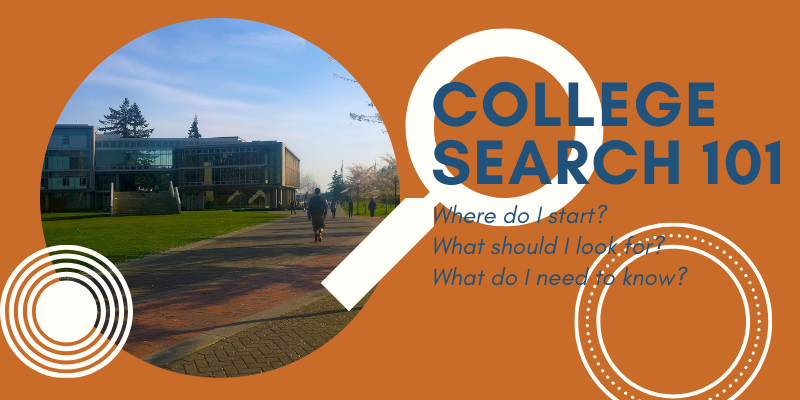
College Search 101

Planning for college is happening for high school juniors and seniors right now! Some may have already applied, and some are already hearing back from schools they’ve applied to. Often, students with an intellectual disability (ID) are left out of these discussions and activities, thinking that college is not an option. Think College is determined to correct this misconception and spread the word that college IS possible for students with intellectual disabilities. So, if you think you might want to go to college after high school, here are some things you can do to get started on YOUR college planning.

Get to know the over 300 college programs that are designed for students with intellectual disabilities specifically.

They all have important things in common…

  • They are located at a college, university, or community college. 
  • They are non-degree programs. This means that students earn a certificate at the end of the program, not an associate or bachelor’s degree.
  • There is an alternate admission process that differs from what is required to get into a degree program at the same college. 
  • Supports for students with ID are provided.

But they can differ from each other in a lot of important ways…

  • Programs can be anywhere from 1 – 4 years long
  • Some programs offer campus housing and others do not
  • Some programs are fully inclusive which means that they do not create any special classes or social experiences that are only for students in the program. Other programs have some separate learning or social experiences.
  • Some programs have a general certificate that can be individually designed around the interests of students, and others offer certificates that prepare students for a specific career, such as early childhood education or hospitality, as just two examples.
  • The amount and type of supports can vary. For example, some programs may have program staff available to students every day while others may not offer support on campus on weekends. Some may provide support prior to, during, and after college classes, others may provide limited support.
  • Some programs accept students who are still in high school and they go to college as their transition program, and some programs accept students who are out of high school. At some programs, they may have both kinds of students attending.
  • Admission processes and requirements are different at every program.
  • Some programs offer access to federal financial aid, and others do not.

Just as college programs vary, so of course does every student. To begin to identify a college that is going to work, you have to start with discovering what matters to YOU.  Imagine yourself in college – what are you doing?

  • What classes are you taking?
  • What social events are you participating in?
  • Where are you living?
  • Are you close to home or far away?
  • When you complete college, what do you want to do?

Visualizing college and talking to your friends and family about how you want it to be for YOU can help you learn what is most important. Now, armed with a list of things that matter to you, start exploring!

Think College Search gives you a place to start learning about the options. You can:

  • Discover programs that offer the things that matter the most to you by using the “filters”.  Like for example, seeing only the programs that offer campus housing if you want to live on campus.
  • Save the ones that look promising
  • Compare programs on how they are the same and how they are different.

Finding the right fit takes time. College options for students with ID are a relatively new idea.

Because they are all different, it can take a bit of digging to learn enough about a program to really know if it is right for you. Use our How to Conduct a College Search Guideto review questions that were suggested by real students and families that you can ask to learn more about the college programs you are most interested in.

Here is the bottom line: students who are getting ready to finish high school start thinking about what they will do next. Lots of students begin to look at colleges and see if there is a good fit for them. Think College offers resources that can help students with intellectual disability look at lots of options. We want to make sure that if a student wants to go on to college, they can! 

Post author: Cate Weir is the project director for the Think College National Coordinating Center, a position she has held since the Center’s inception in 2010. One of her favorite parts of that job is talking to families and students as they embark on the journey to postsecondary education and finding the right college.

This blog was originally posted on ThinkCollege.net

November 1, 2023, Filed Under: Uncategorized

Employment Experience as a Predictor of Post-School Employment for Youth with Disabilities

E4Texas Senior Outreach Program Coordinator

Kathleen Hernandez

Photo description: Grocery store employee with intellectual disability smiling at the camera while holding a digital tablet working in a local supermarket.

According to Rich Luecking, EdD Research Professor at the University of Maryland, the importance of paid employment experiences for youth with disabilities is the single-strongest predictor of post-school employment. In fact, students with disabilities are 3.8 times more likely to be employed one year after high school if they were employed during high school (Rabren et al., 2002). To ensure a seamless transition from secondary school to the next phase of their lives, it is crucial for students to have exposure to work experiences and job opportunities.

The E4Texas program recognizes the significance of work experiences in preparing students for successful employment outcomes. By connecting students with internship opportunities in their chosen field of study during their final semester, E4Texas aims to provide practical, hands-on experience in real-world settings. These internships allow students to develop essential work skills, explore their career paths, and identify their preferences in terms of working environments. It’s our intent that when a student officially completes the E4Texas program, they have the tools they need to seamlessly transition to employment.

Collaboration between our E4Texas staff and community partners (transition coordinators, vocational rehabilitation counselors, community rehabilitation agencies, and community employers) are an invaluable part of this transition process. By leveraging the available resources and support available through their E4Texas connections, students have the opportunity to engage in meaningful work experiences that lead to post-school employment. Through these collaborations, E4Texas students gain valuable work experience, receive job coaching support, and have a smoother transition into the workforce.

By integrating work experiences into the curriculum and leveraging community partnerships, E4Texas empowers its students with the skills, confidence, and network needed to pursue their career goals. These internships not only provide practical training but also foster independence, self-advocacy, and a sense of accomplishment for the students.

The E4Texas program recognizes the importance of paid employment experiences as a crucial aspect of seamless transition for young adults with disabilities. By assisting students in finding internship opportunities and facilitating partnerships with community organizations, E4Texas equips its students with the necessary skills and support to successfully enter the workforce. Through practical work experiences, students gain valuable insights, develop work skills, and increase their chances of long-term employment success.

Want to learn more about the E4Texas post-secondary program at the University of Texas-Austin? Register for our annual Open House to learn all about this employment-focused transition program!  For additional information, visit our website or email our Program Outreach Coordinator at Kathleen.Hernandez@austin.UTexas.edu. Your journey towards growth and empowerment starts here!

October 1, 2023, Filed Under: Uncategorized

Record-breaking Employment Trend Continues for People with Disabilities in Jobs Report

alt text: Illustration of an office workplace including two people in a wheelchair amongst the team; concept of social inclusion.

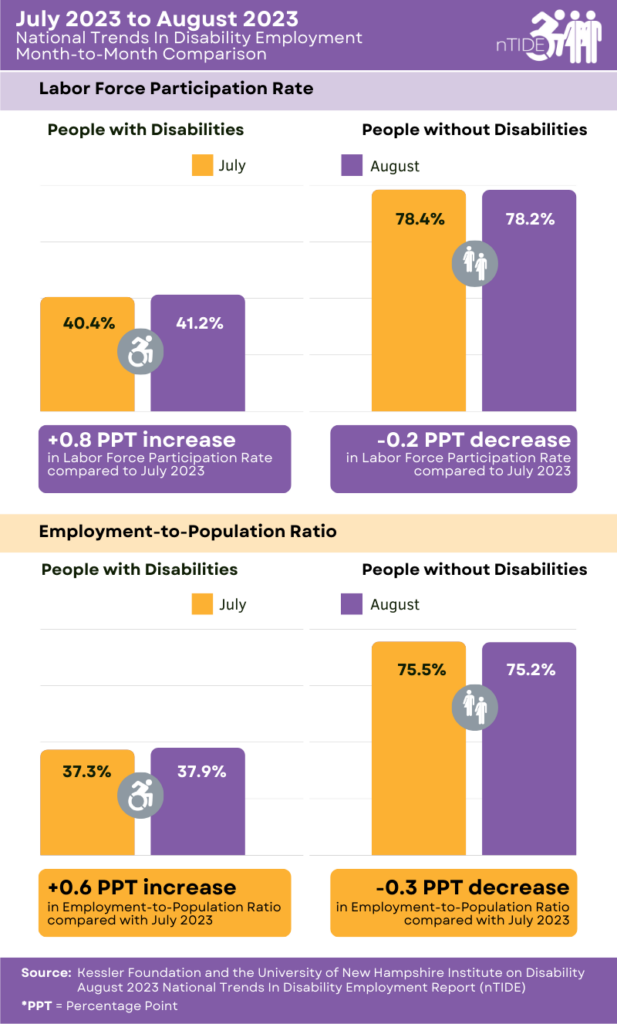
The latest National Trends in Disability Employment (nTIDE) report for August 2023, issued by Kessler Foundation and the University of New Hampshire’s Institute on Disability brings good news for people with disabilities. The new report highlights record-breaking achievements in labor force participation and employment-to-population ratios among people with disabilities.

Labor Force Participation:

Participation in the labor force for people with disabilities aged 16-64 saw a 2% increase, rising from 40.4% in July 2023 to 41.2% in August 2023.

Conversely, the rate for those without disabilities decreased marginally from 78.4% in July 2023 to 78.2% in August 2023 (source).

Month-to-Month Comparison:

From July 2023 to August 2023, the employment-to-population ratio for people with disabilities (ages 16-64) increased from 37.3% to 37.9% (a 1.6% improvement).

In contrast, people without disabilities witnessed a slight decline, with the employment-to-population ratio dropping from 75.5% to 75.2% (source, source).

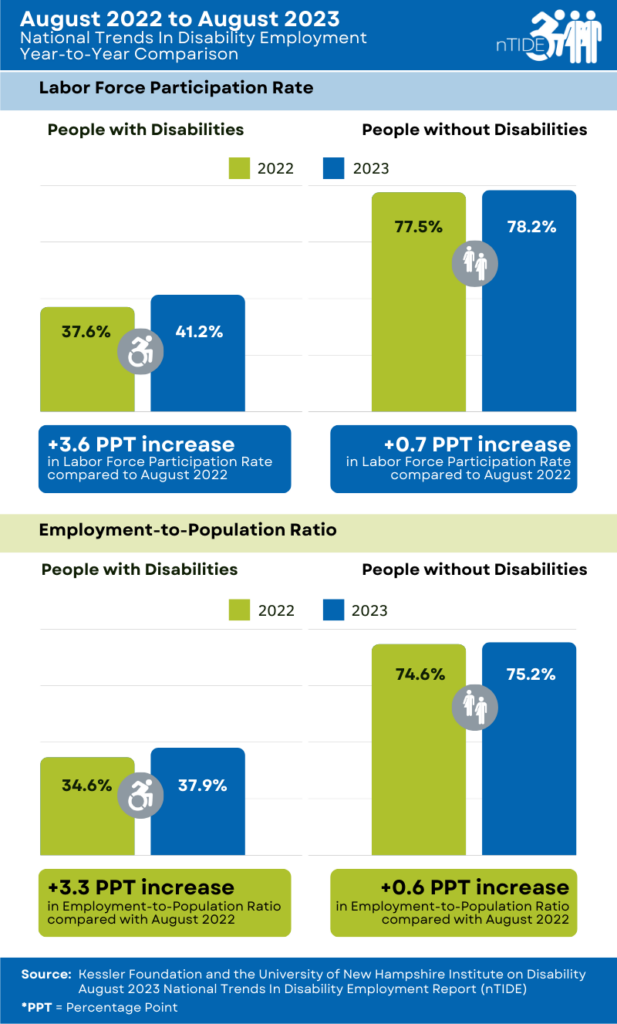
Year-to-Year Comparison:

Compared to 2022, participation in the labor force for people with disabilities increased by an impressive 9.6%, reaching 41.2% by August 2023.

For those without disabilities, the rate also increased, though by a smaller margin of 0.9%, reaching 78.2%.

Total Workforce Representation:

In August 2023, people with disabilities aged 16-64 made up 4.3% of the total U.S. workforce, totaling 6,533,000 workers out of 150,594,000.

Overall, the nTIDE August 2023 Jobs Report shows positive trends in employment for people with disabilities, demonstrating their continuous growing participation in today’s work force. These findings underscore the importance of creating inclusive post-secondary education opportunities like E4Texas, and inclusive workplaces and opportunities for people with disabilities.

For more detailed information on this report, please visit the nTIDE archives. For more information about the E4Texas post-secondary program at the University of Texas-Austin, please visit the E4Texas website, where you can register for our upcoming annual Open House to learn all about this employment-focused transition program!  For additional information, visit our website or email our Program Outreach Coordinator at Kathleen.Hernandez@austin.UTexas.edu. Your journey towards growth and empowerment starts here!

September 12, 2023, Filed Under: Uncategorized

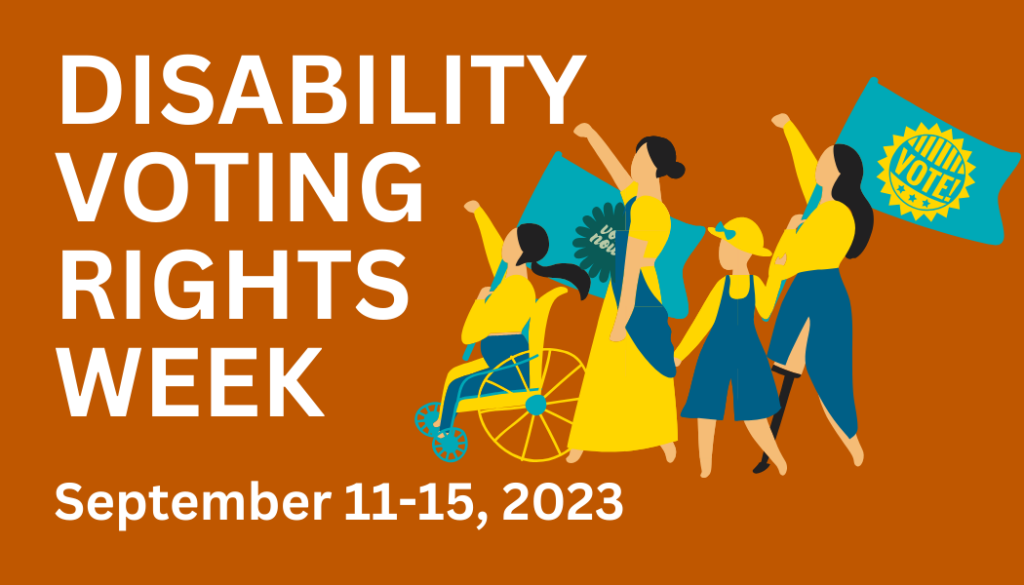
E4Texas Celebrates Disability Voting Rights Week

At E4Texas, we are proud to support Disability Voting Rights Week (DVRW), happening September 11th- 15th, 2023. This important week, formerly known as National Disability Voter Registration Week, is a nationwide effort coordinated by the American Association of People with Disabilities’ REV UP Voting Campaign. It’s a week dedicated to empowering the disability community by ensuring equal access to voting, and advocating for the rights of over 38 million eligible voters with disabilities.

During DVRW, the focus is on breaking down barriers that have historically hindered people with disabilities from participating fully in our democratic process. Discriminatory voting practices, limited registration locations, and inadequate resources have historically excluded millions of Americans from exercising their right to vote. To bridge this gap, efforts include providing assistance for voter registration, ensuring equitable access to absentee ballots and applications, and making all polling places accessible to voters with disabilities.

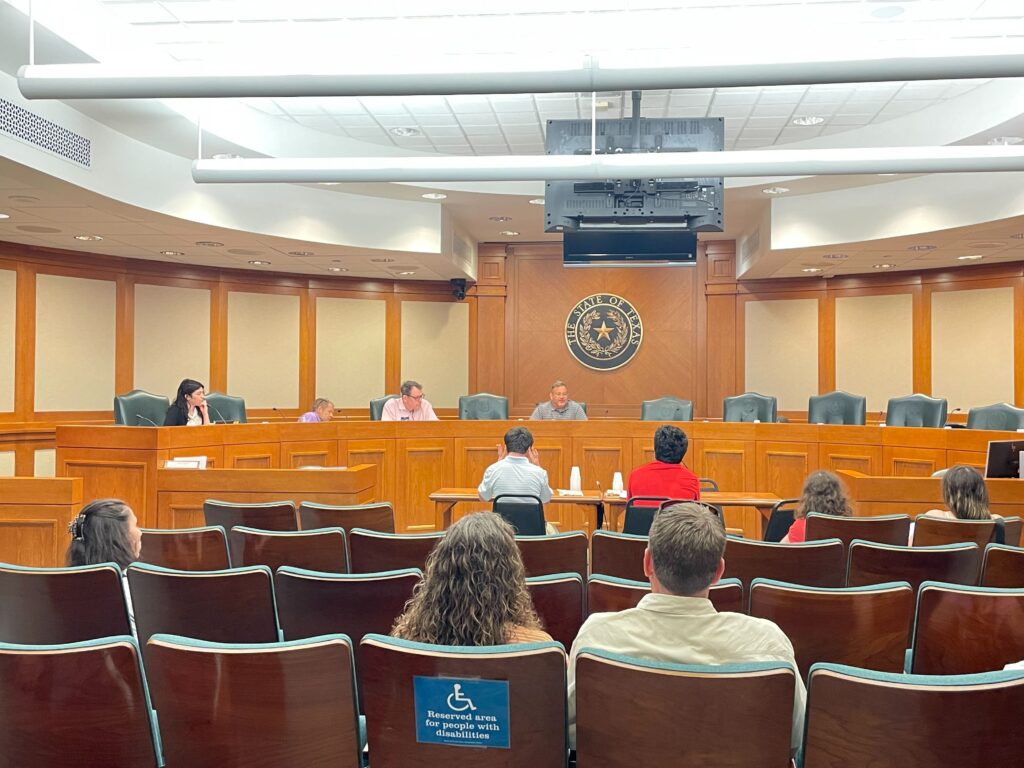
At E4Texas, we understand that education and self-advocacy go hand in hand, and are two things that help our students go on to lead more independent lives. An important part of our program curriculum is teaching our students about disability history, including an emphasis on legislative advocacy. The disability community has overcome many obstacles to exercise their right to vote, and we hope to shed light on this history to encourage our students to become involved themselves. A highlight of the program is the opportunity for our students to visit the Texas State Capitol every year during the summer semester to testify on behalf of a bill of their choosing, exercising their right to participate in the local government. This experience not only deepens their understanding of legislative advocacy, but empowers our students to be active participants in shaping policies that matter to them. Our students get to experience firsthand the power of legislative advocacy, the importance of speaking up for their rights, and how to be effective self-advocates. Similarly, DRVW is another opportunity for the disability community to put these skills into action, and use their voice to through the power of voting.

How to get involved during Disability Voting Rights Week:

  1. Check Your Voter Registration: Verify your voter registration status, or register to vote to ensure your voice is heard.
  2. Know Your Rights: Learn about your voting rights, and access accommodations and language assistance at the polls.
  3. Get Involved: Participate in the Every Voice, Every Vote campaign to strengthen our democracy by encouraging and protecting voter participation.
  4. Host an Event: Consider hosting a voter registration or education event to engage your community.
  5. Social Media Activism: Raise awareness by activating your social media platforms to promote DVRW and its mission.
  6. Spread the Word: Share your thoughts and experiences on DVRW and the importance of activism by writing an op-ed for your local newspaper.
  7. Collaborate: Partner with other disability and voting rights organizations to amplify your impact.
  8. Engage Local Leaders: Get involved in your local government and encourage town leaders to issue a proclamation for Disability Voting Rights Week.
  9. Stay Informed: Visit Vote411.org for state-specific voter information and resources for voters with disabilities.
  10. SignVote: If you are part of the Deaf and Hard of Hearing community, explore SignVote’s resources and instructional videos in American Sign Language.

Disability Voting Rights Week serves as a reminder that our democracy thrives when everyone actively participates, and it falters when our citizens are excluded. At E4Texas, we are committed to fostering an inclusive society where all individuals, regardless of their abilities, can engage in the democratic process. We encourage our students and the broader community to get involved in DVRW and help shape a more equitable and inclusive future for all.

In closing, remember that every vote counts, and your participation can influence accessibility and issues that matter to voters like you! Whether you have a disability or not, your voice matters. At E4Texas, we are dedicated to supporting and amplifying the voices of all our students as they engage in the democratic process during Disability Voting Rights Week and beyond.

For more information about Disability Voting Rights Week, please visit the American Association of People with Disabilities’ REV UP Voting Campaign website and explore the resources available to make your voice heard. For more information about the E4Texas post-secondary program at the University of Texas-Austin, please visit the E4Texas website, where you can register for our upcoming annual Open House to learn all about this employment-focused transition program! Your journey towards growth and empowerment starts here!

[Source: American Association of People with Disabilities’ REV UP Voting Campaign]

September 8, 2023, Filed Under: Uncategorized

Advancing Disability Rights in Healthcare: New Proposed Rule by the U.S. Department of Health and Human Services (HHS)

E4Texas Senior Outreach Program Coordinator

Kathleen Hernandez

In a step towards promoting equal access to healthcare and human services, the U.S. Department of Health and Human Services (HHS) has just announced a new proposed rule: Nondiscrimination on the Basis of Disability in Programs or Activities Receiving Federal Financial Assistance. This proposed rule aims to strengthen regulations against discrimination on the basis of disability, updating provisions that help people with disabilities access health and human services under Section 504 of the Rehabilitation Act of 1973. The announcement was made for immediate release yesterday, September 7th, 2023– the week before Disability Voting Rights Week (September 11-15, 2023), and 50 years after the enactment of the Rehabilitation Act, reflecting over 50 years of advocacy by the disability community.

A Milestone in Disability Rights

The proposed new rule would represent an advancement in the ongoing fight for disability rights. For many Americans, especially for those with disabilities, accessing quality healthcare can be a challenge. This rule aims to reduce that challenge, designed to ensure people with disabilities are not subjected to discrimination in any program or activity receiving funding from HHS solely because of their disability. Freedom from disability-based discrimination is a civil right, and that it could very much be a matter of life and death in health and human services programs. It reflects commitment to improve disability rights, and would be a step towards a more inclusive, equitable and accessible healthcare system for all.

Key Provisions of the Proposed Rule:

  1. Eliminating Bias: It ensures that medical treatment decisions are not based on biases or stereotypes about individuals with disabilities.
  2. Web Accessibility: The rule clarifies obligations for web, mobile, and kiosk accessibility to ensure digital information is available to all.
  3. Accessible Medical Equipment: Enforceable standards for accessible medical equipment will be established to enhance healthcare access.
  4. Child Welfare Programs: Clarifications are made regarding requirements in HHS-funded child welfare programs and activities.
  5. Value Assessment: It prohibits the use of value assessment methods that place a lower value on life-extension for individuals with disabilities.

  6. Integrated Services: Clarifications emphasize the obligation to provide services in the most integrated setting appropriate to the needs of individuals with disabilities.

It’s important to note that this rulemaking is still underway. If you believe you or someone else has been discriminated against on the basis of disability, you can file a complaint through the OCR complaint portal here.

At E4Texas, we recognize the significance of such developments in advancing disability rights. We believe in empowering our students to participate fully in society, and advocate for their rights, including in the areas of healthcare and human services.

For more information about the E4Texas inclusive post-secondary program at the University of Texas-Austin, please visit the E4Texas website, where you can register for our upcoming annual Open House to learn all about this employment-focused transition program! Your journey towards growth and empowerment starts here!

September 5, 2023, Filed Under: Uncategorized

Finding Purpose, Love, and Interdependence: A Graduation Speech from E4Texas Instructor Meghan Schrader

In this heartfelt graduation speech from May 2023, E4Texas instructor Meghan Schrader reflects on her journey as an educator, disability studies scholar, and disability justice advocate. She shares her personal struggles with mental illness and the profound impact of finding her role within the E4Texas community. Through poignant storytelling, Meghan highlights the transformative power of interdependence, where teachers and students mutually inspire and support each other. Her speech underscores the importance of valuing oneself in a world that often marginalizes individuals with disabilities and encourages graduates to pursue their dreams and goals with determination and creativity. Meghan’s words resonate with the essence of E4Texas, a program that fosters a unique sense of camaraderie and empowers students to build lives filled with purpose.

“As an educator, disability studies scholar, and disability justice advocate, I love my job at E4Texas, and I appreciate this opportunity to post a graduation speech I gave in May of 2023. I think it illustrates our program’s grounding in disability justice, and the unique sense of camaraderie that our program seeks to foster between students, teachers and the broader community.” -Meghan Schrader

Speech given by E4Texas instructor Meghan Schrader for E4Texas Graduation in May 2023:

There’s a saying, I don’t know where it comes from, that reads, ‘I sought my soul, but my soul I could not see. I sought my God, but my God eluded me. I sought my brother, and I found all three.’ I’ve been meditating on that saying as I’ve been reflecting on my time at E4Texas. I’ve had treatment resistant mental illness since my mid-teens, and the most constant social factor driving that condition has been a lack of accessible employment for someone with my learning disability, or for someone with my particular cluster of strengths, skills and weaknesses.

And so, I often have not felt like the self that existed prior to the onset of the depression. When I was little, my Mom’s good friend told me that everyone had a metaphorical ‘love light’ inside of them that guided how they treated others, and she kindly remarked that my ‘love light’ was very bright. But, without a grounding environment where my talents were valued, without a job where my deficits were accommodated, without an appropriate community to work in, I have often felt as though my ‘love light’ went out, or was constantly flickering. I am a devout Christian, but without an appropriate outlet for my impulse to help others, I have over the years found myself periodically thinking and acting in ways that made me worry that maybe I wasn’t really God’s servant. That was very painful for me.

But, in the last few years, a wonderful thing has happened to me. I’ve found my job at E4TEXAS. I know we teachers have had some authority over you students as we try to direct you toward choices and skills that will help you flourish in life, but you, the students, are helping the teachers lead meaningful lives as well. You are being your teachers’ teachers. E4TEXAS is a shining example of interdependence— people working together in a community to help each other lead fulfilling, independent, happy lives. I can’t tell you all what it’s meant to me to mentor you, carve Halloween pumpkins with you, talk about ethics with you, expose you to different types of music, or continue my own teacher training by helping you learn at the Priscilla Pawn Flawn Children’s Education Center. I have been honored to instruct you all this year. Because of my work with you all, I have lately felt like God’s servant. I have felt as though my ‘love light’ has been turned back on, and the real me is alive again.

I pray that our time together talking about treating others the way we want to be treated, and how to choose between right and wrong, has helped you learn critical thinking skills that will serve you as you build careers and have the healthy, fulfilling relationships that all of you deserve. I hope that your time with us at E4TEXAS has taught you all more about how to value yourselves in a society that often doesn’t value disabled people very much. Don’t settle for the limited menu of choices that the world so often gives to people with developmental disabilities. Never give up on your goals– if your goal is to go to community college, go for it. If your goal is to become a professional advocate for other people with disabilities, go for it. If your dream is to go to a four-year college and become a speech pathologist, go for it. If your goal is to work at a bakery and live in your own apartment with your friends, go for it. If your dream is to be a sound healer, go for it.  If your goal is to own your own business, go for it. Just keep creatively thinking about how you can work towards building a life of meaning, purpose and integrity, one step at a time.

Want to learn more about the E4Texas post-secondary program at the University of Texas-Austin? Register for our annual Open House to learn all about this employment-focused transition program!  For additional information, visit our website or email our Program Outreach Coordinator at Kathleen.Hernandez@austin.UTexas.edu. Your journey towards growth and empowerment starts here!

August 18, 2023, Filed Under: Uncategorized

What’s the Summer Semester like at E4Texas? Take a look!

The E4Texas summer semester has now concluded, offering students a unique opportunity to delve into important subjects and build crucial skills. With a curriculum that’s thoughtfully designed, E4Texas is committed to fostering growth, empowerment, and community engagement. Let’s take a closer look at what the summer program had in store for our new students:

E4Texas students visiting a local art museum.

Summer is always an exciting and busy time for E4Texas. Our new cohort of nine students moved onto campus at the beginning of July and hit the ground running. Students have been exploring UT and the city of Austin. We saw the fireworks at Zilker Park, hung out on the rooftop garden at the Central Library, and celebrated the anniversary of the ADA at ADAPT Headquarters. Students have taken courses in Work Readiness, Independent Living, Healthy Relationships, Disability History, Disability in the Media, and Legislative Advocacy. Additionally, we had a graduate continue into his second year with E4, pursuing his Childcare Certification through UT Austin’s Priscilla Pond Flawn Child and Family Laboratory.

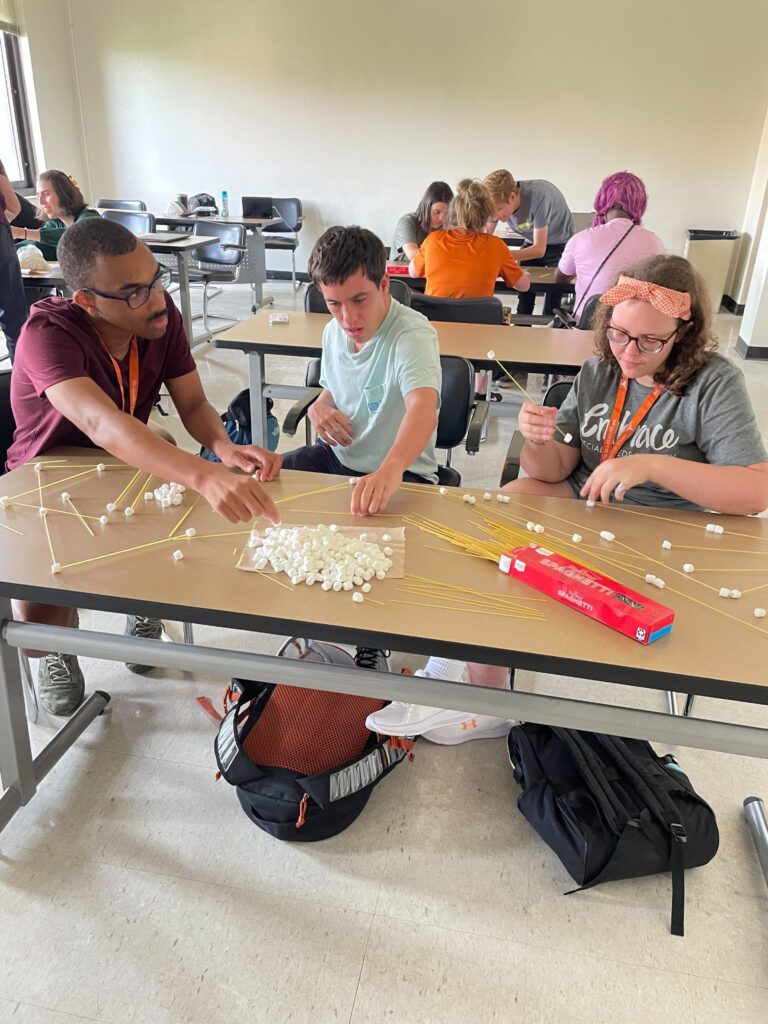
Students participating in a team building exercise

Learning Objectives

The E4Texas summer semester is built on a foundation of 3 essential learning objectives. Over the summer, E4Texas students will:

  1. Enhance their understanding of disability history, providing a foundation for self-advocacy skills.
  2. Develop their independent living skills, enabling them to lead more self-sufficient lives.
  3. Strengthen their ability to collaborate within teams– a skill that’s invaluable in any context, but will be especially important as students proceed through the program in pursuit of employment in their chosen career field.
Visiting the State Capitol

A Comprehensive Approach

The summer semester comprises four key components that ensure a well-rounded educational experience:

  1. Core Learning Outcomes: E4Texas staff performs daily student assessments on our 5 core learning outcomes for every student: Communication, workplace professionalism, problem-solving, building connections, and professional appearance. These daily assessments offer real-time insights into students’ growth, which is crucial not just for academic progress but also for data-driven personal and professional development.
  2. Group Disability History Project: An introduction to disability history creates an understanding of the challenges faced and the victories achieved. This project sheds light on the legislative journey toward inclusion.
  3. Legislative Advocacy Testimony: Students explore self-advocacy by practicing their advocacy skills at the Texas Capitol at the end of the Summer semester. Their empowered voices contribute to shaping policies that matter to them.
  4. Classroom Assignments: From in-class activities and discussions to quizzes, tests, projects, and community engagement, these assignments provide an engaging curriculum.

Want to learn more about the E4Texas post-secondary program at the University of Texas-Austin? Register for our annual Open House to learn all about this employment-focused transition program!  For additional information, visit our website or email our Program Outreach Coordinator at Kathleen.Hernandez@austin.UTexas.edu. Your journey towards growth and empowerment starts here!

  • « Go to Previous Page
  • Page 1
  • Page 2
  • Page 3
  • Page 4
  • Go to Next Page »

Primary Sidebar

Recent Posts

  • Class of 2027’s First Semester at E4Texas
  • Faces of E4Texas: Get to Know Some Students and Staff
  • The E4Texas Summer Adventure
  • E4Texas Internship Spotlight
  • E4Texas: Embracing a New Semester Full of Opportunities!

Footer

  • Email
  • Facebook
  • Instagram
  • LinkedIn

UT Home | Emergency Information | Site Policies | Web Accessibility | Web Privacy | Adobe Reader

© The University of Texas at Austin 2026